
Cisco · CCNA
200-301 Free Learning Path
Start with 7 free learning topics for Implementing and Administering Cisco Solutions.
7 free/ 53 total
77 free/ 330 total
PUBLIC BETA OFFER
Save 50% off on an Eligible Learning PlanValid for 1-month plan, 3-month plan, 12-month plan · Code LPXBETA50 · Ends Nov 4, 2026
Cisco · CCNA
Start with 7 free learning topics for Implementing and Administering Cisco Solutions.
Included free
Study resources
Guides and study preparation resources for this certification.
Security enforcement works only when it is placed on the traffic path and when its dependencies are trusted.
Network security is a system of complementary controls. A threat is a potential cause of harm, a vulnerability is a weakness, an exploit uses a weakness, and a mitigation reduces likelihood or impact.
IP services turn basic reachability into an operable network. They assign addresses, resolve names, synchronize time, translate traffic, collect telemetry, prioritize congestion-sensitive flows, and provide management access.
Open Shortest Path First version 2 (OSPFv2) lets routers exchange IPv4 topology information and calculate routes.
A router forwards a packet by matching its destination against installed routes. Understanding the routing table prevents a common mistake: treating the configuration as proof that a route is usable.
A wireless connection crosses radio frequency, access-point, switching, controller, security, addressing, and upstream routing dependencies.
Explore video explanations for this subject.
 7:53
7:53Many CCNA candidates study individual topics without understanding how those topics depend on one another. That creates weak labs, poor troubleshooting habits, and false confidence from memorized commands. In this video, we build a practical study roadmap for Cisco CCNA 200-301 v1.1 and explain how to prepare in the right order before the transition to CCNA v2.0. We begin with the foundational dependencies: Ethernet frames, IP packets, subnetting, TCP, and UDP. From there, we move into VLANs, tr
 11:32
11:32Network diagrams become much easier to understand when every device has a clearly defined responsibility. In this video, we break down the network architecture concepts CCNA 200-301 candidates need to understand—not simply memorize. We’ll examine what each component forwards, what it manages, where security policy is applied, and how failures affect the overall traffic path. We’ll walk through the roles of routers, Layer 2 switches, multilayer switches, wireless access points, Wireless LAN Contr
 11:32
11:32A green link light and a successful ping do not always prove that a network connection is healthy. In this video, we trace connectivity from the physical link through Ethernet switching and into TCP and UDP application behavior. The goal is to understand how data moves through the network and how to identify the exact layer where a failure begins. We’ll compare copper Ethernet, multimode fiber, and single-mode fiber, including why speed and distance depend on the cable category, transceiver mode
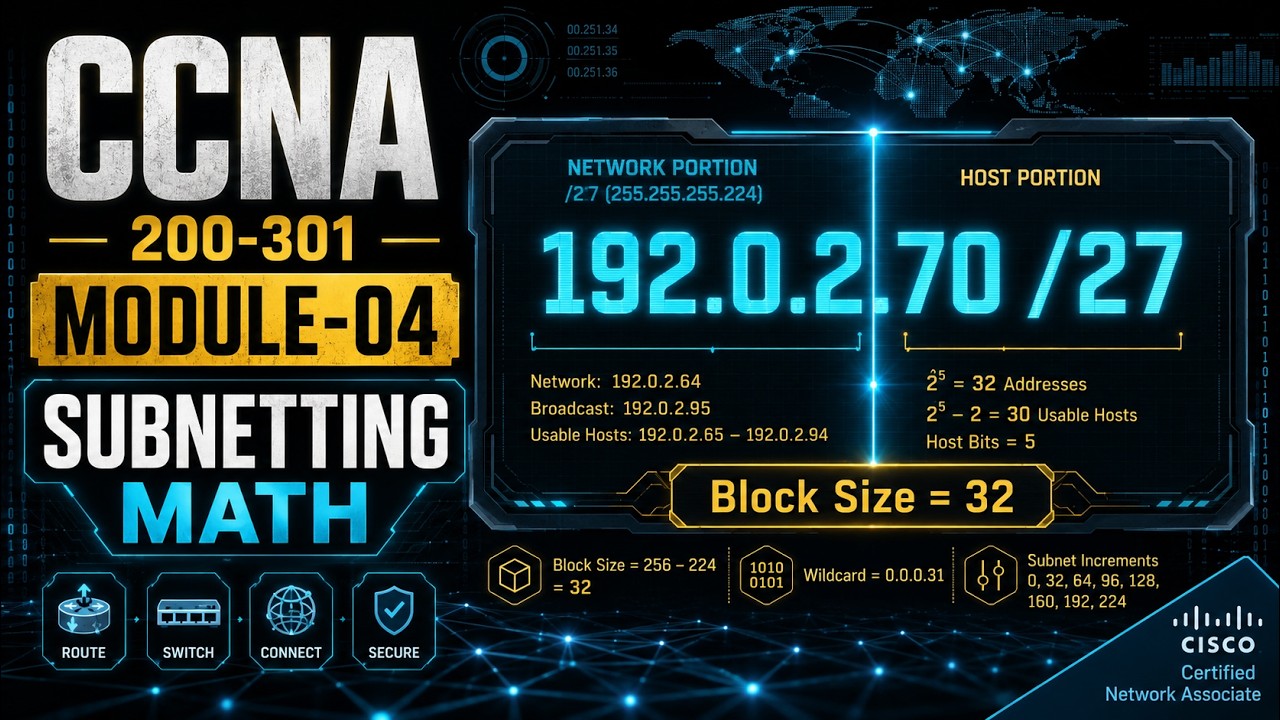 8:37
8:37Subnetting is not just an exam calculation. It determines whether a destination is treated as local or whether the packet must be sent to a default gateway. In this video, we break down IPv4 addressing and subnetting for CCNA 200-301 using a repeatable block-size method. We’ll work through the address 192.0.2.70/27 step by step. You’ll see how the /27 prefix becomes the subnet mask 255.255.255.224, how the block size of 32 is calculated, and how that reveals the complete subnet range: Network ID
 8:12
8:12IPv6 is not simply IPv4 with longer addresses. It changes how interfaces establish scope, generate addresses, discover neighbors, and identify next hops. In this video, we build the IPv6 mental model CCNA 200-301 candidates need for both exam questions and practical troubleshooting. We begin with the structure of a 128-bit IPv6 address and the two rules used to make addresses easier to read: • Leading zeros inside a hexadecimal group can be removed. • One continuous sequence of all-zero groups c
 10:07
10:07VLANs are not just switch commands. They define Layer 2 boundaries, control broadcast domains, and determine where routing must occur. In this video, we break down VLANs, trunking, and inter-VLAN routing for CCNA 200-301 by following the actual path that network traffic takes. We start with the foundation: why flat networks create unnecessary broadcast traffic and how VLANs solve this problem by creating separate Layer 2 broadcast domains. You’ll learn the difference between: • Access Ports — co
PUBLIC BETA OFFER
Valid for 1-month plan, 3-month plan, 12-month plan · Code LPXBETA50 · Ends Nov 4, 2026