
Introduction
Open Shortest Path First version 2 (OSPFv2) lets routers exchange IPv4 topology information and calculate routes. First-hop redundancy protocols solve a different problem: they preserve an endpoint's default-gateway service when one gateway device fails. Keeping these responsibilities separate makes convergence easier to understand.
Architecture Overview
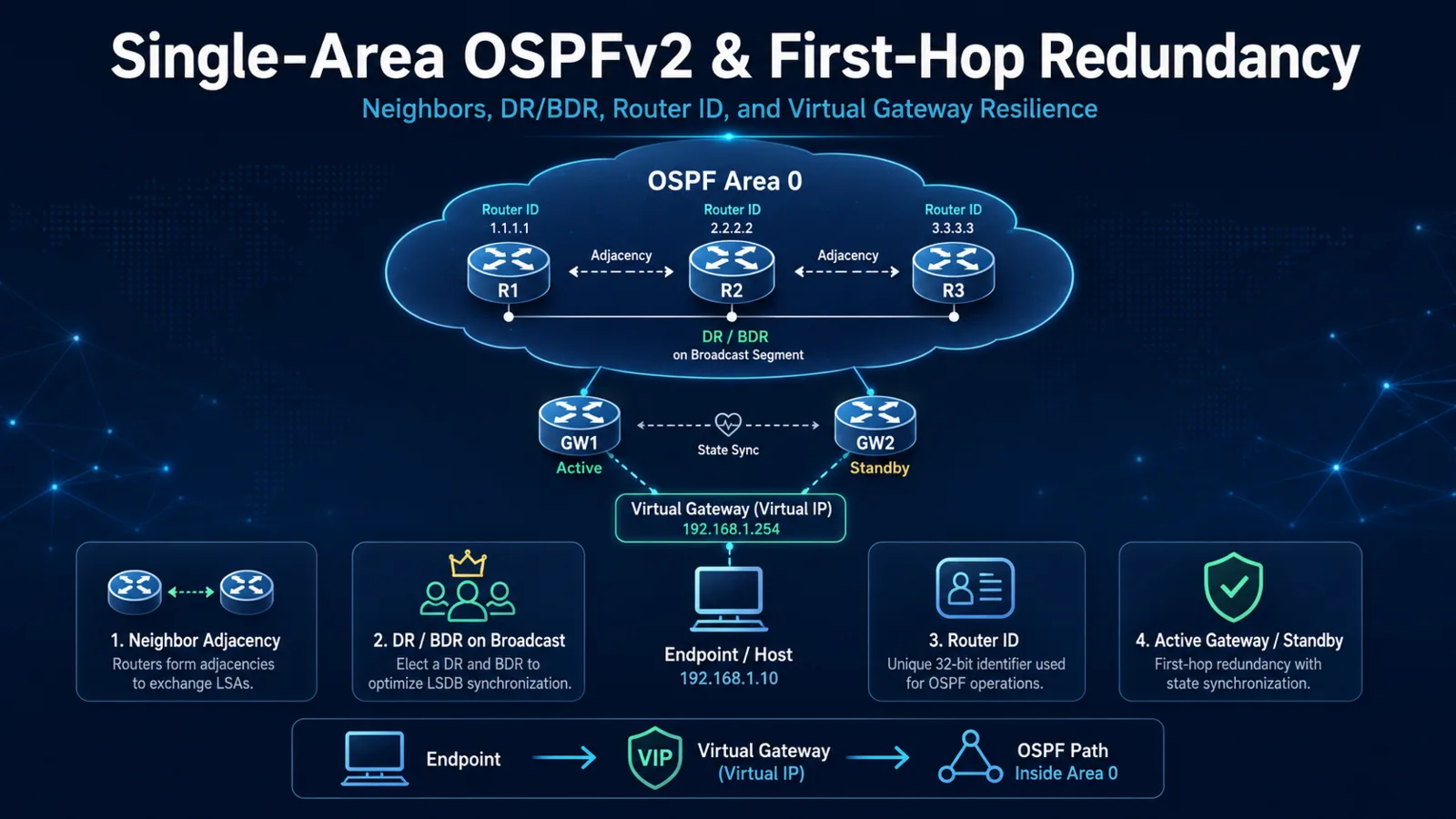
OSPF routers discover neighbors, form adjacencies when required parameters agree, exchange link-state information, and run a shortest-path calculation. In a single-area CCNA design, participating links belong to one OSPF area, commonly area 0.
On broadcast networks, OSPF elects a designated router (DR) and backup designated router (BDR) to reduce adjacency and flooding complexity. Point-to-point networks do not need a DR/BDR election. The router ID is a 32-bit identifier used by the OSPF process; it is not necessarily a forwarding address.
Core Components
Adjacency Dependencies
Neighbors must agree on important parameters such as area, network compatibility, hello/dead behavior, and authentication where configured. Interfaces must be operational and able to exchange OSPF packets. A neighbor relationship alone does not prove that the intended prefixes are advertised or installed.
First-Hop Redundancy
First-hop redundancy protocols present hosts with a resilient virtual gateway identity backed by multiple routers. One device forwards for the virtual identity while another can take over according to the protocol's state and priority rules. This protects the local default gateway; it does not replace dynamic routing beyond that segment.
How Components Work Together
An endpoint sends off-subnet traffic to a virtual gateway address. The active gateway routes the packet using its routing table, which may include OSPF-learned paths. If the active gateway fails, the redundancy protocol can transfer forwarding ownership, while OSPF independently reconverges on available network paths.
Design Considerations
Assign stable router IDs deliberately, use consistent OSPF parameters, and verify which interface type drives DR/BDR behavior. Align gateway redundancy with routing reachability; a router should not remain preferred for first-hop forwarding when it lacks the required upstream path unless tracking or design controls address that condition.
Common Mistakes
- Assuming Layer 2 adjacency guarantees an OSPF neighbor relationship
- Troubleshooting DR/BDR election on a point-to-point link
- Confusing router ID with the interface used to forward traffic
- Treating a full adjacency as proof that every expected route exists
- Believing first-hop redundancy repairs all upstream route failures
- Mixing OSPF metric with administrative-distance comparison
Certification Relevance
The v1.1 blueprint includes single-area OSPFv2 neighbor adjacencies, point-to-point and broadcast networks, DR/BDR selection, router IDs, and the purpose and concepts of first-hop redundancy. It does not require advanced multi-area design in this scope.
Conclusion
OSPF protects and adapts the routed path; first-hop redundancy protects endpoint gateway access. Verify adjacency, learned prefixes, installed routes, and gateway ownership as distinct states.