
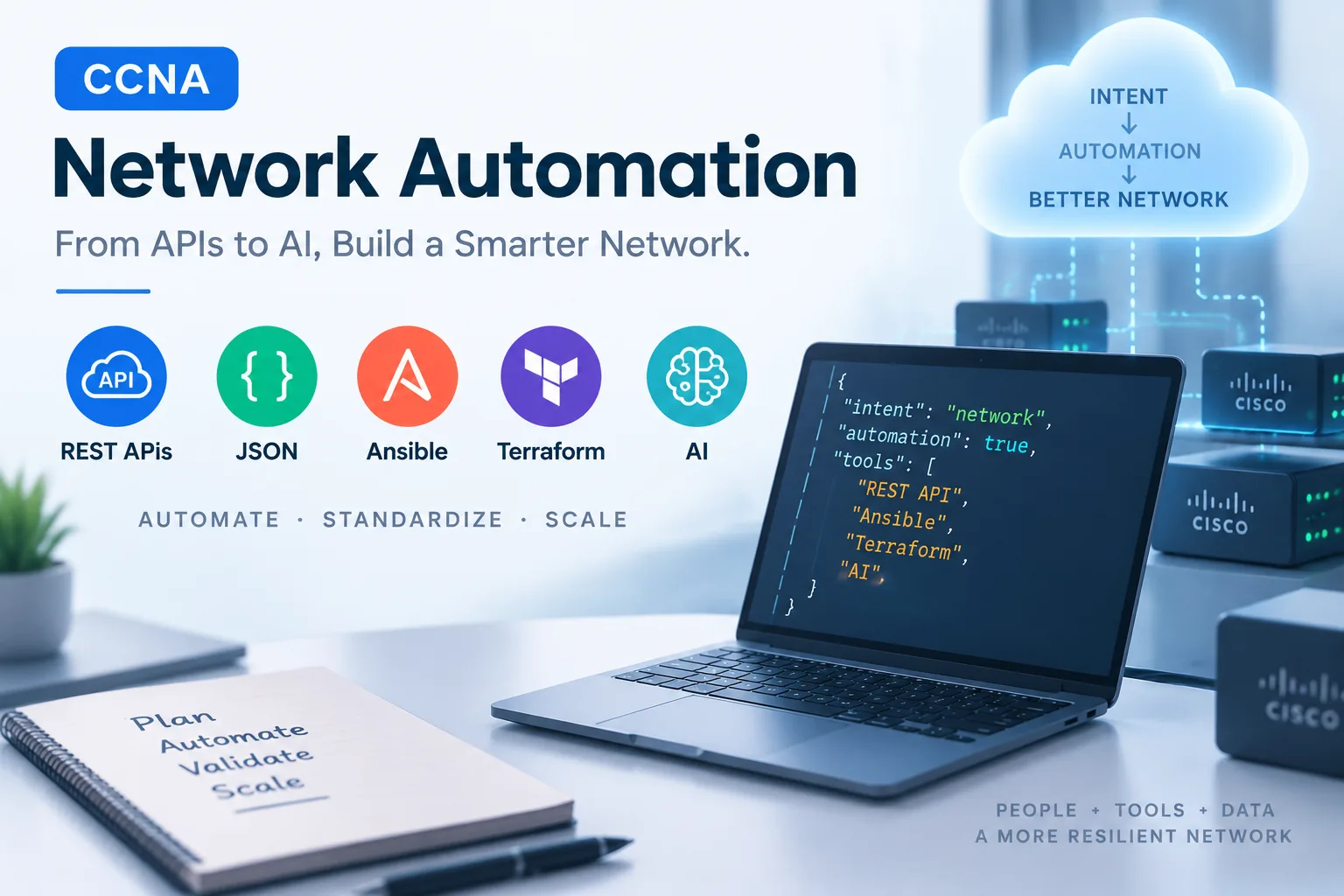
Introduction
Network automation replaces repeated manual actions with data, policy, and repeatable workflows. It can improve consistency and scale, but it also amplifies incorrect intent. Reliable automation therefore needs an authoritative source of desired state, controlled credentials, validation, change review, and observable results.
Architecture Overview
Traditional device management often uses a person or script to connect to individual devices. Controller-based networking centralizes intent and state through a control system. Software-defined architectures distinguish an underlay that provides basic transport, an overlay that creates logical connectivity, and a fabric that combines those mechanisms with policy and control.
The data plane forwards traffic. The control plane builds forwarding knowledge. A controller exposes northbound application interfaces and uses southbound mechanisms to manage infrastructure. These directions describe architectural relationships; exact protocols depend on the platform.
Core Components
REST APIs and JSON
A representational state transfer (REST) API commonly addresses resources through URLs and uses HTTP methods such as GET, POST, PUT, PATCH, and DELETE. Create, read, update, and delete (CRUD) describes operations, but method semantics are defined by each API. Authentication may use tokens, keys, sessions, certificates, or other documented mechanisms.
JavaScript Object Notation (JSON) represents objects as name-value pairs and arrays as ordered collections. Values can be strings, numbers, booleans, null, objects, or arrays. Automation must validate both JSON syntax and the API's required schema; valid JSON can still be an invalid request.
Ansible and Terraform
Ansible commonly applies task-based automation using inventories, modules, and playbooks. Terraform declares infrastructure resources and tracks state so it can plan changes toward desired configuration. Neither tool removes the need to understand device capabilities, idempotency, dependencies, secrets, rollback, or drift.
AI and Machine Learning in Operations
Predictive artificial intelligence (AI) and machine learning can identify patterns, anomalies, or likely outcomes from operational data. Generative AI can summarize evidence, create drafts, or assist operators through natural-language interfaces. Output quality depends on data, model behavior, permissions, and validation. AI suggestions are not authoritative device state and should not bypass change control.
How Components Work Together
A controller or management system collects state, exposes it through an API, and accepts intended changes. An automation tool reads inventory and desired data, calculates or sequences work, authenticates to the control surface, applies changes, and verifies outcomes. Telemetry and audit records close the loop.
Design Considerations
Start with read-only collection and schema validation. Use least-privilege service identities, protect secrets, preview changes, limit blast radius, and make failure visible. Test on a lab or small canary group before wider deployment. Back up relevant state and define how to recover from partial success.
Common Mistakes
- Assuming every API uses the same HTTP method semantics
- Treating syntactically valid JSON as a valid payload
- Confusing an overlay with the physical transport underlay
- Running automation without checking the target inventory
- Editing Terraform-managed resources outside the agreed workflow
- Accepting AI-generated configuration without source and state validation
Certification Relevance
CCNA v1.1 includes automation impact, traditional versus controller-based networks, software-defined architecture, control/data-plane separation, northbound and southbound APIs, AI/ML in operations, REST characteristics, Ansible, Terraform, and JSON components.
Conclusion
Automation is a controlled state transition. Understand the management architecture, validate inputs and schemas, constrain authority, preview the change, and verify the resulting network state.