
Introduction
A useful 200-301 CCNA v1.1 plan combines the official blueprint, current Cisco documentation, repeatable labs, and evidence-based review. Cisco states that v1.1 remains available through February 2, 2027 and that v2.0 begins February 3, 2027. Choose the blueprint that matches your test date and do not blend objectives silently.
What the Roadmap Measures
Readiness means being able to explain a behavior, configure objectives that explicitly require configuration, predict operational output, identify a fault from evidence, and restore service safely. Reading alone cannot establish those skills.
Why a Lab Record Matters
For each lab, save a sanitized topology, address plan, intended configuration, pre-change evidence, post-change evidence, test result, and rollback note. This creates a feedback loop: prediction, observation, explanation, correction, and retest.
Core Learning Phases
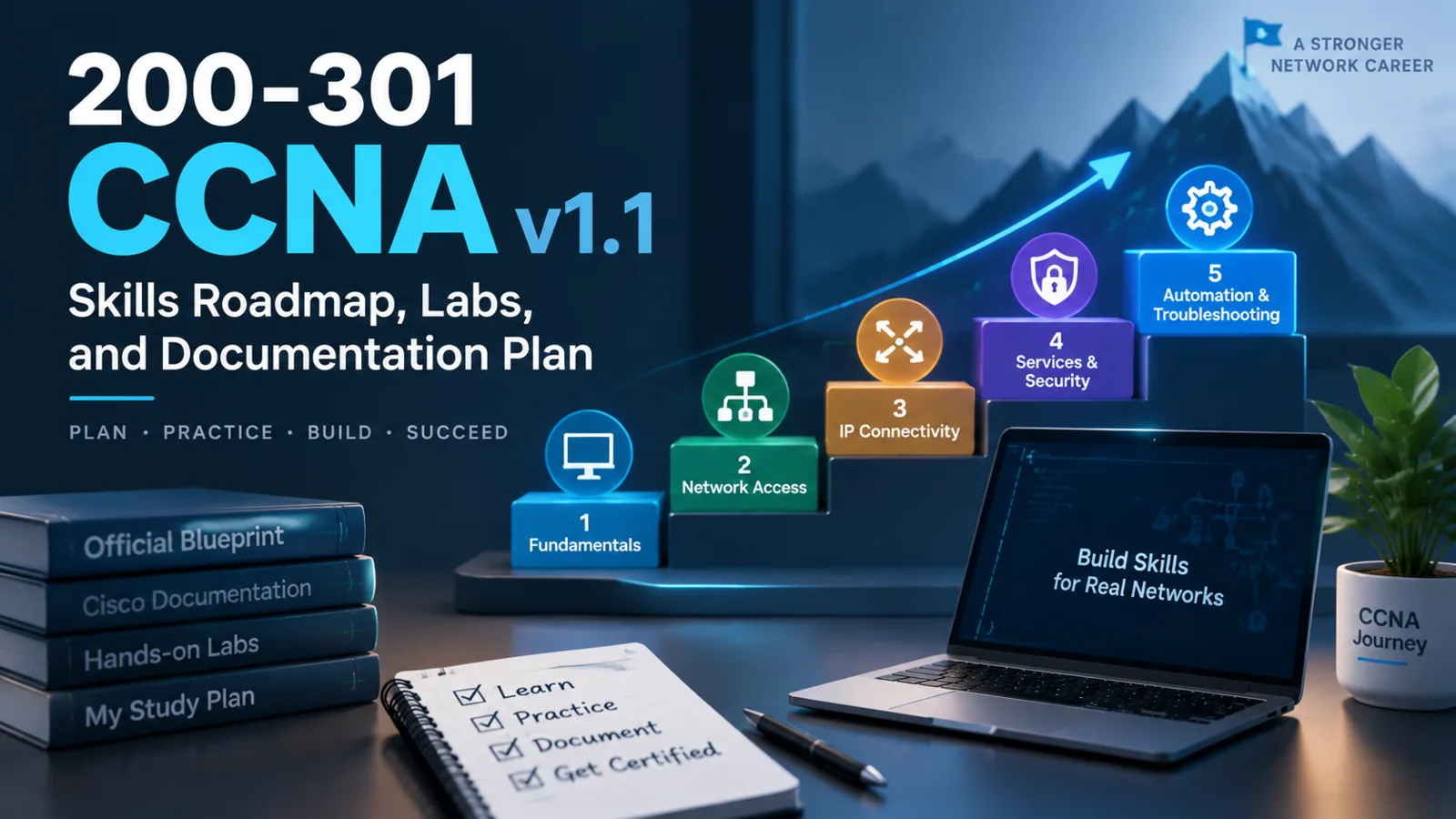
Phase 1: Network Fundamentals and Addressing
Build Ethernet and routed topologies. Practice MAC learning, interface counters, TCP versus UDP observations, IPv4 subnet calculations, IPv6 scopes, client parameters, wireless principles, and virtualization concepts. Do not progress until you can predict whether a destination is local or routed.
Phase 2: Network Access
Create VLANs across multiple switches, configure access and trunk links, verify IEEE 802.1Q behavior, add inter-VLAN routing, build an LACP EtherChannel, and interpret Rapid PVST+ roles. Practice CDP and LLDP evidence. Use a controller simulator or documented interface to interpret WLAN, security, and quality-of-service settings where physical wireless gear is unavailable.
Phase 3: IP Connectivity
Read routing tables before configuring routes. Practice default, network, host, and floating static routes for IPv4 and IPv6. Build single-area OSPFv2 on point-to-point and broadcast networks; observe adjacency, router ID, DR/BDR behavior, learned routes, and failure convergence. Explain first-hop redundancy separately from dynamic routing.
Phase 4: Services and Security
Create original labs for NAT, NTP, DHCP relay, SSH, ACLs, DHCP snooping, Dynamic ARP Inspection, and port security when supported. For DNS, SNMP, syslog, QoS, VPNs, AAA, and wireless security, trace control objects and evidence even when a full lab is unavailable. Use nonproduction credentials and a recovery path.
Phase 5: Automation and Integrated Troubleshooting
Read JSON structures, inspect REST requests and responses, and compare controller, Ansible, and Terraform workflows. Explain underlay, overlay, fabric, and control/data-plane separation. Evaluate AI/ML output as an inference that requires validation. Finish with fault-injection labs that combine interface, VLAN, route, service, and policy failures.
Documentation Plan
Use the official CCNA exam page and v1.1 topic PDF to control scope. Use Cisco IOS XE, Catalyst switching, Catalyst wireless, security, and DevNet documentation for behavior and syntax. Check the exact platform release before copying a command; simulators and physical devices may support different features.
Readiness Checks
- Can you derive an IPv4 subnet and explain an IPv6 address scope?
- Can you predict Layer 2 forwarding and identify the active spanning-tree path?
- Can you explain why a route wins using prefix length, administrative distance, and metric?
- Can you separate transport reachability from DNS, authentication, and application success?
- Can you map an ACL, Layer 2 control, or WLAN policy to its trust boundary?
- Can you read JSON and describe an API or configuration-management workflow?
- Can you troubleshoot without changing configuration before capturing evidence?
Common Learning Challenges
Avoid studying by domain percentages alone. IP Connectivity has the highest weight, but routing labs fail without addressing and Layer 2 foundations. Avoid unverified command lists, answer-dump material, and versionless notes. Original labs and official documentation create knowledge that transfers beyond one exam version.
Conclusion
Use the blueprint as a checklist, documentation as technical authority, and labs as proof of skill. Keep every exercise tied to an observable result and preserve the v1.1/v2.0 transition boundary throughout the plan.