
Introduction
The 200-301 CCNA exam is the single exam associated with the Cisco Certified Network Associate (CCNA) certification. The current v1.1 blueprint measures foundational networking, campus access, routing, infrastructure services, security, and automation skills. It is broad because an entry-level network professional must understand how those layers interact, not because every topic requires expert-level depth.
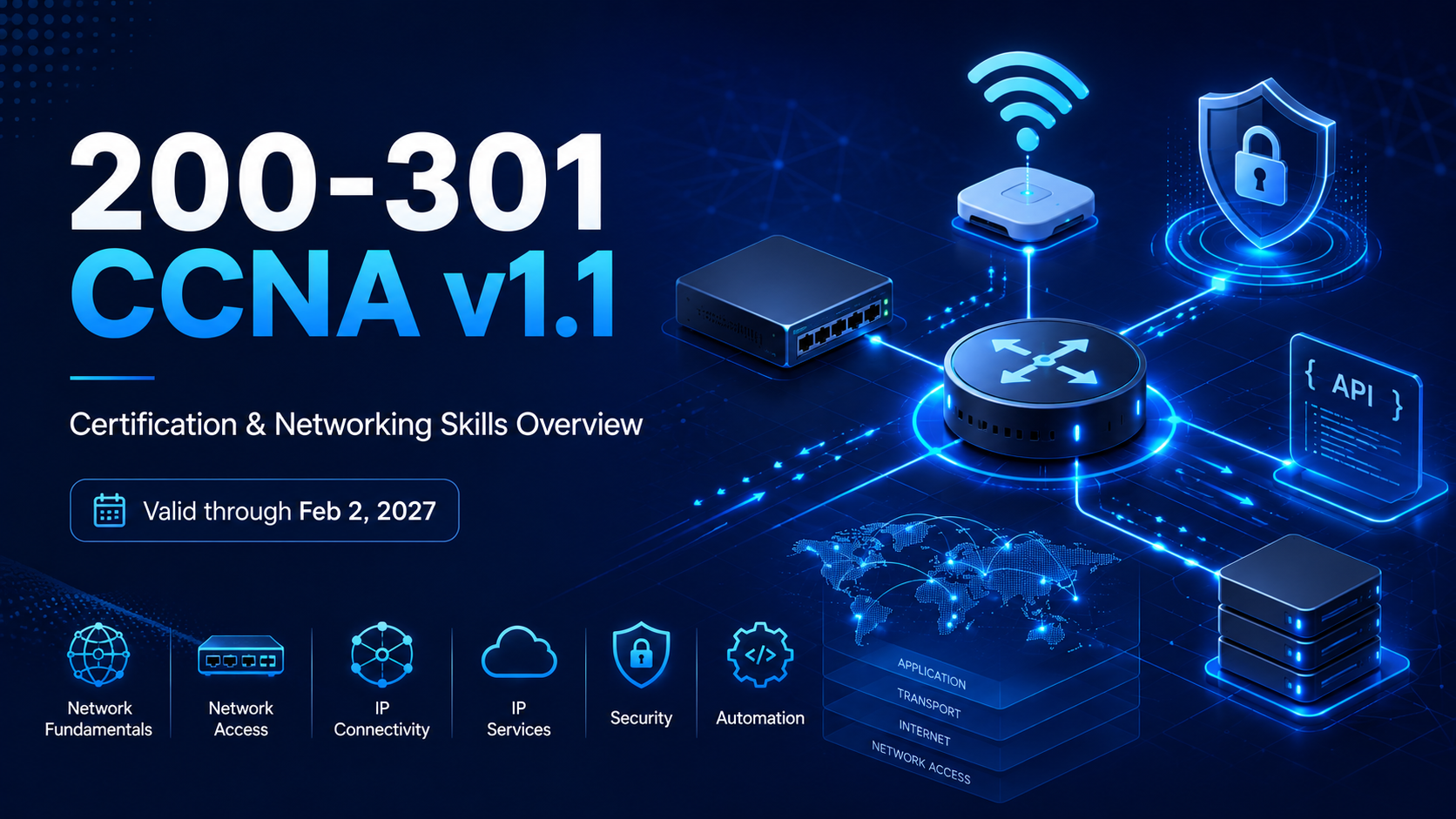
This article establishes the current version boundary and turns the official objectives into a practical learning sequence. Cisco states that v1.1 remains available through February 2, 2027, with CCNA v2.0 beginning February 3, 2027. Candidates should therefore verify which version matches their planned test date.
What the 200-301 CCNA v1.1 Covers
The official blueprint assigns 20% to Network Fundamentals, 20% to Network Access, 25% to IP Connectivity, 10% to IP Services, 15% to Security Fundamentals, and 10% to Automation and Programmability. These percentages describe relative emphasis; they do not turn the objectives into isolated subjects.
A failed Domain Name System (DNS) lookup, for example, can look like an application failure even while IP routing works. A virtual LAN (VLAN) mismatch can prevent a router adjacency from forming. An access control list (ACL) can block Dynamic Host Configuration Protocol (DHCP) or management traffic. Strong preparation therefore follows traffic across layers and validates evidence at each boundary.
Why the Certification Scope Matters
CCNA provides a common vocabulary for people who install, operate, and support small- to medium-sized networks. The value comes from being able to explain what a router, switch, wireless controller, firewall, service, or automation system owns—and then select the right evidence when something fails.
The exam blueprint is a scope guide rather than a product manual. Use it to identify required skills, then use current Cisco configuration guides and command references to verify platform behavior and syntax.
Core Concepts
Build Skills in Dependency Order
Start with Ethernet frames, IP packets, addresses, prefixes, and transport protocols. Continue with VLANs, trunks, spanning tree, EtherChannel, and wireless access. Only then move into routing tables, static routes, Open Shortest Path First version 2 (OSPFv2), and infrastructure services. Security and automation make more sense after the forwarding path is clear.
For every lab, record four things: intended state, configuration state, operational state, and end-to-end result. A configured interface is not necessarily up; a route in a configuration is not necessarily installed; and successful local connectivity does not prove remote service reachability.
Target Audience
The series suits entry-level network engineers, administrators, support technicians, help desk technicians, and systems professionals who need a networking foundation. Learners should be comfortable navigating a command-line interface and reading binary or hexadecimal notation, but the sequence develops the required networking model from first principles.
Technical Value
The most transferable CCNA skill is structured diagnosis. Instead of guessing at commands, determine which component owns the failed behavior, inspect the nearest reliable evidence, and move outward one dependency at a time. That method remains valuable across Cisco IOS XE, controller-managed networks, cloud-managed systems, and API-driven operations.
Common Learning Challenges
- Memorizing commands without predicting their output
- Treating configured state as proof of operational state
- Confusing route selection with packet forwarding
- Mixing Layer 2 loop prevention with Layer 3 redundancy
- Applying a security control without mapping traffic direction
- Learning automation vocabulary without reading actual JSON or API exchanges
Conclusion
Prepare for 200-301 CCNA v1.1 as an integrated networking skills program. Use the blueprint for scope, official Cisco documentation for technical detail, and original labs for evidence. Keep the February 2027 version transition visible so that study materials remain aligned with the exam you intend to take.