
Introduction
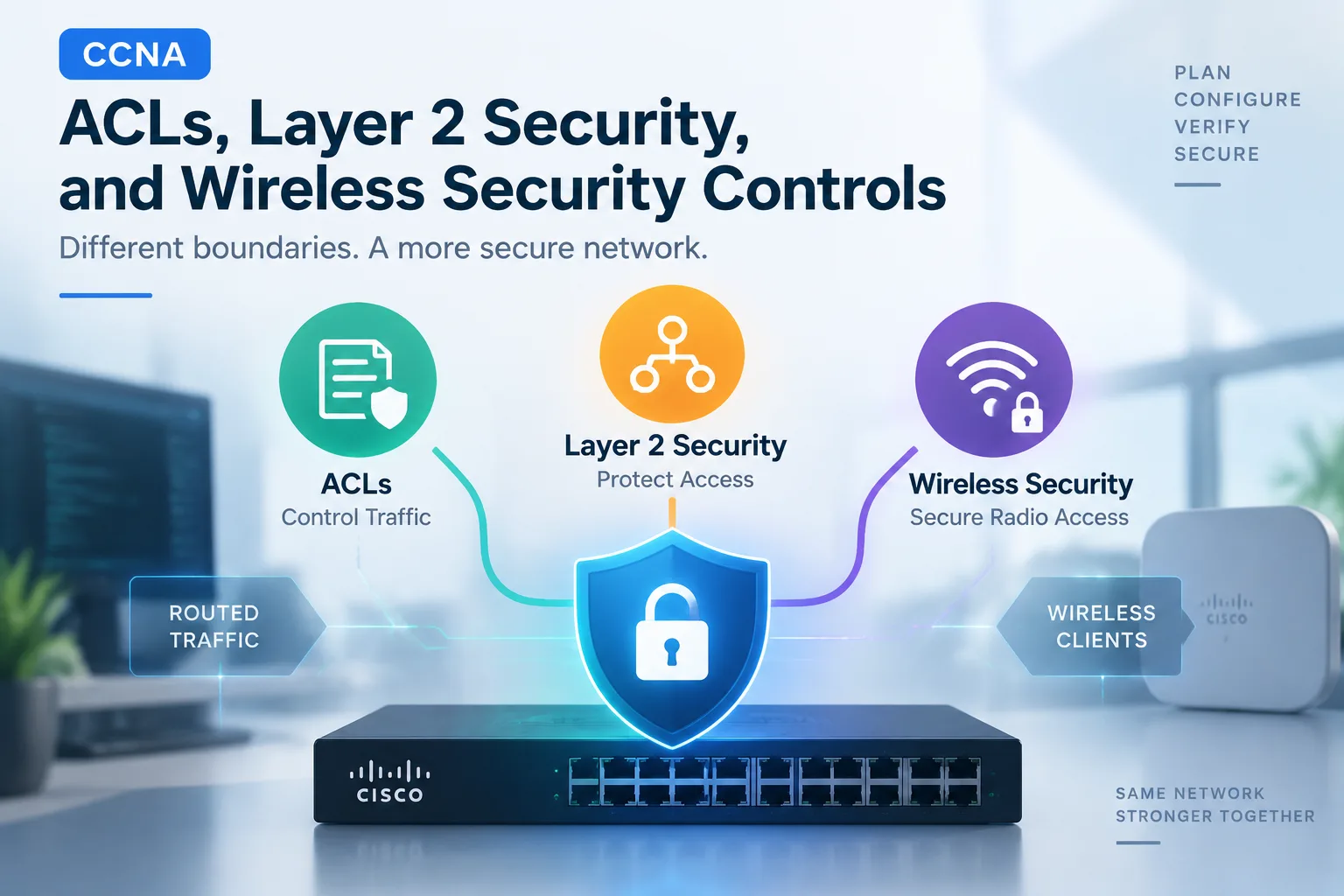
Security enforcement works only when it is placed on the traffic path and when its dependencies are trusted. Access control lists (ACLs) filter routed traffic, Layer 2 security features protect local access behavior, and wireless protocols protect radio access. A change in any of these areas can interrupt production connectivity, so verification and recovery planning are part of the configuration.
What ACLs Control
An ACL processes entries in order and stops at the first match. If no entry matches, an implicit deny applies. Standard IPv4 ACLs primarily match source addresses; extended ACLs can match protocol, source, destination, and transport details. Direction is relative to the interface: inbound before a routing decision, outbound after one.
Before applying an ACL, describe the intended flow as source, destination, protocol, port, and direction. Include management, routing, address-assignment, and return traffic that the policy must preserve. Use counters and controlled tests to prove the expected entry is matching.
Layer 2 Security Dependencies
DHCP snooping classifies ports as trusted or untrusted, filters unsuitable DHCP server messages, and builds a binding database from legitimate lease activity. Dynamic ARP Inspection (DAI) can validate Address Resolution Protocol messages against trusted binding information. If the binding source is absent or wrong, legitimate hosts can be blocked.
Port security restricts Media Access Control (MAC) addresses on a switch port according to configured learning and violation behavior. It is an access-edge control, not a substitute for authentication or endpoint security. Moving a legitimate device may require the learned state and operational policy to be reconciled.
Wireless Security Controls
Wi-Fi Protected Access (WPA), WPA2, and WPA3 represent generations of wireless security. Exact cipher and authentication choices depend on client, access point, controller, and organizational requirements. A WPA2 pre-shared key (PSK) WLAN uses a shared secret; enterprise authentication uses an identity infrastructure and is a separate design.
When interpreting a controller GUI, verify WLAN enablement, SSID, security mode, key settings, policy or interface mapping, and client status. Do not publish real secrets in screenshots, configuration files, or lab records.
Practical Change Workflow
Capture the current state, identify the enforcement direction and trust boundary, stage recovery access, apply the smallest change, and test both permitted and denied traffic. Review counters, bindings, violations, and wireless client events. Remove or revise a control only after evidence identifies it as the failure point.
Common Learning Challenges
- Forgetting the implicit ACL deny
- Applying the correct ACL in the wrong direction
- Trusting an endpoint-facing DHCP snooping port
- Enabling DAI without valid bindings or required exceptions
- Treating port security as user authentication
- Confusing an SSID with a security method
- Changing a PSK without coordinating clients
Conclusion
ACLs, Layer 2 protections, and WLAN security defend different boundaries. Map the traffic and trust relationship first, then prove enforcement with counters, bindings, client state, and controlled positive and negative tests.