
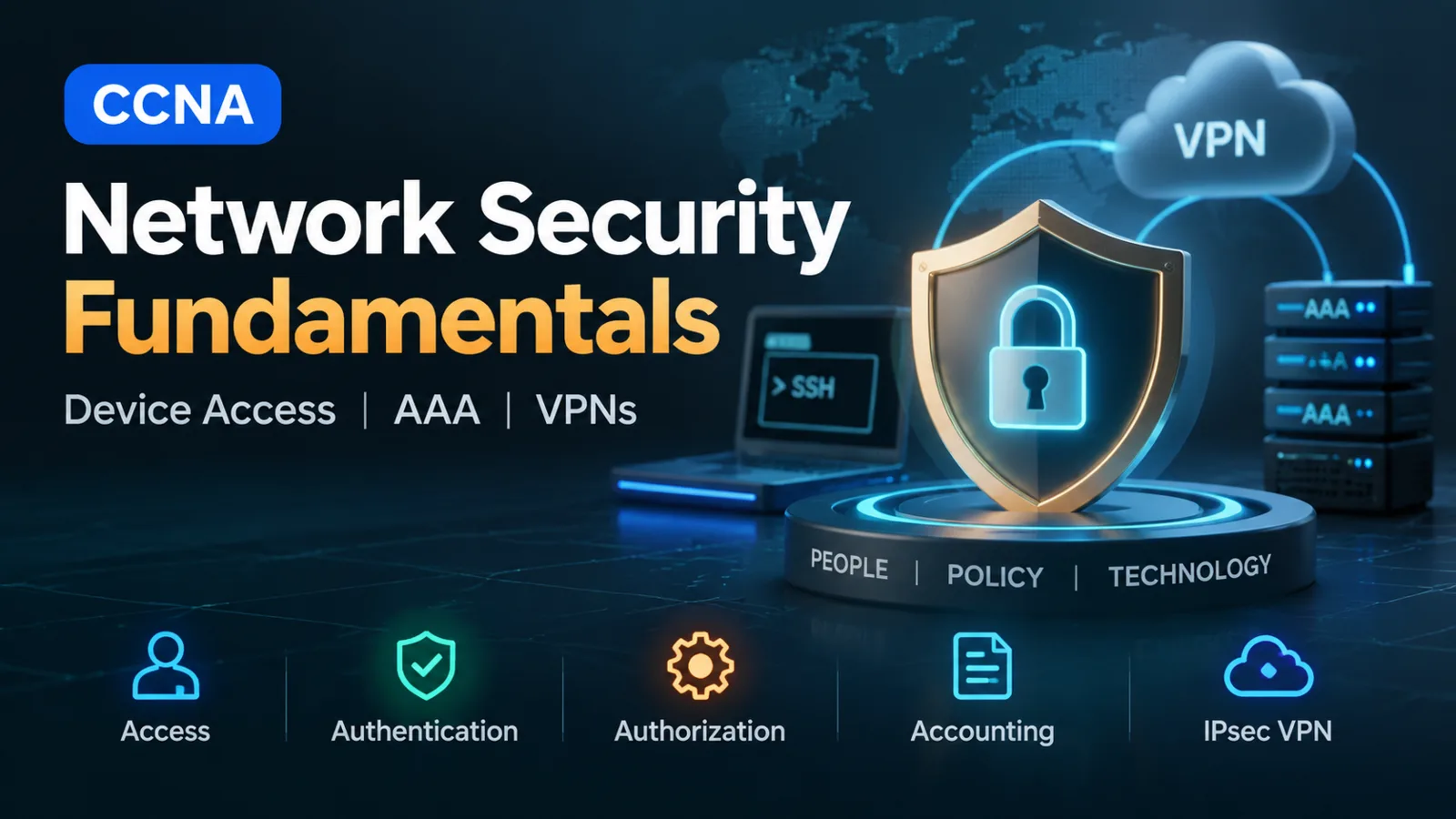
Introduction
Network security is a system of complementary controls. A threat is a potential cause of harm, a vulnerability is a weakness, an exploit uses a weakness, and a mitigation reduces likelihood or impact. Effective design combines people, facilities, identity, device hardening, encrypted transport, segmentation, monitoring, and recovery.
Architecture Overview
Security programs include user awareness, training, and physical access control because technical controls cannot compensate for every human or facility failure. Policies define expected behavior; technical enforcement and audit evidence show whether the policy is operating.
On a device, the management plane needs authenticated access, appropriate privilege, encrypted protocols, logging, and recovery procedures. Local accounts can provide direct access or fallback, while centralized systems improve consistent policy and auditability.
Core Components
Credentials and Stronger Alternatives
Password policy covers secure storage, rotation or lifecycle rules, resistance to guessing, and controlled recovery. Complexity alone does not eliminate phishing or reuse. Multifactor authentication (MFA) combines factors, certificates bind keys to identities through a trust model, and biometrics measure a physical or behavioral characteristic. Each has enrollment, revocation, and recovery dependencies.
Authentication, Authorization, and Accounting
Authentication confirms identity. Authorization determines permitted actions. Accounting records activity. TACACS+ and RADIUS can support centralized AAA use cases, but their protocol behavior and deployment roles differ. A successful login does not prove the user received the intended authorization, and an authorization decision does not prove accounting records reached the server.
IPsec VPN Models
An IPsec site-to-site virtual private network (VPN) protects traffic between network gateways. A remote-access VPN protects a user or endpoint connection into an organization. Both require matching cryptographic and policy parameters, reachability to the peer, identity or key validation, and correct protected-traffic definitions.
How Components Work Together
A secure management session needs routed reachability, encrypted transport, identity verification, authorization, and logging. If centralized AAA is unavailable, the documented fallback behavior determines whether administrators can recover access. Security should fail according to an intentional policy rather than an accidental dependency.
Design Considerations
Apply least privilege and separate routine administration from emergency access. Protect management traffic in a dedicated path or policy boundary. Store recovery credentials securely and test recovery under change control. Before altering remote AAA or access policy, establish console or out-of-band access to avoid locking out administrators.
Common Mistakes
- Treating a threat, vulnerability, and exploit as synonyms
- Assuming authentication automatically grants correct permissions
- Enabling central AAA without a tested failure path
- Using Telnet because access is already restricted by IP address
- Calling every encrypted tunnel a site-to-site VPN
- Changing management security without preserving recovery access
Certification Relevance
CCNA v1.1 includes security concepts, program elements, local device access, password policy and alternatives, AAA concepts, and IPsec remote-access and site-to-site VPN descriptions.
Conclusion
Security decisions should name the asset, threat, controlling object, dependency, and evidence. Layered controls reduce the chance that one failed credential, link, policy, or human action becomes a complete compromise.