
Introduction
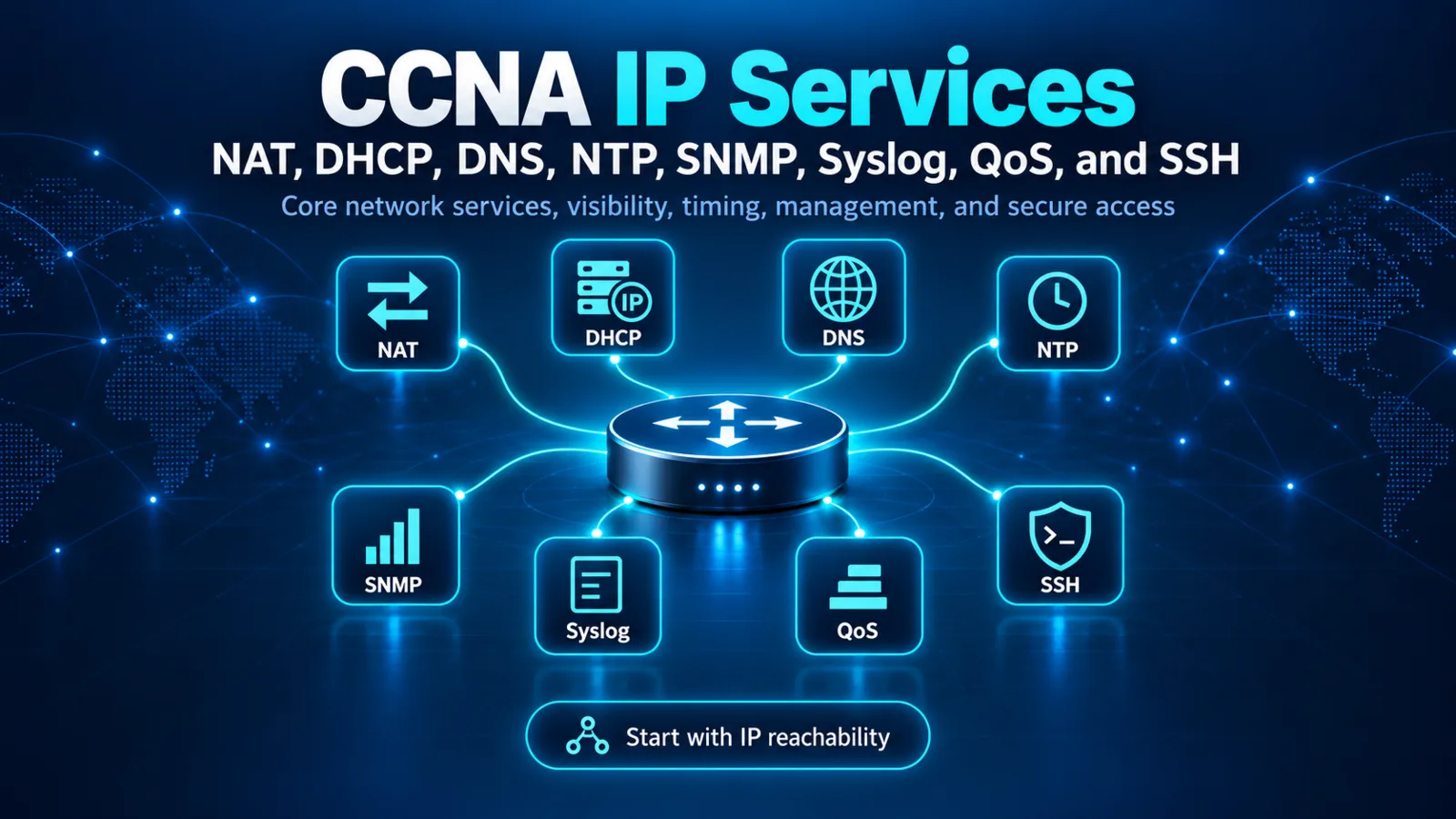
IP services turn basic reachability into an operable network. They assign addresses, resolve names, synchronize time, translate traffic, collect telemetry, prioritize congestion-sensitive flows, and provide management access. Their dependencies overlap, so a layered service map is more useful than isolated command memorization.
What the Main IP Services Do
Network Address Translation (NAT) changes address information at a boundary. Inside-source static mappings provide a fixed translation, while pool-based translation selects addresses from a defined range. Confirm inside/outside roles, translation rules, route reachability, and active translations separately.
Dynamic Host Configuration Protocol (DHCP) supplies client parameters. A relay forwards client requests across a routed boundary toward a server. Domain Name System (DNS) maps names and other records to data such as IP addresses. DHCP can deliver a DNS server address, but the services remain independent.
Network Time Protocol (NTP) synchronizes clocks. Accurate time makes syslog, authentication, certificates, and event correlation more trustworthy. A Cisco device may act as an NTP client or provide time to downstream clients according to the supported configuration.
Core Operational Services
Simple Network Management Protocol (SNMP) lets management systems retrieve or receive management information. Syslog transports event messages with facilities and severity levels. Neither automatically proves root cause: correlate events with interface, route, and service evidence, and protect management access and credentials.
Quality of service (QoS) classifies traffic and may mark it for downstream treatment. Queuing chooses how packets wait; policing enforces a rate by dropping or remarking excess traffic; shaping buffers traffic to smooth its rate. QoS manages congestion and priority—it does not create bandwidth.
Secure Shell (SSH) provides encrypted remote command-line access. Telnet does not encrypt the session and should not be used for routine management. SSH depends on reachable management addressing, local or centralized authentication, supported cryptographic settings, and line access policy.
Trivial File Transfer Protocol (TFTP) is a simple UDP-based transfer mechanism with minimal built-in security. File Transfer Protocol (FTP) uses TCP and provides authentication but does not encrypt credentials or content by default. Use secure alternatives when the platform and workflow support them.
Practical Troubleshooting Sequence
For a service failure, first prove IP reachability by address. Then verify the client's supplied parameters, the relevant transport port, the service response, and any intervening policy. For NAT, inspect matching traffic and translation state. For NTP and syslog, validate time, source interface, destination, and return reachability. For SSH, verify both transport reachability and authentication policy.
Common Learning Challenges
- Treating DHCP and DNS as the same service
- Assuming NAT replaces routing or security policy
- Reading an old translation or log entry as current evidence
- Expecting QoS to fix a physically saturated design without trade-offs
- Using unsynchronized logs to infer event order
- Enabling SSH without verifying identity, keys, and access policy
Conclusion
Map each service to its prerequisite and observable evidence. Basic IP reachability comes first; service configuration, transport access, identity, and policy follow.