
Introduction
A wireless connection crosses radio frequency, access-point, switching, controller, security, addressing, and upstream routing dependencies. A visible service set identifier (SSID) proves only that a network is being advertised; it does not prove authentication, address assignment, or application reachability.
Architecture Overview
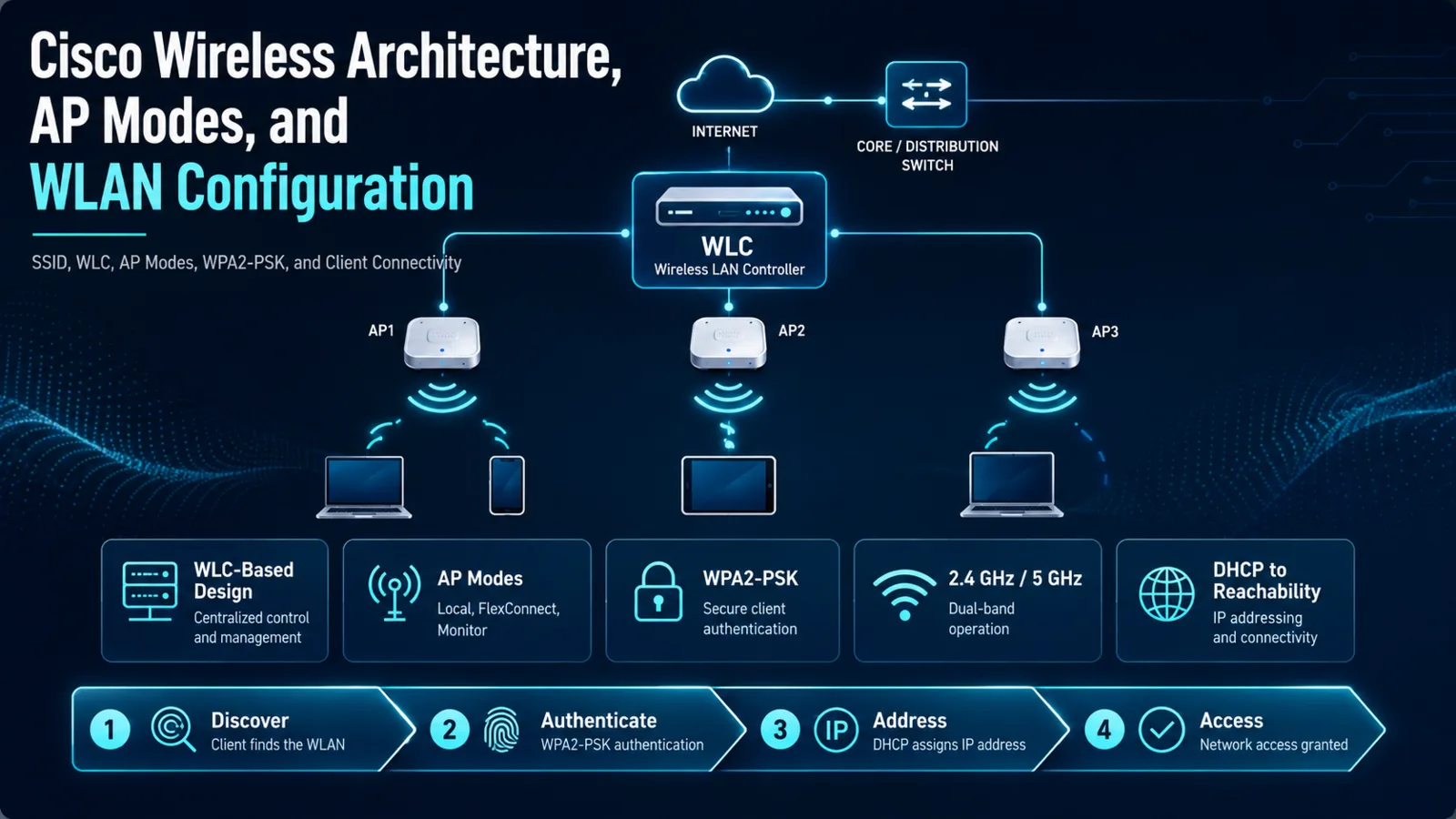
In a controller-based Cisco design, access points (APs) provide radio service while a Wireless LAN Controller (WLC) centralizes WLAN policy and management. Physical infrastructure commonly includes AP access or trunk ports, controller uplinks, and link aggregation groups where supported. The exact traffic path depends on AP mode and design.
Autonomous or cloud-managed designs use different management models. CCNA-level reasoning should identify whether the control and management functions are local, controller-based, or cloud managed before selecting evidence.
Core Components
Radio, Identity, and Policy
The 2.4 GHz band has a limited set of nonoverlapping channel choices, while 5 GHz and newer bands provide different channel plans and regulatory constraints. Channel width, interference, signal level, and client capability influence performance. An SSID is a network identifier, not encryption.
WLAN settings bind an SSID to security and policy. A WPA2 pre-shared key (PSK) WLAN requires matching credentials and compatible encryption. Quality-of-service profiles and advanced settings can change client treatment even after association succeeds.
AP modes define behavior such as serving clients, monitoring radio conditions, or supporting specialized deployment needs. Use the current controller documentation for exact mode capabilities.
How Components Work Together
A client discovers the SSID, selects an AP, authenticates and associates, receives IP configuration, resolves destinations, and sends traffic through the wired network. Failure at each stage produces different evidence: radio visibility, association status, security events, DHCP leases, client address parameters, and upstream routing.
Design Considerations
Plan channels and power from measured radio conditions rather than from a uniform guess. Map switch-port configuration to the AP and controller design. Protect management access using secure protocols such as Secure Shell (SSH) and HTTPS; Telnet and HTTP lack transport encryption. Central authentication may use TACACS+ or RADIUS depending on the management design.
Best Practices
- Separate SSID visibility, association, authentication, addressing, and reachability tests.
- Verify AP-to-switch and controller uplink configuration.
- Use the correct regulatory domain and supported channel plan.
- Treat a PSK as a secret and rotate it through an approved process.
- Record controller and client evidence before changing radio parameters.
Common Mistakes
Common errors include calling the SSID a password, changing channels before checking authentication failures, assigning an AP port type that conflicts with its design, assuming the WLC is always in the client data path, and testing DNS before confirming that DHCP supplied a valid address and gateway.
Certification Relevance
CCNA v1.1 covers wireless principles, Cisco wireless architectures, AP modes, WLAN infrastructure connections, management access, and interpretation of GUI settings for client connectivity, including WPA2 PSK.
Conclusion
Troubleshoot wireless as a sequence, not as a single link: RF discovery, association, authentication, address configuration, and routed service access. The first failed transition identifies the most relevant control plane and evidence source.