
Introduction
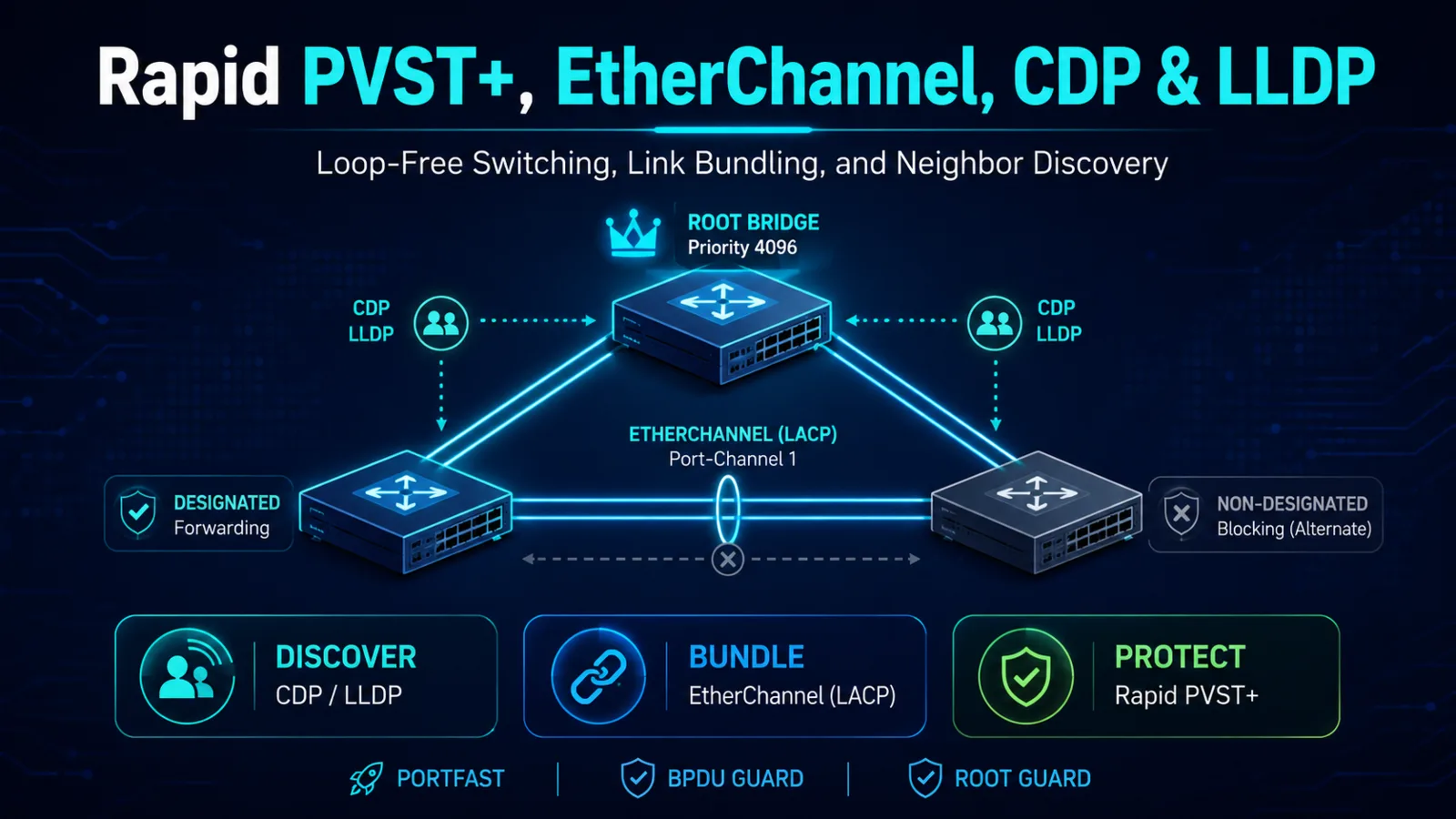
Redundant Layer 2 links improve availability but can create loops. Rapid Per-VLAN Spanning Tree Plus (Rapid PVST+) selects a loop-free topology, while EtherChannel makes multiple compatible links operate as one logical connection. Cisco Discovery Protocol (CDP) and Link Layer Discovery Protocol (LLDP) reveal directly connected neighbors and help validate physical intent.
Architecture Overview
Spanning tree elects a root bridge per VLAN and assigns port roles based on the best path to that root. Root ports provide a non-root switch's best path toward the root. Designated ports forward for their segments, while alternate roles provide standby paths. Rapid transitions reduce convergence time compared with older spanning-tree behavior.
Link Aggregation Control Protocol (LACP) negotiates an EtherChannel. Spanning tree sees the resulting port-channel as one logical link, which prevents it from blocking individual members merely because they are parallel.
Core Components
Edge and Guard Features
PortFast allows an intended edge port to reach forwarding rapidly. It does not disable spanning tree and should not be used casually on links that may connect switches. BPDU Guard can shut an edge port when it receives a bridge protocol data unit. Root Guard prevents an attached device from becoming root through that port. Loop Guard helps protect against a unidirectional condition that stops expected BPDUs. BPDU Filter changes BPDU handling and can remove loop protection if misapplied.
Neighbor and Bundle Evidence
CDP is Cisco proprietary; LLDP is an IEEE standards-based discovery protocol. Both can report neighbor identity, local and remote ports, and capabilities when enabled. They reveal direct adjacency, not full path health or policy correctness.
LACP member interfaces need compatible Layer 2 or Layer 3 parameters. A port can be configured for a channel but remain suspended or individual when speed, duplex, trunk, access, VLAN, or channel settings conflict.
How Components Work Together
First confirm the physical neighbors with CDP or LLDP. Then validate port-channel membership and the logical interface. Finally inspect spanning-tree root, roles, states, and protections for the relevant VLAN. This order prevents a logical protocol diagnosis from hiding incorrect cabling.
Design Considerations
Choose and document the intended root bridge. Keep EtherChannel member settings consistent. Apply edge protections only where the physical role is controlled. A remote spanning-tree or channel change can disrupt management, so establish console or out-of-band recovery before production work.
Common Mistakes
- Assuming PortFast means spanning tree is off
- Configuring LACP on only one side or mixing negotiation modes
- Reading spanning-tree state for the wrong VLAN
- Treating a neighbor entry as proof that the trunk carries the required VLAN
- Applying BPDU Filter to silence symptoms instead of removing the loop
- Troubleshooting member links while ignoring the port-channel interface
Certification Relevance
The v1.1 blueprint includes CDP, LLDP, Layer 2 and Layer 3 LACP EtherChannel, Rapid PVST+ roles and states, PortFast, Root Guard, Loop Guard, BPDU Filter, and BPDU Guard.
Conclusion
Use discovery to prove topology, EtherChannel evidence to prove bundling, and spanning-tree evidence to prove loop-free forwarding. Protective features are safe only when matched to the port's intended role.