
Study & Preparation
CCNA 200-301 IPv6 Addressing and Prefixes Explained
About this video
IPv6 is not simply IPv4 with longer addresses. It changes how interfaces establish scope, generate addresses, discover neighbors, and identify next hops. In this video, we build the IPv6 mental model CCNA 200-301 candidates need for both exam questions and practical troubleshooting. We begin with the structure of a 128-bit IPv6 address and the two rules used to make addresses easier to read: • Leading zeros inside a hexadecimal group can be removed. • One continuous sequence of all-zero groups can be replaced with a double-colon. The double-colon can appear only once in an IPv6 address. Using it more than once makes the original 128-bit value impossible to reconstruct without ambiguity. We’ll then compare the major IPv6 address scopes: Global Unicast Addresses are used for globally routable communication. Unique Local Addresses use the fc00::/7 prefix and are intended for internal organizational use. Link-Local Addresses use the fe80::/10 prefix and remain limited to the local link. Routers do not forward link-local traffic between interfaces, but link-local addressing remains essential for next-hop communication, Neighbor Discovery, and DHCPv6 exchanges. The lesson also explains the difference between multicast and anycast. Multicast delivers traffic to members of a group, while anycast allows multiple interfaces to use the same unicast address and relies on routing to reach the topologically closest instance. We’ll also examine IPv6 dynamic configuration through SLAAC, or Stateless Address Autoconfiguration. A host can use information from a Router Advertisement to generate an address from an advertised /64 prefix. You’ll see how Modified EUI-64 builds a 64-bit interface identifier from a 48-bit MAC address by inserting ff:fe and changing the universal/local bit. We’ll also explain why modern operating systems frequently use stable, randomized, or temporary privacy-oriented identifiers instead of exposing the physical MAC address. For troubleshooting, we move into Neighbor Discovery Protocol. IPv6 does not use ARP. It uses ICMPv6 Neighbor Solicitation and Neighbor Advertisement messages to resolve local Layer 2 information. Solicited-node multicast is used during this process instead of an IPv4-style broadcast. You’ll also learn why link-local troubleshooting requires special attention. Identical link-local addresses can exist on different interfaces, so a link-local destination may require an outgoing interface or zone index. Useful Cisco IOS verification commands include: show ipv6 interface brief show ipv6 route show ipv6 neighbors These commands help confirm interface status, assigned addresses, installed prefixes, and Neighbor Discovery mappings. The exam-thinking principle is to verify scope before assuming reachability. A valid IPv6 address may still be unusable for the intended destination if its scope is wrong. A working local ping does not prove that a global route exists, and a configured prefix does not prove that it is installed in the active routing table. The lesson finishes with six common IPv6 traps: • Using the double-colon more than once • Treating link-local addresses like internal routed addresses • Expecting routers to forward link-local traffic • Confusing multicast with anycast • Assuming Modified EUI-64 is mandatory • Pinging a link-local destination without defining the outgoing interface Use this video to strengthen your understanding of IPv6 representation, scopes, SLAAC, interface identifiers, Neighbor Discovery, and operational verification for the CCNA exam. #CCNA #Cisco #CCNA200301
Keep watching
 7:53
7:53Study & Preparation
CCNA 200-301 v1.1 Study Roadmap Before v2.0
 11:32
11:32Study & Preparation
CCNA 200-301 Network Devices and Topologies Explained
 11:32
11:32Study & Preparation
CCNA 200-301 Ethernet Switching, MAC Learning, and TCP vs UDP
 8:37
8:37Study & Preparation
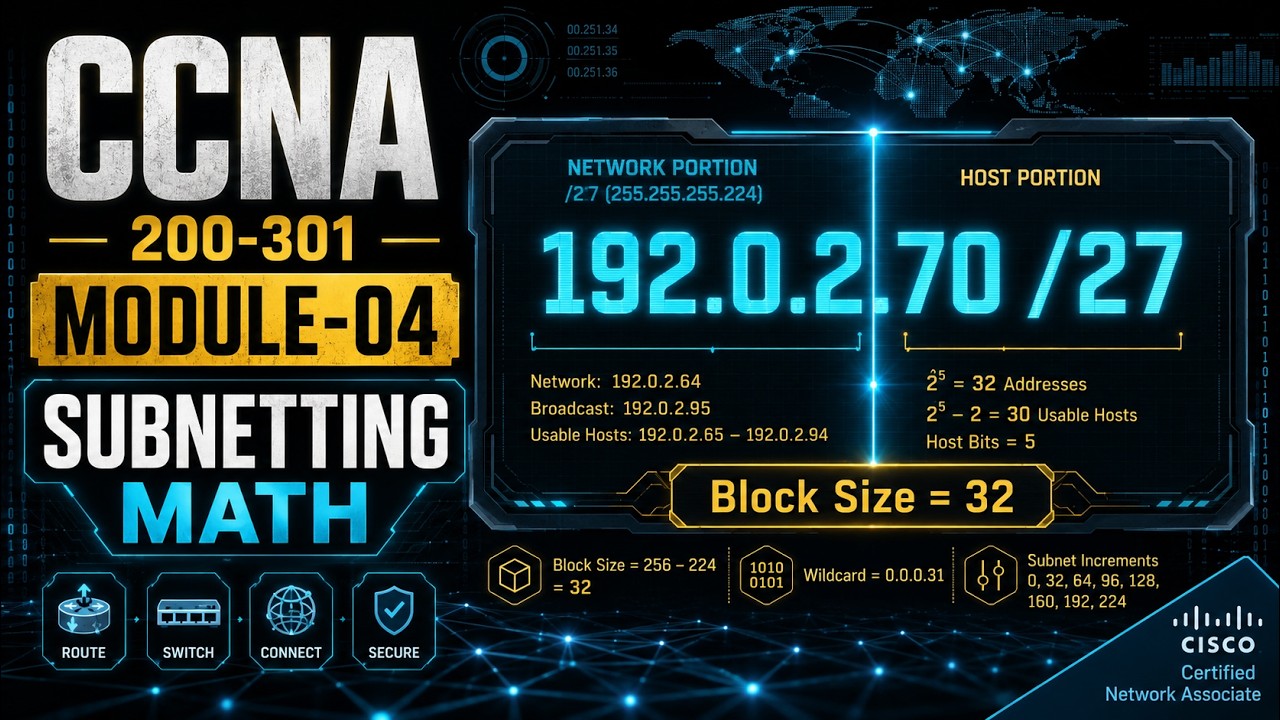
CCNA 200-301 IPv4 Addressing and Subnetting Explained
 10:07
10:07Study & Preparation
CCNA 200-301 VLANs, Trunks, and Inter-VLAN Routing Explained
 8:23
8:23Study & Preparation