
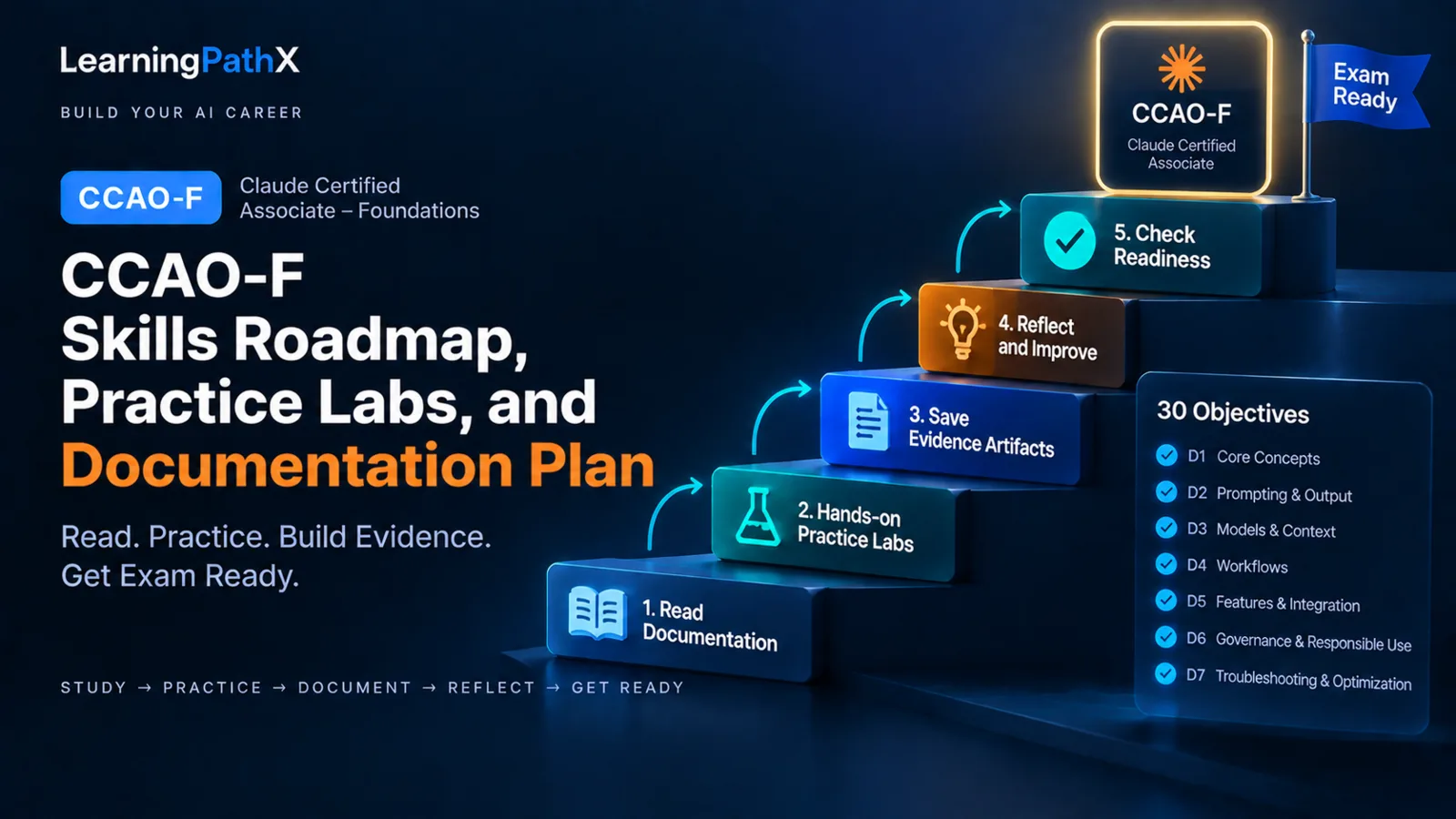
Turn the 30 detailed CCAO-F objectives into a source-backed roadmap by repeating five stages for every objective: read the controlling official documentation, perform an original low-risk lab, preserve an evidence artifact, reflect on the result and its limitations, and make a readiness decision supported by that evidence. Work through the objectives in dependency order, refresh living product facts before each relevant lab, and revisit any objective whose evidence is incomplete, stale, or not reproducible.
The Claude Certified Associate – Foundations Exam Guide v1.0 defines the 30-objective scope; it does not prove current product behavior or disclose live items. This procedure therefore combines that scope with current official product documentation and original workplace practice. It is a way to build demonstrable competence, not an exam-question reconstruction, answer key, confidential-content source, pass guarantee, or claim that completing one resource ensures success.
Establish the Official Baseline
Before scheduling study work, create a dated baseline record. Use the current certification page to confirm the credential identity and published exam baseline, the Certification FAQ to recheck current access and program rules, and the Partner Certifications catalog to confirm the Associate role boundary. Record the page titles, URLs, access date, and any fact that could affect the preparation schedule.
Use the Claude Certified Associate – Foundations Prep Course as an official learning companion, not as a substitute for the exam guide or hands-on evidence. Its current learning objectives connect product and model choice, prompting, evaluation, workflow integration, Projects, governance, and troubleshooting, which makes it useful for sequencing the objective ledger below.
Create one row for each objective, D1.1 through D7.3, and give it these fields:
- controlling official reading and access date;
- original lab and approved or synthetic input;
- saved evidence artifact and version;
- reflection on what worked, failed, changed, and still needs verification;
- readiness state; and
- next review date when the product fact or evidence can become stale.
A practical readiness vocabulary is not started, practicing, demonstrated, and refresh required. These are self-assessment labels, not predicted exam results. Mark an objective demonstrated only when another person could inspect the artifact, reproduce the important step, and understand the decision and its limitations.
Use the Five-Stage Evidence Loop
Apply the same evidence loop to every objective so reading and practice remain connected:
- Documentation reading: Identify what the exam guide places in scope, then read the official product page that governs the behavior used in the lab. Record the access date and any plan, setting, permission, or surface condition.
- Original lab: Use a low-risk workplace scenario you created yourself. Use synthetic or approved data, state the intended outcome, and define acceptance criteria before running the task.
- Evidence artifact: Save the prompt, input description, relevant configuration, output or decision record, validation evidence, and final disposition. Redact sensitive values and follow organizational retention rules.
- Reflection: Explain the observed result, the cause of any gap, the smallest useful change, the role of human judgment, and whether the result transfers to a different case.
- Readiness check: Ask whether the artifact proves the objective, the procedure is repeatable, material claims are verified, controls were preserved, and current product behavior was checked. If any answer lacks evidence, keep practicing or mark the objective for refresh.
Use one shared scenario across several objectives only when it still produces distinct evidence for each objective. A workflow map may support D4.4 and D4.5, for example, but the integration decision and stakeholder explanation should remain separately reviewable.
Recheck Living Claude Product Behavior
Feature availability and controls can change during a preparation period. Reopen the applicable help page immediately before a lab, capture the access date, and record what is actually available in the approved account. Do not present an observed plan or organization configuration as universal behavior.
| Surface | Current documented baseline to verify | Lab evidence to preserve |
|---|---|---|
| Prompting | Anthropic's prompt-design guidance says Claude does not begin with the user's task or organizational context and benefits from specific instructions. | The exact task, context, constraints, output contract, acceptance criteria, prompt version, and resulting difference. |
| Projects | The current Projects documentation describes self-contained workspaces with chat history, project knowledge, and project instructions; specific limits and collaboration or retrieval behavior remain plan-sensitive. | Project purpose, instructions, knowledge inventory, access or sharing boundary, source dates, and retrieval checks. |
| Artifacts | The current Artifacts documentation describes substantial standalone content in a dedicated area and ties current enablement to code execution and file creation settings. | Account surface, enablement state, artifact type, revision history, export or sharing decision, and validation result. |
| connectors | The current connector documentation says connectors inherit source-system permissions and that organization controls can further restrict actions. | Connected identity, approved service, requested permissions, action boundary, approval behavior, source result, and disconnect or cleanup state. |
| Skills | The current Skills documentation describes Skills as dynamically loaded folders of instructions, scripts, and resources for specialized tasks; current use depends on code execution and applicable plan or organization controls. | Skill source and owner, enabled state, triggering task, loaded behavior, output comparison, version, and review decision. |
For model choices, effort controls, context behavior, feature visibility, and administrator settings not established by these pages, record the current approved-account observation and return to the appropriate series article and current official documentation before asserting a general rule. The roadmap should survive product changes because it preserves the verification step rather than memorizing one interface snapshot.
Map Domain 1 to Prompting Evidence
| Objective | Documentation reading | Original lab | Evidence artifact | Reflection and readiness check |
|---|---|---|---|---|
| D1.1 — Create effective prompts for business and technical tasks | Read the Exam Guide scope and current prompt-design guidance. | Turn approved meeting notes into a decision-and-action summary using an explicit outcome, context, constraints, format, and acceptance criteria. | Prompt brief, source boundary, output, rubric, and validation record. | Explain which prompt element made the result reviewable; demonstrate on a second low-risk task. |
| D1.2 — Decompose complex requests into structured tasks | Read the Exam Guide and prep-course task-decomposition objective. | Split a multi-stage planning request into bounded stages with intermediate checks and a final assembly step. | Task map, stage prompts, dependencies, checkpoints, and assembled result. | Identify where decomposition prevented ambiguity or rework; reproduce the sequence with one changed input. |
| D1.3 — Iterate prompts to improve output quality | Read the prompt-design guidance and the objective boundary. | Run a deliberately underspecified prompt, diagnose one material gap, change one instruction, and rerun the same case. | Baseline and revised prompts, paired outputs, rubric scores, and change rationale. | Attribute the observed difference to evidence rather than preference; retain the weaker version to show the comparison. |
| D1.4 — Adapt prompting to analysis, research, drafting, and brainstorming | Read the Exam Guide task statement and prep-course learning objective. | Use one approved topic to create four prompt briefs, each with a task-appropriate success definition and source boundary. | Four prompt briefs and a short comparison of their output contracts and review needs. | Explain why one generic prompt would not serve every task type; demonstrate the distinctions without relying on memorized wording. |
Map Domain 2 to Evaluation and Delivery Evidence
| Objective | Documentation reading | Original lab | Evidence artifact | Reflection and readiness check |
|---|---|---|---|---|
| D2.1 — Evaluate outputs for accuracy and completeness | Read the Exam Guide and prep-course evaluation objective. | Evaluate a source-backed brief against a predeclared claim and required-field rubric. | Annotated output, claim inventory, completeness checklist, and disposition. | Distinguish factual acceptance from writing preference; repeat the rubric on a new brief. |
| D2.2 — Identify hallucinations, inconsistencies, and biases | Read the Exam Guide scope and official evaluation learning objective. | Inspect a synthetic draft containing a plausible unsupported claim, an internal contradiction, and an unbalanced framing. | Issue log with location, category, evidence, severity, and required correction. | Explain why fluent language is not evidence; show that each finding is tied to an observable problem. |
| D2.3 — Apply fact-checking and validation techniques | Read the objective and identify authoritative source owners before drafting. | Build a claim-to-source trace for a short brief using two current official pages. | Claim table with exact supporting location, date, exception, and validation status. | Explain why source relevance and authority differ; refresh one time-sensitive claim and update the trace. |
| D2.4 — Decide when human review or further verification is required | Read the Exam Guide and prep-course human-verification objective. | Classify synthetic low-, medium-, and high-impact outputs and assign accept, verify, escalate, or reject dispositions. | Triage matrix with impact, uncertainty, reviewer role, evidence requirement, and owner. | Defend the escalation boundary and show that Claude output never becomes the accountable decision by default. |
| D2.5 — Edit, adapt, refine, and compare outputs for the intended audience | Read the objective after completing factual acceptance work. | Adapt one validated source document for an executive reader and an operating team without changing verified facts. | Baseline, two audience versions, comparison rubric, and approved final version. | Identify changes in emphasis, terminology, and detail separately from factual corrections. |
| D2.6 — Organize and curate information and choose artifact, inline, or structured-data formats | Read the Exam Guide plus current Artifacts behavior. | Present the same validated information as a concise inline response, structured table, and suitable standalone Artifact. | Three formats, selection rationale, enablement state, and accessibility or usability review. | Explain which consumer and reuse need justified the selected form; verify that formatting did not hide evidence or limitations. |
Map Domain 3 to Selection and Context Evidence
| Objective | Documentation reading | Original lab | Evidence artifact | Reflection and readiness check |
|---|---|---|---|---|
| D3.1 — Select suitable Claude features such as Projects, research, chat, and Artifacts | Read the Exam Guide, prep-course selection objective, Projects documentation, and Artifacts documentation. | Classify several low-risk tasks by currency, persistence, collaboration, depth, and output-form needs, then test two plausible routes for one task. | Capability decision matrix, tested routes, observed availability, and final selection. | Explain why the chosen surface fits the task without claiming it is universally best. |
| D3.2 — Differentiate Haiku, Sonnet, and Opus model types | Read the Exam Guide and current official model guidance referenced by the model-selection article on the day of practice. | Compare the currently available eligible model choices on one fixed task and acceptance rubric. | Dated model names, settings, outputs, quality notes, time or usage evidence available to the user, and limitations. | Describe observed differences without turning one run into a permanent ranking; mark refresh required after a material lineup change. |
| D3.3 — Align model choice with cost, speed, and quality needs | Read the objective and prep-course model-selection outcome, then recheck current controls. | Create three workload profiles with different quality, speed, and resource constraints and choose a justified current model route for each. | Decision record with workload, constraints, eligible choices, test evidence, tradeoff, and review rule. | Show that the choice follows task needs and current evidence rather than habit or model-name prestige. |
| D3.4 — Manage context limits and memory decisions by restarting, summarizing, or persisting | Read the objective and current Projects documentation. | Run a controlled long-task scenario, then compare a clean restart, a verified summary, and approved persistent Project context. | Context inventory, summary validation, Project state, outputs, omissions, and selection rationale. | Explain what must remain authoritative, what can be summarized, and when persistence creates freshness or access obligations. |
Map Domain 4 to Workflow Evidence
| Objective | Documentation reading | Original lab | Evidence artifact | Reflection and readiness check |
|---|---|---|---|---|
| D4.1 — Apply Claude to requirements and use-case analysis | Read the Exam Guide and prep-course workflow-integration objective. | Analyze a fictional request for goals, users, constraints, sources, risk, acceptance criteria, and unsuitable delegation. | Requirements brief, assumption log, open issues, and go, revise, escalate, or reject decision. | Explain which missing fact could change the design and who must resolve it. |
| D4.2 — Use Claude for research, planning, and process optimization | Read the objective and official workflow learning outcome. | Select one approved planning task, define its source and human-review boundary, and compare the current process with a bounded Claude-assisted step. | Current-state and candidate maps, source record, measures, validation result, and decision. | Distinguish initial process improvement from unsupported automation; show evidence for the chosen boundary. |
| D4.3 — Support solution design, development, and iteration | Read the Associate-track boundary in the Exam Guide and Partner Certifications catalog. | Iterate a non-API workplace solution, such as a reusable intake-and-summary workflow, from requirements through a reviewed pilot. | Design record, versions, feedback, accepted changes, unresolved risks, and owner. | Demonstrate useful iteration while recognizing when production engineering belongs to a Developer or Architect. |
| D4.4 — Integrate Claude to augment or redesign existing workflows | Read the Exam Guide and prep-course integration objective. | Map a recurring process and place Claude only at stages with suitable inputs, controls, handoffs, and fallback paths. | Swimlane or process map, role assignments, approval gates, exception routes, and pilot evidence. | Explain why each delegated step is appropriate and how the process behaves when Claude is unavailable or unacceptable. |
| D4.5 — Communicate Claude's value and limitations to stakeholders | Read the objective and Associate role description in the Partner Certifications catalog. | Produce a one-page stakeholder brief for the workflow lab. | Brief with value hypothesis, evidence, limits, costs or dependencies, human ownership, risks, and next decision. | Remove hype and unsupported certainty; verify that a decision maker can see both benefit and constraint. |
Map Domain 5 to Configuration and Knowledge Evidence
| Objective | Documentation reading | Original lab | Evidence artifact | Reflection and readiness check |
|---|---|---|---|---|
| D5.1 — Configure Projects with instructions and knowledge sources | Read current Projects documentation before configuring the lab. | Build a low-risk Project with a stated purpose, concise instructions, a current style guide, a template, and one source document. | Project configuration record, knowledge inventory, access boundary, test prompts, outputs, and review date. | Show that instructions and knowledge serve different roles and that another user can understand the maintained context. |
| D5.2 — Manage uploaded knowledge and connectors | Read both current Projects and connector documentation. | Compare governed uploaded knowledge with permissioned connector access for the same synthetic information need; do not use restricted production data. | Source inventory, connected identity, permissions, requested actions, retrieval results, and system-boundary decision. | Explain when maintained Project knowledge or live external access is appropriate; verify that neither route bypasses ownership or permission. |
| D5.3 — Create effective system-level instructions | Read the Project-instructions behavior in current Projects documentation. | Write concise persistent instructions for role, source precedence, output behavior, uncertainty, and escalation, then test several tasks. | Instruction versions, conflicting test case, outputs, precedence observations, and approved revision. | Distinguish persistent configuration from a task prompt; show that the instructions remain useful without suppressing task-specific context. |
| D5.4 — Inform, maintain, and update configurations, knowledge, and instructions | Read current Projects documentation and record the lab's source owners. | Add a clearly labeled obsolete document to a test copy, observe the effect, then remove or supersede it and retest. | Before-and-after inventory, owner, version dates, retrieval or output comparison, maintenance log, and next review date. | Explain the freshness failure and prove that the maintenance action corrected it without erasing the audit trail. |
Map Domain 6 to Governance Evidence
| Objective | Documentation reading | Original lab | Evidence artifact | Reflection and readiness check |
|---|---|---|---|---|
| D6.1 — Identify appropriate and inappropriate use cases | Read the Exam Guide and prep-course governance objective, plus the organization's current controlling policies. | Classify synthetic use cases by purpose, impact, reversibility, expertise, evidence, and human ownership. | Approve, constrain, escalate, or reject matrix with rationale and decision owner. | Show that business value does not override suitability and that a prohibited or unsupported path remains rejected. |
| D6.2 — Apply data-sensitivity, regulatory, and privacy considerations | Read the objective and the policies applicable to the approved account and data class. | Build a synthetic data-flow inventory and minimize fields before any Claude step. | Data classification, minimum-necessary set, account and feature boundary, retention rule, reviewer, and escalation path. | Identify which authority sets each restriction; demonstrate that the lab does not treat technical access as permission. |
| D6.3 — Follow organizational AI policies and governance standards | Read the current internal policy and map it to the Exam Guide objective. | Trace several policy controls through one workflow lab, including allowed account, data, review, record, and prohibited-action rules. | Control-to-step matrix, approval evidence, exception path, and unresolved-policy log. | Show where the workflow enforces each control and where a qualified owner must decide. |
| D6.4 — Understand ethical implications of AI use | Read the objective and the organization's applicable responsible-use guidance. | Review a synthetic communication workflow for affected people, bias, transparency, contestability, accountability, and foreseeable misuse. | Impact assessment, mitigations, residual concerns, consultation record, and final disposition. | Explain why policy compliance alone may not resolve every stakeholder impact; escalate judgments beyond your role. |
Map Domain 7 to Troubleshooting and Optimization Evidence
| Objective | Documentation reading | Original lab | Evidence artifact | Reflection and readiness check |
|---|---|---|---|---|
| D7.1 — Diagnose and resolve underperforming prompts or poor outputs | Read the Exam Guide, prompt-design guidance, and the current page for the surface used in the failure. | Create one controlled failure by omitting an audience, using stale test knowledge, or restricting necessary approved access; change one causal layer and retest. | Expected-versus-actual record, reproducible setup, cause classification, targeted change, and original plus edge-case retest. | Demonstrate cause rather than correlation and verify that the correction did not weaken a control. |
| D7.2 — Adjust the approach based on feedback and results | Read the objective and prep-course troubleshooting outcome. | Convert one reviewer finding or operating observation into a measurable gap, one change hypothesis, and a controlled retest. | Feedback record, baseline, hypothesis, changed variable, comparison, and accept, reject, revise, or escalate decision. | Explain how the evidence supports the adjustment and why untested simultaneous changes were avoided. |
| D7.3 — Optimize workflows for efficiency and effectiveness | Read the objective after the workflow and troubleshooting evidence is complete. | Baseline a functioning synthetic workflow, measure quality and effort, change one justified lever, and compare the same workload under unchanged safeguards. | Baseline and candidate measures, acceptance evidence, guardrails, tradeoff, rollback condition, and final decision. | Demonstrate that efficiency did not come from lowering quality, permission, governance, or human-review thresholds. |
Build a Reviewable Readiness Portfolio
Store the evidence in an approved location with a simple objective-based naming convention. A compact portfolio should contain:
- the dated official baseline and 30-row objective ledger;
- original inputs or a description sufficient to reproduce them;
- prompt, configuration, source, model or capability, and workflow versions relevant to each lab;
- validation rubrics, claim traces, permission records, approvals, and human-review dispositions;
- before-and-after comparisons for iteration, troubleshooting, and optimization;
- reflections that state limitations and unresolved gaps; and
- a refresh queue for product behavior, program rules, organizational policy, and stale evidence.
Do not store confidential information merely to make a portfolio look realistic. Synthetic or approved data is enough to demonstrate the method. If an artifact depends on a connector, shared Project, Artifact setting, or Skill, preserve the access and configuration decision without copying secrets or restricted source-system content.
Run the Final Readiness Review
Complete the final review in four passes:
- Coverage: Confirm that D1.1 through D7.3 each has reading, original practice, an artifact, reflection, and a readiness state. Domain weight does not justify leaving an objective blank.
- Currency: Reopen every living product page used by the portfolio. Mark refresh required when a model, feature, plan entitlement, permission surface, organization setting, or certification rule has materially changed.
- Transfer: Ask another reviewer to select several artifacts and vary the input. Demonstrated skill should survive a reasonable change of audience, source, task, or constraint.
- Integration: Run one low-risk capstone that connects task framing, validation, capability selection, workflow and human gates, configuration or permitted data access, governance, troubleshooting, and measured improvement. Keep each objective's evidence traceable within the combined work.
The outcome is an evidence-backed preparation decision: continue building missing evidence, refresh stale evidence, or conclude that the current portfolio demonstrates the published objectives at the intended Associate level. It is not a forecast of a score or a promise of certification success.
Common Roadmap Mistakes
- Reading only summaries and never tracing the 30 objectives to the current exam guide
- Treating course completion or domain weight as proof of objective-level readiness
- Memorizing a current model or feature lineup without recording the verification date
- Practicing only successful prompts and never preserving a reproducible failure
- Combining many changes so the cause of improvement cannot be identified
- Treating Projects, Artifacts, connectors, and Skills as interchangeable context mechanisms
- Using confidential or production data when approved or synthetic data would demonstrate the same skill
- Saving polished outputs without prompts, sources, controls, validation, and decision evidence
- Marking an objective demonstrated when the artifact cannot be reproduced or explained
- Using real or reconstructed exam items, answer keys, confidential content, or pass claims as study evidence
Conclusion
A durable CCAO-F skills roadmap treats every objective as a five-stage evidence loop: read the current official source, perform original practice, preserve the work product and controls, reflect on the observed result, and make a dated readiness decision. Mapping that loop to D1.1 through D7.3 creates a portfolio that is complete, inspectable, and refreshable as Claude and the certification program evolve. The final standard is demonstrated professional judgment across the connected workflow, not completion of a particular course or exposure to exam-like content.
Authoritative Sources
- Claude Certified Associate – Foundations Exam Guide
- Claude Certified Associate – Foundations Certification
- Certification FAQ
- Partner Certifications
- Claude Certified Associate – Foundations Prep Course
- Introduction to prompt design
- What are projects?
- What are artifacts and how do I use them?
- Use connectors to extend Claude's capabilities
- What are skills?
Related Reading
- CCAO-F: Claude Certified Associate – Foundations Overview
- CCAO-F: Prompting and Task Execution with Claude
- CCAO-F: Evaluating and Validating Claude Outputs
- CCAO-F: Refining Claude Outputs for Audience and Delivery Format
- CCAO-F: Choosing Claude Products and Capabilities for Work
- CCAO-F: Choosing Claude Models and Managing Context
- CCAO-F: Designing Human-in-the-Loop Workflows with Claude
- CCAO-F: Governance, Risk, Privacy, and Responsible Claude Use
- CCAO-F: Configuring Claude Projects, Instructions, and Knowledge
- CCAO-F: Claude Connectors, Permissions, and Data Access
- CCAO-F: Troubleshooting Underperforming Claude Prompts and Outputs
- CCAO-F: Optimizing Claude Workflows for Efficiency and Effectiveness