
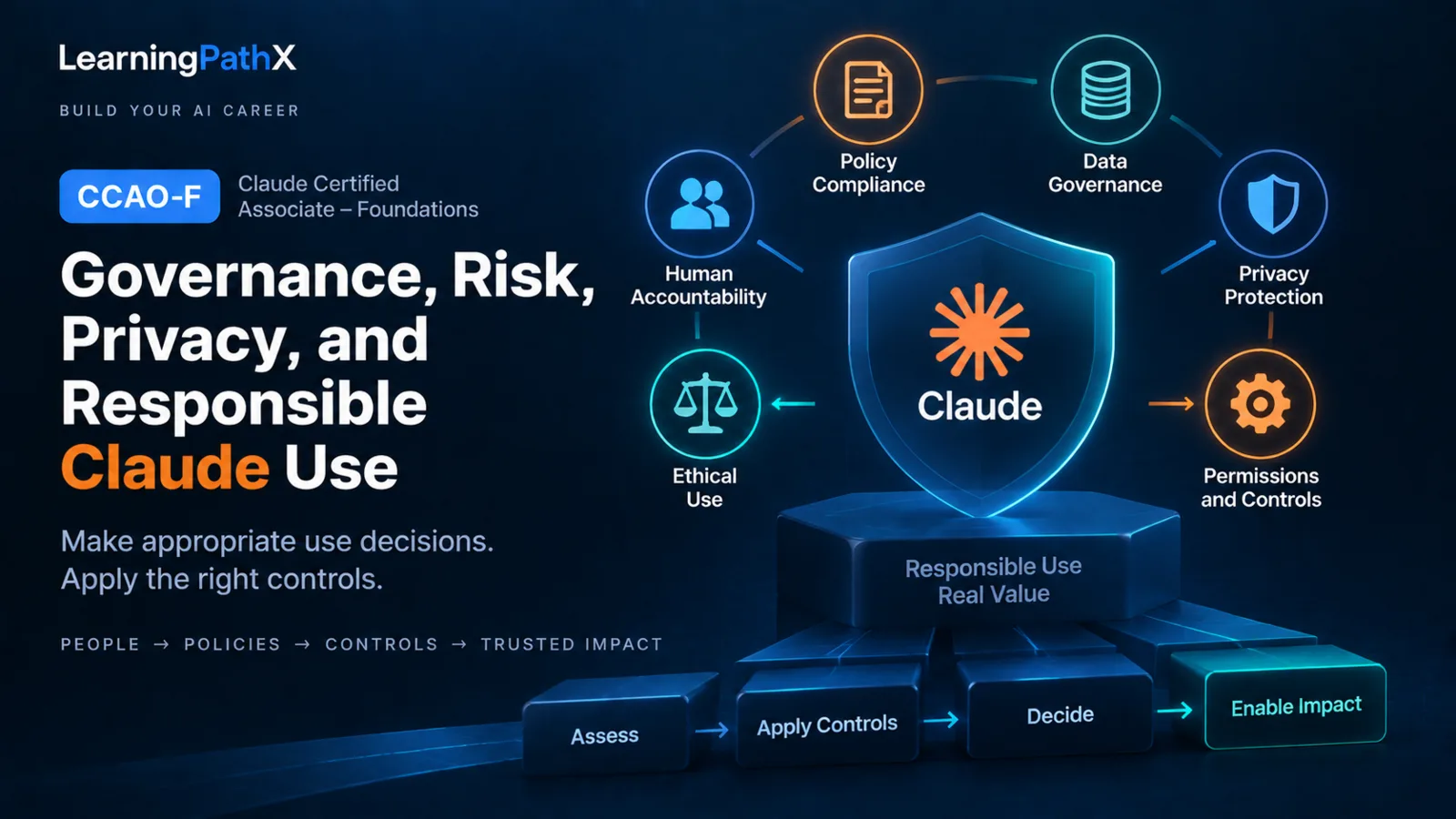
Decide whether a professional Claude use case is appropriate in two stages: first test whether the purpose and foreseeable impact are acceptable; then test whether the organization can apply sufficient controls for the data, privacy obligations, policy requirements, permissions, ethical risks, and human accountability involved. If the use is prohibited, the data is not authorized, the required human judgment cannot be preserved, or a material control is unavailable, do not proceed as proposed. Otherwise, choose one of four outcomes—allow, allow with explicit controls, redesign or escalate, or do not use Claude—and record who owns that decision.
This framework is not legal advice and is not a universal policy. The Anthropic Usage Policy governs use of Anthropic products and services, while applicable law, contracts, professional duties, and the organization's own policies may impose additional or stricter requirements. The framework helps a professional assemble those authorities into a repeatable decision; it does not replace a qualified legal, privacy, security, compliance, ethics, or domain specialist.
Start with an Appropriateness Decision
A technically possible task is not automatically an appropriate task. Describe the proposed use before choosing a prompt, model, Project, or connector:
- The legitimate business purpose and intended beneficiary
- The role Claude would play, such as assisting research, organizing material, drafting, or recommending an action
- The people or groups affected by the input, output, or downstream decision
- The consequence and reversibility of a mistake, disclosure, biased result, or unauthorized action
- Whether a person can inspect the evidence, change the result, and stop the workflow before a consequential outcome
Then apply the relevant authorities in layers. Anthropic's Usage Policy defines uses that are prohibited and adds human-in-the-loop and disclosure requirements for specified high-risk use cases. It also states that the user or organization remains responsible for the accuracy and appropriateness of high-risk information. Those vendor requirements are a floor for using the service, not a complete statement of what a particular organization, profession, contract, regulator, or jurisdiction permits.
The decision should become more restrictive as impact rises or reversibility falls. Routine internal drafting from approved, low-sensitivity material may be suitable with normal review. A use that affects a person's employment, finances, health, legal position, access, safety, or reputation needs qualified oversight and may require redesign, formal approval, or rejection even when the vendor policy does not prohibit the broad category.
Apply the Six-Control Decision Framework
Use the following control questions in order. A later control cannot cure an earlier prohibition or missing authority.
| Control question | Evidence needed for a defensible decision | If the evidence is missing |
|---|---|---|
| 1. Is the purpose permitted? | The use is consistent with Anthropic's current Usage Policy and the organization's acceptable-use rules, contracts, and applicable obligations. | Do not proceed, or escalate the interpretation to the authorized policy owner. |
| 2. Is the data permitted? | The organization has classified the information, authorized its use in the selected account and service, and limited the input to what the task needs. | Remove or replace the data, use an approved alternative, or stop. |
| 3. Are privacy duties satisfied? | The organization has identified affected people, the governing account and agreement, the necessary notice or consent, and applicable retention and sharing limits. | Escalate to the privacy or legal owner; do not infer permission from access alone. |
| 4. Are permissions bounded? | The user, Claude surface, and any external service have only the access and actions required for the approved task. | Reduce the capability or redesign the workflow before use. |
| 5. Are ethical risks acceptable? | The team has considered harm, fairness, deception, autonomy, vulnerable groups, and who bears errors or exclusions. | Add safeguards and affected-domain review, redesign the use, or reject it. |
| 6. Is a human accountable? | A named role has the competence, evidence, authority, time, and stop power needed to approve or reject the consequential result. | Keep the use advisory and non-consequential, or do not use Claude for that decision. |
These are governance decisions, not a scoring formula. One failed requirement can be decisive, and uncertainty about a material requirement is a reason to escalate rather than average it against controls that passed.
Classify Data Before Supplying It
Use the organization's own data-classification scheme rather than inventing an Anthropic classification. Labels such as public, internal, confidential, personal, regulated, privileged, or restricted are common examples, but their definitions and permitted destinations must come from the organization that owns the information.
For each input, establish:
- Who owns or controls the information and whether the user is authorized to use it for this purpose
- Which organizational class applies and whether the selected Claude account, plan, and capability are approved for that class
- Whether personal, confidential, regulated, contractual, or intellectual-property interests create additional handling requirements
- What minimum subset is necessary and whether identifiers or sensitive fields can be removed
- Where the information could travel through sharing, connected services, generated artifacts, exports, or downstream use
- Which approval, retention, deletion, logging, or incident requirements the organization applies
Account type matters to this assessment. Anthropic's Claude for Work data guidance says that the organization's designated Primary Owner manages the Work account and its associated data, the organization determines available services and features, and the agreement between Anthropic and the organization governs the account. It also directs users to their organizational owner for internal policy and privacy questions. Do not generalize a Work-account statement to a consumer account, or treat a user's ability to paste information as proof that the organization authorized that use.
Separate Vendor Policy from Organizational Controls
Responsible use depends on several authorities with different owners:
- Anthropic policy: Anthropic defines the conditions under which its products and services may be used, including prohibited activities and specified high-risk requirements.
- Organizational policy: The organization decides which business purposes, data classes, roles, Claude surfaces, external services, and review paths it authorizes.
- Law, regulation, contract, and professional duty: Qualified organizational owners determine which obligations apply to the deployment and whether additional restrictions, notices, records, or approvals are required.
- Task-specific accountability: The business and domain owners decide whether the proposed workflow has acceptable consequences and sufficient human control.
Organization instructions can reinforce organization-wide context, communication rules, data-handling reminders, or referral guidance. Anthropic's organization-instructions guidance says that organization instructions apply across conversations on Team and Enterprise plans and take precedence over conflicting individual instructions. The same guidance cautions that prioritization relies on prompt-level instructions and can vary in rare contradictory cases. Treat instructions as a useful behavior layer, not as the sole enforcement mechanism for a legal, privacy, access, or safety requirement.
No prompt can grant authority that the user does not have, override Anthropic's safety controls, or make an organizational rule universally applicable. Policy owners must define the rule; technical and process controls must enforce it at the appropriate boundary; and the accountable person must verify that those controls fit the use case.
Bound Permissions and External Actions
Permissions answer two different questions: what a user or service can access, and what the approved use case should access. The second can be narrower than the first.
Anthropic's connector guidance states that a connector inherits each person's permissions from the connected service. For Team and Enterprise plans, organization-level enablement does not itself grant each person access; source-system permissions still apply. Organization restrictions can also narrow connector actions, but they do not grant access that the source system withheld.
Use that relationship as a governance check without treating it as a configuration procedure:
- Confirm that the connected service, account, data domain, and action are approved for the stated purpose.
- Prefer the narrowest read or action capability that supports the task.
- Separate access to information from authority to use, share, modify, delete, purchase, send, or publish it.
- Require explicit human approval before a consequential external action when policy or impact calls for it.
- Reassess the use when a capability, permission, owner, data source, or downstream destination changes.
Permission inheritance prevents one class of overreach; it does not establish business need, privacy compliance, ethical acceptability, or authorization to use every accessible record.
Evaluate Ethical Impact and Human Accountability
An ethical review asks who benefits, who could be harmed, and who has a meaningful chance to challenge the result. Consider whether the use could create or amplify unfair treatment, deceptive communication, privacy invasion, loss of autonomy, exclusion, manipulation, or disproportionate harm to a vulnerable group. Anthropic's Usage Policy addresses several of these harms, including privacy violations, discriminatory practices, impersonation, misinformation, and specified decisions affecting individuals. An organization's ethical review should add its own mission, professional standards, risk tolerance, and affected-community context rather than presenting the vendor policy as a complete ethics code.
Human review is a control only when the reviewer has meaningful responsibility. Name the person or role who:
- Has the domain competence and authority to make the decision
- Can inspect the relevant input, evidence, limitations, and downstream consequence
- Applies defined acceptance, rejection, and escalation criteria
- Can require correction, change the workflow, or stop the use
- Owns the final communication, decision, action, and record
Anthropic warns that Claude can produce plausible but incorrect or misleading responses and should not be treated as a singular source of truth, especially for high-stakes advice. Its guidance on incorrect or misleading responses supports preserving qualified human judgment. The detailed techniques for checking individual output claims belong to the separate output-evaluation article; here, the governance question is whether an accountable reviewer and an adequate review path exist before the use is approved.
Record One of Four Outcomes
End the assessment with an explicit disposition and owner.
Allow
Use this outcome only when the purpose is permitted, the data and privacy conditions are satisfied, permissions are bounded, ethical impact is acceptable, and ordinary accountable review is sufficient. Record the approved scope and the person responsible for the result.
Allow with Controls
Use this outcome when the use is appropriate only with named constraints, such as data minimization, a narrower capability, specialist review, disclosure, a limited audience, approval before an external action, or additional documentation. The record should identify each control, its owner, and the event that would require reassessment.
Redesign or Escalate
Use this outcome when the purpose may be legitimate but authority is unclear, a control is missing, the consequence is too difficult to reverse, or the proposed Claude role carries more judgment or access than necessary. A qualified policy, legal, privacy, security, ethics, or domain owner decides the unresolved question; Claude does not decide whether its own use is permissible.
Do Not Use Claude
Use this outcome when the proposal violates an applicable requirement, depends on unauthorized data or access, creates unacceptable ethical harm, removes required human authority, or cannot be made adequately controllable. Document the reason and choose a safer non-Claude process when the business need remains valid.
Reassess When the Use Changes
Approval applies to the assessed purpose, information, people, capabilities, permissions, controls, and destination—not to every future use that appears similar. Reassess when any of those elements changes, when Anthropic or organizational policy changes, when an incident reveals a new failure mode, or when affected people or reviewers identify a material harm that the original decision missed.
Do not replace this reassessment with an instruction that says the workflow is safe or compliant. Instructions can express expectations, but governance requires current authority, enforceable controls, and an accountable decision.
Common Governance Mistakes
- Starting with prompt quality instead of deciding whether the use itself is appropriate
- Treating compliance with Anthropic's Usage Policy as proof that every organizational or regulatory requirement is satisfied
- Using a generic data label without applying the organization's definition and handling rules
- Assuming that technical access proves authorization, business need, or ethical acceptability
- Treating organization instructions as a guaranteed enforcement boundary
- Giving Claude authority to approve its own use, exception, or consequential result
- Adding a ceremonial review step without evidence, competence, stop power, or a named owner
- Carrying an approval forward after the purpose, data, capability, permission, or destination changes
Certification Relevance
For Claude Certified Associate – Foundations (CCAO-F), this decision framework connects D6.1 appropriate and inappropriate use cases, D6.2 data sensitivity, regulation, and privacy, D6.3 organizational policy and governance, and D6.4 ethical implications. Supporting D2.4 scope reinforces the need for human review. A useful practice exercise is to assess a familiar professional use case, identify the governing policy and data class, map permissions and affected people, name the accountable reviewer, and defend one of the four outcomes without turning the exercise into legal advice.
Keep adjacent skills separate. Output evaluation and validation owns the detailed checking of generated claims. Project instructions and connector configuration have their own articles; this article decides whether those capabilities and controls are appropriate before anyone configures them.
Conclusion
Responsible Claude use starts with suitability, not output quality. Test the purpose against Anthropic policy and the organization's own authorities, classify and minimize data, confirm privacy and permission boundaries, examine ethical impact, and preserve a named person's ability to approve, reject, escalate, or stop the work. Allow the use only when every material control has an owner and enough evidence; otherwise constrain it, redesign it, escalate it, or do not use Claude.
Authoritative Sources
- Anthropic Usage Policy
- Who owns and manages the data of my team?
- Set organization instructions
- Claude is providing incorrect or misleading responses
- Use connectors to extend Claude's capabilities