
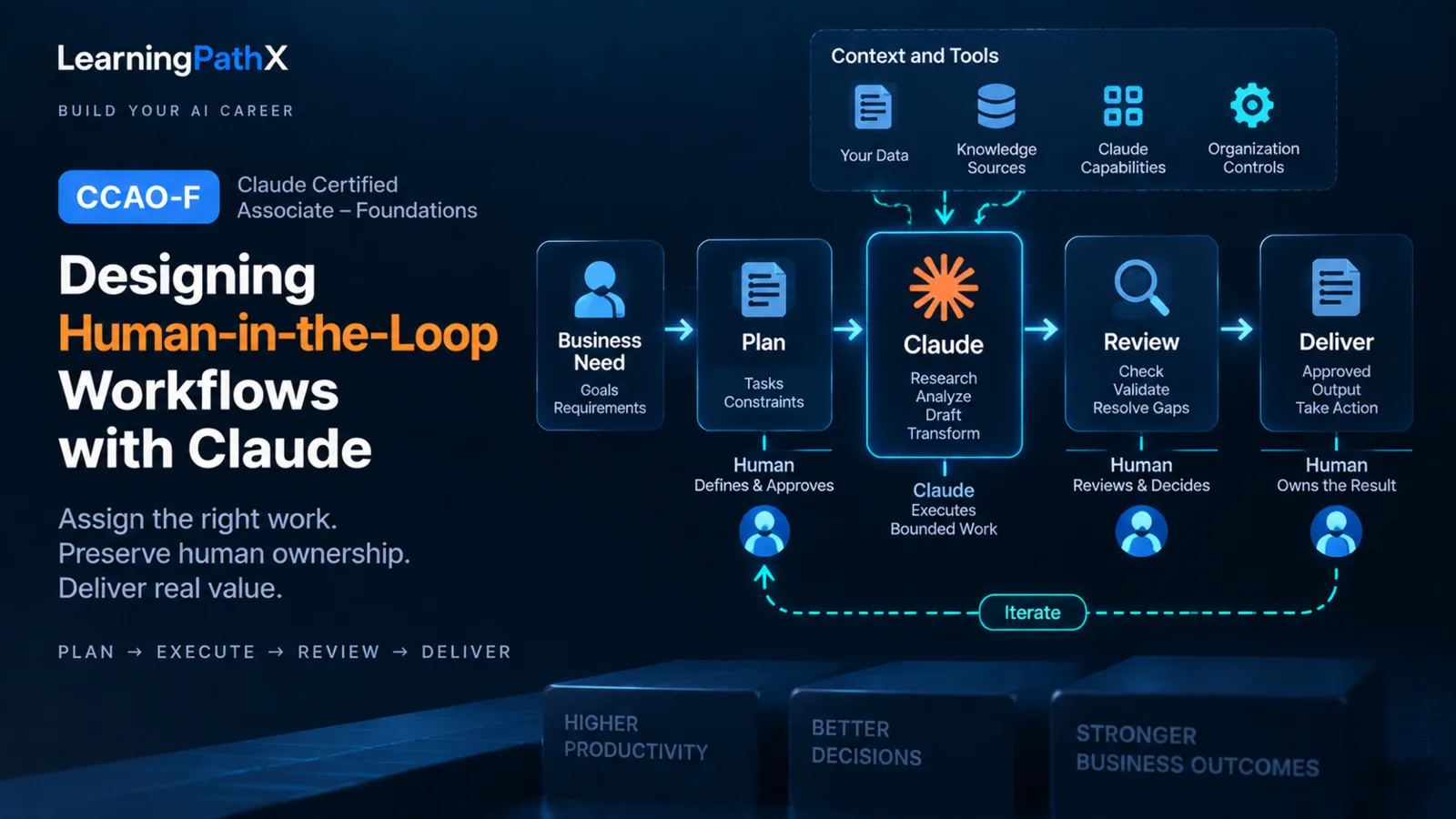
A team should design a human-in-the-loop Claude workflow from the business outcome backward: define the need and acceptance criteria, map the current process, assign Claude only bounded research, analysis, drafting, or transformation steps, and name the people who supply authority, review evidence, resolve exceptions, approve consequential decisions, and own the final result. This architecture can augment an existing process or redesign it, but it must preserve visible handoffs between Claude-assisted work and accountable human judgment.
The resulting workflow should connect requirements, approved inputs, capability choices, instructions, intermediate outputs, review gates, and delivery into one testable path. Pilot that path with representative work, compare the output with initial quality, cycle-time, review-effort, and stakeholder-value measures, then revise the design before broader use. Stakeholders should receive both sides of the case: the expected value and the conditions under which limitations, unavailable capabilities, uncertain evidence, or human review constrain that value.
Start with the Business Use Case
Claude can accept simple or complex requests through a conversational interface, but the visible request is not the whole workflow. Anthropic's getting-started guidance describes prompts as the way users communicate with Claude and notes that requests can range from straightforward questions to multi-step work. A workflow design must add the business context that sits around that interaction.
Capture these requirements before choosing a Claude-assisted step:
- The business outcome, intended user, and final audience
- The current trigger, inputs, source owners, and required deliverable
- The steps that transform information or create a decision
- The acceptance criteria that make the result usable
- The person who owns each input, judgment, approval, and final action
- The likely exceptions and the destination for work that cannot proceed
- The initial evidence that would justify continuing, changing, or stopping the pilot
Map the current process as it actually operates, including delays, duplicated work, informal handoffs, and review queues. Then state whether the proposed design augments a step or redesigns the flow. Augmentation leaves the process substantially intact and adds assistance at a bounded point. Redesign changes the sequence, roles, or evidence path. That distinction helps stakeholders understand whether the proposal saves effort locally or changes how the work is controlled end to end.
Build the Workflow as Seven Connected Components
A practical human-in-the-loop architecture has seven connected components. Each one produces an input or decision needed by the next.
| Component | Claude-assisted responsibility | Human responsibility |
|---|---|---|
| Intake and classification | Structure the request or identify missing fields from an approved intake format | Define the use case, confirm the requester, and resolve ambiguous intent |
| Context and evidence preparation | Organize supplied material or help locate current public evidence with an approved capability | Select authoritative inputs, confirm scope, and decide which evidence may be used |
| Work planning | Propose steps, dependencies, questions, or alternatives for review | Approve the plan, constraints, sequence, and stopping conditions |
| Bounded execution | Draft, summarize, compare, extract, transform, or synthesize within the approved task | Supply domain context and remain responsible for the requested outcome |
| Evaluation and exception handling | Present output in a checkable form and identify gaps it can express | Test acceptance criteria, inspect evidence, resolve exceptions, and reject unsuitable output |
| Approval and delivery | Prepare the reviewed deliverable for the chosen handoff | Approve consequential claims, commitments, decisions, or distribution |
| Pilot learning | Organize recorded results and feedback | Decide whether the design met its initial measures and what must change before wider use |
The components are architectural responsibilities, not mandatory product features. A small internal drafting flow may implement them with a request, a source packet, one Claude response, and one named reviewer. A larger research brief may need distinct planning, evidence, specialist review, and executive approval stages. Add structure only when it makes ownership, evidence, or quality easier to control.
Define Every Claude Step as a Contract
The Claude step should be narrow enough to explain and review. Anthropic's prompt-design guidance recommends specific instructions because Claude does not automatically know the user's task or organization context. Turn that need for context into a maintained work contract rather than relying on an improvised prompt.
For each Claude-assisted step, define:
- Input: The approved material, format, and minimum required fields
- Task: The transformation, analysis, research, draft, or plan to produce
- Constraints: The audience, exclusions, terminology, length, and permitted evidence
- Output: The expected structure and any evidence that must travel with it
- Acceptance criteria: The observable conditions a reviewer will test
- Exception behavior: What the step returns when information is missing, contradictory, or outside its assignment
- Owner: The person accountable for reviewing the result and authorizing the next step
This contract makes the handoff testable. For example, a meeting-brief step can require a supplied agenda and approved notes, extract decisions and unresolved actions, preserve named owners and dates, and mark unsupported items for review. It should not infer commitments or publish the brief. A person verifies the record and approves the final version.
Match Research and Planning to the Evidence Need
Research and planning belong inside the architecture only when the use case requires them. Planning can be a bounded Claude-assisted activity that proposes a sequence, dependencies, or questions; a human approves that plan before it controls later work. Research changes the evidence path and therefore needs an explicit question, source expectations, output form, and review owner.
Anthropic distinguishes web search, extended thinking, and research by the kind of problem being solved. Its guidance positions web search for relatively straightforward current-information needs and research for broader multi-source investigation. Treat those descriptions as selection criteria, not as a guarantee that either capability is available or appropriate in every organization.
When web search is approved for the workflow, Anthropic explains that Claude can use live-web content and return citations and source links. Its web-search guidance also tells users to cross-check important information and prefer authoritative sources for critical decisions. Design the review gate around that limitation: the reviewer opens material citations, checks whether the sources are authoritative and current, and decides whether the evidence supports the deliverable.
Do not turn a research feature into an unbounded assignment. Specify the business question, time horizon, source preferences, exclusions, and what constitutes enough evidence. If the work depends on internal sources, Project knowledge, or connected services, route that requirement to the separate configuration or permission design rather than hiding it inside this workflow step.
Place Human Judgment at Consequential Boundaries
Human involvement is useful only when the workflow states what the person must decide. A generic “human review” label leaves ownership ambiguous and can become a ceremonial click.
For each gate, name:
- The role authorized to review or approve
- The evidence and version of the output under review
- The acceptance criteria or decision threshold
- The actions the reviewer may take: accept, return, revise, escalate, or stop
- The record that shows the decision occurred
- The next step that becomes permissible after approval
Place the gate before a consequential commitment or delivery. The person does not need to repeat every bounded transformation, but must inspect the facts, interpretations, promises, or tradeoffs that matter to the business outcome. When the use case requires governance, privacy, permission, or specialized policy controls, use the dedicated governance and configuration designs rather than inventing those controls inside this article.
Pilot the Architecture and Define Initial Measures
Test the proposed path on representative, approved work before treating it as a standard process. A pilot should reveal whether the assignments, handoffs, evidence, and approval points are understandable and whether the result is worth the review burden.
Choose a small set of initial measures tied to the stated business outcome:
| Measure | Initial design question |
|---|---|
| Acceptance quality | What proportion of pilot outputs meets the approved criteria without material correction? |
| Defect severity | Which factual, completeness, audience, or evidence problems would make an output unusable? |
| Cycle time | How long does work take from valid intake to approved delivery? |
| Human review effort | How much reviewer time and specialist attention does each accepted deliverable require? |
| Exception rate | How often does the workflow stop or escalate, and are those outcomes routed correctly? |
| Stakeholder value | Does the accepted output improve the outcome the sponsor and user actually care about? |
These are measurement categories, not vendor benchmarks. The team must define its own baseline, target, sample, and decision threshold in the approved environment. At this design stage, measures test whether the initial architecture is viable. Controlled post-deployment measurement and optimization of an established workflow belongs to the later optimization deep dive.
Communicate Value and Limitations Together
A stakeholder proposal should describe value as a testable hypothesis, not a promise. Connect each expected benefit to the workflow component that could create it and to the measure that would show whether it occurred.
| Stakeholder question | Evidence-based response |
|---|---|
| What could improve? | Name the specific step, such as initial synthesis, plan preparation, or format transformation, and the outcome measure it may affect. |
| What remains human-owned? | Name the decision, approval, relationship, policy, or professional judgment that remains with an accountable role. |
| What can limit the result? | State dependencies on input quality, available capabilities, source currency, reviewability, and the consequence of error. |
| How will the team know? | State the pilot sample, acceptance criteria, measures, and decision owner. |
| What happens when the path fails? | Name the stop or escalation outcome without presenting unsupported work as a success. |
Avoid claims that Claude will automatically eliminate a role, guarantee accuracy, or create a fixed percentage improvement. Also avoid presenting citations, polished language, or a more elaborate plan as proof that the result is correct. The defensible case is narrower: a particular bounded step may improve a defined outcome under stated inputs, controls, and human ownership, and the pilot will test that hypothesis.
Follow the Architecture Through a Business Brief
Consider a team that prepares a weekly decision brief from approved public updates and internal notes.
- The sponsor defines the decision the brief must support, the audience, and the acceptance criteria.
- The process owner maps the current collection, synthesis, review, and delivery steps, then identifies research and first-draft synthesis as candidate assistance points.
- A human approves the evidence question, source expectations, time horizon, output template, and exclusions.
- Claude helps plan the research and, where approved, uses web search for focused current information or research for a broader investigation. It returns citations with the draft.
- A reviewer opens important sources, checks dates and claims, tests the brief against the criteria, and returns ambiguous or unsupported material.
- The accountable decision owner approves the brief before delivery.
- The pilot record captures acceptance quality, cycle time, review effort, exceptions, and stakeholder usefulness so the owner can decide whether to revise or adopt the design.
This example remains a business workflow. It does not define an application programming interface (API), deploy an agent, authorize a connector, configure a Project, or automate an external action. Those are separate technical or control decisions.
Common Workflow-Design Mistakes
- Starting with a Claude capability before documenting the business outcome and current process
- Assigning an end-to-end result without bounded responsibilities or visible handoffs
- Calling a prompt a workflow while omitting owners, evidence, review, delivery, and exception paths
- Asking a person to “review” without naming the evidence, criteria, authority, or permitted decisions
- Choosing research without bounding the question, sources, time horizon, and deliverable
- Presenting citations as proof without inspecting important sources
- Measuring drafts produced instead of accepted business outcomes and review burden
- Treating an initial pilot as proof of a universal productivity or quality gain
- Hiding governance, Project configuration, connector authorization, incident diagnosis, or post-deployment optimization inside the workflow-design step
- Expanding a professional knowledge-work design into API integration or production-agent engineering
Certification Relevance
For Claude Certified Associate – Foundations (CCAO-F), workflow integration connects D4.1 requirements analysis, D4.2 research planning and process improvement, D4.3 solution design and iteration, D4.4 augmentation or redesign, and D4.5 stakeholder communication. A useful practice exercise is to take one familiar process and produce its current-state map, proposed component architecture, Claude-step contract, human gates, pilot measures, and balanced stakeholder explanation.
Keep the sequence clear. The prior model-and-context decision helps select an appropriate execution approach. The governance article decides whether the use case and controls are appropriate. Project and connector articles own their configuration and permission boundaries. Troubleshooting isolates a weak result, while workflow optimization governs changes to an established process after deployment.
Conclusion
Design a human-in-the-loop Claude workflow as a chain of explicit responsibilities. Begin with the business outcome and current process, define bounded Claude steps as contracts, select research and planning only when the evidence need justifies them, put accountable people at consequential gates, and test the proposed path against initial quality, time, effort, exception, and stakeholder-value measures. Communicate the expected benefit and its limitations together. Claude assists the work; people continue to own authority, approval, and the business outcome.
Authoritative Sources
- Get started with Claude
- Introduction to prompt design
- When should I use web search, extended thinking, and research?
- Enable and use web search