
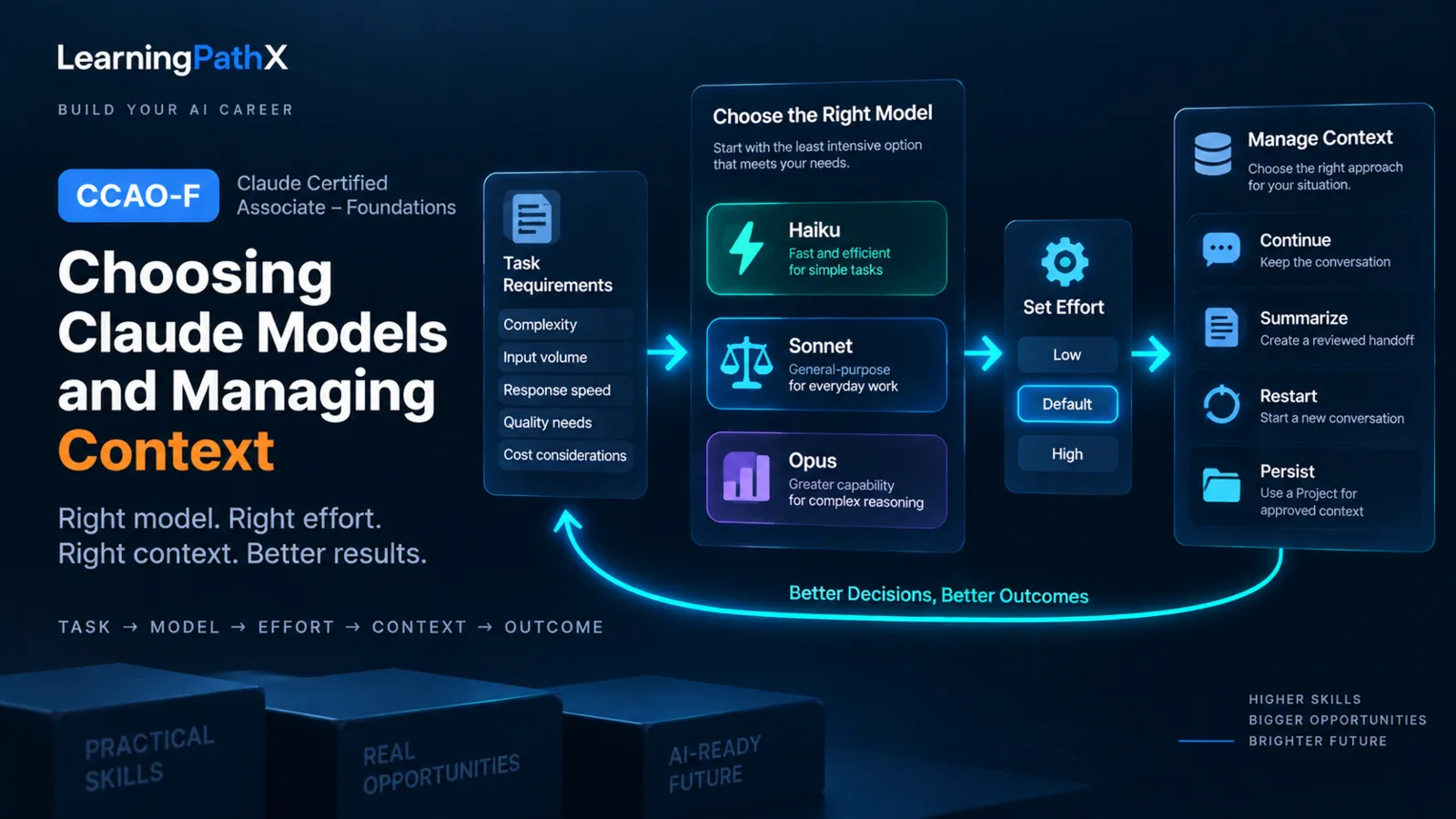
Choose a Claude model and effort setting from the task inward. Start with the least intensive current option that is likely to meet the task's acceptance criteria: Haiku for simple, speed-sensitive work; Sonnet as the general-purpose starting point for everyday writing and analysis; and Opus when genuinely complex reasoning or multi-step work justifies greater consumption and latency. Then set effort separately, beginning with the model's documented default and increasing it only when the task benefits from more thorough reasoning. Model names, settings, and access can change, so the live model menu, organization controls, and current Anthropic documentation must govern the final choice.
Manage context as a separate decision. Continue when the conversation remains focused and its history is useful; summarize into a reviewed handoff when the same objective must continue with less accumulated history; restart when the objective or controlling assumptions change; and persist only approved reusable background through a governed mechanism such as a Project. These choices balance complexity, cost, speed, quality, and context pressure, but none of them replaces output validation or accountable human review.
Make the Decision in Four Passes
A model-context decision has four passes:
- Classify the task: Identify its complexity, ambiguity, number of dependent steps, input volume, response urgency, and consequence of error.
- Choose the model family: Select the lowest-intensity current family that plausibly satisfies those requirements.
- Set effort and thinking: Decide how much additional reasoning time is useful for this response instead of treating the model name as the only quality lever.
- Plan the context: Decide whether to continue, summarize, restart, or use an already approved persistence layer.
Keep the acceptance criteria visible throughout. A model is suitable only when its result can be checked against the task's requirements and risk threshold. Importance alone does not justify more effort: a high-impact but simple fact still needs authoritative verification, while a low-risk planning problem may benefit from deeper reasoning because of its structure.
This framework begins after the working surface and product capabilities have been selected. The product and capability decision framework owns choices such as chat, Projects, Artifacts, web search, research, and Skills.
Choose a Model Family from Task Complexity
Anthropic's current Enterprise consumption guide positions the three CCAO-F model families along a qualitative task-and-consumption spectrum. That guidance supports a routing decision, not a fixed performance benchmark.
| Task signal | Starting family | Decision rationale |
|---|---|---|
| Direct lookup, straightforward summary, simple extraction, or lightweight transformation | Haiku | Prioritizes fast responses and lower token intensity for bounded work. |
| Everyday drafting, analysis, question answering, or work with several ordinary constraints | Sonnet | Provides the general-purpose balance of capability, speed, and consumption. |
| Complex reasoning, research synthesis, or difficult multi-step work with interacting constraints | Opus | Accepts higher token intensity when additional capability is material to the outcome. |
These are starting positions rather than guarantees. Task content, input length, instructions, settings, and current model versions all affect the result. Do not claim that one family is always faster, cheaper, or more accurate by a fixed amount. Test the selected family against the task's actual acceptance criteria and retain the required review control.
Current Anthropic guidance also lists Claude Fable for long-running agentic coding or reasoning work. That prevents the live catalog from being reduced to a permanent three-option list, but those development-oriented workloads are outside this Foundations article's professional knowledge-work boundary. Recheck the current guide instead of expanding CCAO-F into API deployment or agent engineering.
Set Effort and Thinking Separately
Model family answers “which capability range fits?” Effort answers “how much work should this model apply to this response?” Anthropic's current model, effort, and thinking guidance treats model, effort, and extended thinking as distinct controls and notes that higher effort takes longer and uses more tokens.
Use the current interface labels rather than assuming every model exposes the same controls:
- Begin with the level marked as the model's default for ordinary work.
- Use a lower setting for routine, well-specified tasks when it still meets the acceptance criteria.
- Increase effort for detailed analysis, comprehensive planning, or multi-step problems whose dependencies benefit from greater thoroughness.
- Reserve the most intensive settings for the rare tasks that justify their latency and consumption.
- Consider extended thinking separately when visible and approved; do not infer that enabling it automatically changes the effort level.
Some current settings are intended primarily for long-running coding or agentic tasks. Their presence in a menu does not make them the right choice for ordinary CCAO-F knowledge work. Availability can also differ by model and organization role, and an administrator may disable a model or effort level. Verify what is available in the user's approved environment instead of publishing an entitlement matrix.
Higher effort can improve thoroughness, but it does not establish truth. It cannot update a model's training data, guarantee that a source is authoritative, or transfer accountability from the professional using the result. The validation and human-review threshold remains the same or becomes stricter as the consequence of error rises.
Manage Context Without Inventing Memory Behavior
Context is the working material available for the current response: the request, conversation history, supplied content, and any context provided by approved capabilities. It is finite, and more history is not automatically better. Anthropic's consumption guidance notes that chat token use scales with message length and conversation history, while its Projects documentation explicitly describes project knowledge approaching context limits.
Choose among four context actions:
| Context condition | Action | What the user must preserve or check |
|---|---|---|
| Same objective, relevant history, no material stale assumptions | Continue | Keep the controlling requirements and unresolved decisions explicit. |
| Same objective, but the useful state is buried in accumulated history | Summarize | Create a concise, reviewed handoff containing the objective, authoritative inputs, constraints, decisions, open questions, and acceptance criteria. |
| Objective, audience, source set, or controlling assumptions changed materially | Restart | Begin a focused conversation and supply only the verified context required for the new objective. |
| Reusable approved background is needed across related work | Persist | Use an organization-approved persistence layer and assign ownership, freshness, permissions, and maintenance outside this article's model-choice step. |
A summary is not automatic memory. It is a new input whose omissions and wording must be checked before it becomes the basis for later work. A restart also does not make a task correct by itself; it removes irrelevant history only when the user supplies the necessary current facts and constraints again.
Projects can provide reusable knowledge and instructions across focused chats, but this article does not configure them. Project knowledge curation, instruction precedence, retrieval behavior, permissions, testing, and maintenance belong to CCAO-F: Configuring Claude Projects, Instructions, and Knowledge. Here, persistence is only one possible context decision after the responsible owner has approved that layer.
Do not hard-code a universal token threshold for restarting or summarizing. Exact limits and behavior vary by model, plan, surface, and time. Use observable task conditions—lost requirements, repeated corrections, irrelevant history, conflicting assumptions, or an input set that no longer fits the working objective—then consult the current documentation and approved environment.
Separate Context from Information Currency
A fresh conversation can reduce stale conversational assumptions, but it does not move a model's training-data cutoff. Anthropic publishes a current model-specific knowledge-cutoff list and warns that models may not know events after their respective cutoffs.
Treat the published cutoff as a warning boundary, not proof that an earlier fact is present or accurate. If the task depends on changing information, identify the authoritative current evidence required by the work and verify it through capabilities already approved for that task. Do not select the capability here, because CCAO-F: Choosing Claude Products and Capabilities for Work owns that choice. Regardless of the model, important claims still need source inspection and risk-appropriate human review.
This distinction prevents three common errors:
- Adding more conversation history does not make training data newer.
- Increasing effort does not supply missing current evidence.
- Persisting a source does not prove that the source remains authoritative or fresh.
Apply the Framework to Typical Knowledge Work
Routine transformation
Suppose a user must turn an approved meeting transcript into a short action list using a fixed format. The task is bounded, the source is supplied, and the transformation has clear acceptance criteria. Haiku is a reasonable family to evaluate first. If the selected model exposes an effort control in the current environment, begin with its documented default and consider a lower setting only if the result continues to meet those criteria. Continue in the same conversation while the objective remains stable; restart if the chat has mixed in unrelated work.
The user still checks names, dates, owners, and omitted actions against the transcript. Lower intensity is justified by task structure, not permission to lower the acceptance standard.
Everyday analysis with several constraints
Consider comparing three supplied proposals against an approved rubric and drafting a recommendation for review. Sonnet is the general-purpose starting family because the task combines reading, comparison, and writing without necessarily requiring the most intensive reasoning option. Begin at the documented default effort; increase it only if the proposal interactions and tradeoffs are genuinely complex.
If the discussion becomes long, summarize the reviewed rubric, evidence, tentative judgments, and unresolved questions before continuing. Do not let a compressed handoff silently turn tentative claims into accepted facts.
Complex multi-step reasoning
For a difficult scenario plan with interacting constraints, competing assumptions, and several dependent stages, Opus may justify its higher consumption. A higher effort setting may also be appropriate when deeper analysis is material to the result. Keep the context focused on the current objective, record assumptions explicitly, and restart from a reviewed handoff if the scenario or controlling constraints change.
Greater capability and effort do not approve the plan. A qualified person must inspect the reasoning, evidence, constraints, and consequences before action.
Common Model and Context Selection Mistakes
- Defaulting to the most intensive model and effort setting without classifying the task
- Choosing a lightweight family only for speed when the task has complex dependencies
- Treating family descriptions as fixed benchmarks or guaranteed performance
- Assuming every user, role, plan, or surface exposes the same models and effort controls
- Confusing effort with extended thinking or assuming every model implements both identically
- Raising effort to compensate for missing current evidence
- Carrying a mixed-topic conversation forward when the objective has changed
- Summarizing without checking that requirements, sources, decisions, and uncertainty survived
- Treating a Project or another persistence layer as automatic, unlimited, or self-maintaining memory
- Pulling product-surface choice, Project configuration, or workflow optimization into the model-selection decision
- Treating a stronger model as a substitute for validation and accountable human review
Certification Relevance
For Claude Certified Associate – Foundations (CCAO-F), model and context selection means explaining why the task's complexity, quality threshold, urgency, consumption sensitivity, and context state support a particular current choice. Practice with the same bounded workplace task at three complexity levels and state which family, effort approach, and context action you would start with—then explain what evidence would make you change that decision.
Keep the boundaries clear. CCAO-F: Choosing Claude Products and Capabilities for Work selects the product surface and capabilities before this decision. CCAO-F: Configuring Claude Projects, Instructions, and Knowledge owns persistent Project instructions and knowledge. CCAO-F: Optimizing Claude Workflows for Efficiency and Effectiveness measures and improves an established workflow after deployment. This article owns the point-in-time choice of model family, effort, thinking, and context action for the task at hand.
Conclusion
Choose Claude models and manage context with a current-docs-first, task-inward framework. Use Haiku for bounded lightweight work, Sonnet as the general-purpose starting family, and Opus when genuinely complex reasoning justifies greater consumption; treat specialized current families as living-catalog options rather than expanding the CCAO-F scope. Set effort separately, start from the documented default, and increase it only for work that benefits from greater thoroughness. Continue, summarize, restart, or persist context according to the objective and state of the working material, and never use model strength, effort, or persistence as a substitute for current evidence, validation, or human accountability.
Authoritative Sources
- Change the model, effort, and thinking settings
- Claude Enterprise consumption guide
- How up-to-date is Claude's training data?
- What are projects?