
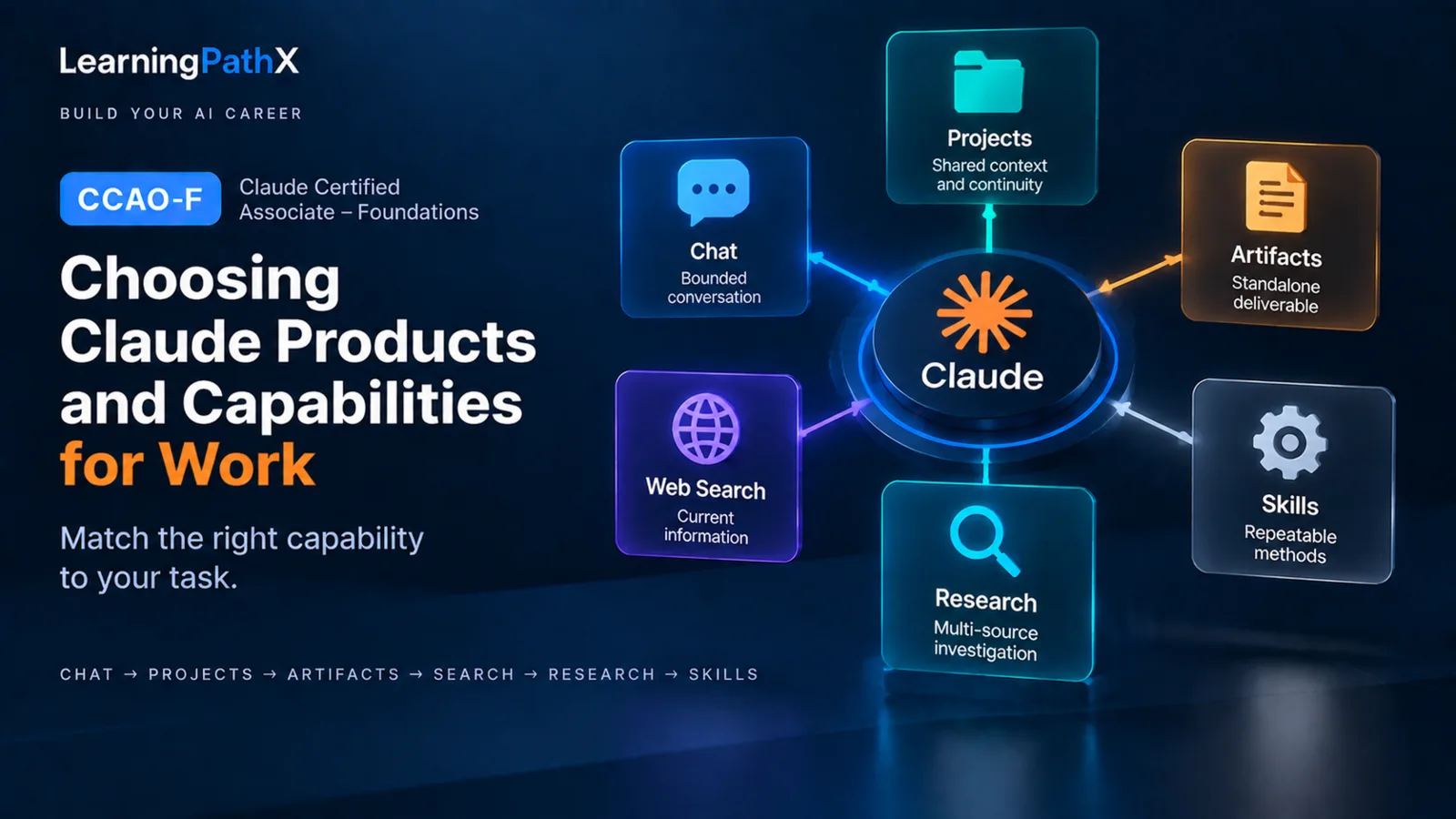
A knowledge worker should choose Claude products and capabilities from the task inward. Use chat for a bounded conversation, a Project when related conversations need shared background and continuity, an Artifact when the deliverable should stand alone for editing or reuse, web search for a current and relatively focused fact-finding need, research for a broader multi-source investigation, and a Skill when the task should follow a specialized repeatable method.
These choices are layers, not a permanent entitlement matrix or six mutually exclusive products. A task may begin in a chat, use a Project for its working context, add web search or research for current evidence, apply a Skill for a repeatable method, and produce an Artifact. Define what the task needs first, choose only the layers that satisfy those needs, and then confirm that the selected capabilities are available and approved in the user's current environment.
Select Capabilities from Four Task Requirements
Separate the decision into four requirements so a visible feature does not become the architecture by default:
- Working surface: Is this one bounded conversation, or do related conversations need shared background and continuity?
- Information source: Is supplied information enough, does the task need a focused current-web check, or does it need broad investigation across multiple sources?
- Task method: Can the user describe the method in the request, or should Claude apply a specialized procedure repeatedly?
- Deliverable form: Is a conversational response sufficient, or should the result become a substantial standalone item?
The following matrix gives a first routing decision. A task can produce more than one “yes,” in which case the selected capabilities should have distinct responsibilities.
| Task requirement | First choice | Selection judgment |
|---|---|---|
| One bounded question, draft, comparison, or exploration | Chat | Keep the work conversational when the necessary material and instructions can be supplied for that task. |
| Related conversations need shared background or a common workspace | Project | Use a Project for continuity across focused chats; leave configuration and knowledge maintenance to the Project-specific design step. |
| The answer depends on recent or changing public information | Web search | Use web search when a focused search can ground the response in current sources with citations. |
| The question requires a broader, multi-source investigation and synthesis | Research | Use research when the work is an investigation rather than a straightforward lookup. |
| A specialized procedure should be applied consistently when relevant | Skill | Use a Skill for reusable task instructions, scripts, and resources, subject to trust and environment controls. |
| The output should stand alone for substantial editing, iteration, or reuse | Artifact | Use an Artifact as the deliverable surface rather than leaving a substantial item only inside the conversation. |
Use Chat as the Bounded Default
As a practical default, use a chat when the task is self-contained and its necessary inputs can be supplied directly. Examples include comparing two provided proposals, drafting a response from an approved brief, or exploring several names for an internal program. The conversation keeps instructions, questions, intermediate reasoning, and revisions close together without adding a persistent workspace or specialized capability that the task does not need.
Chat is also the interaction layer for many compound selections. Adding web search does not eliminate the chat; it changes how the response gets current evidence. Requesting an Artifact does not eliminate the conversation; it gives a substantial output a separate working surface. The relevant question is therefore not “chat or everything else?” but “which additional responsibilities, if any, must be added to this chat?”
Move beyond a standalone chat when the task signals a durable requirement: recurring background, multiple related conversations, current external evidence, broad research, a repeatable specialized method, or a standalone deliverable. Do not add a capability solely because it is visible in the interface.
Choose a Project for Shared Background and Continuity
Use a Project when several related conversations should operate within the same body of background material. Anthropic describes Projects as self-contained workspaces with their own chat histories and knowledge bases; they can also include project instructions and support collaboration where sharing controls are available.
That makes a Project a strong selection for recurring work such as a communications program that uses the same approved terminology, a client engagement that relies on a defined source set, or a team initiative that needs several focused chats around one body of knowledge. It is a weaker fit for a one-time question whose few inputs can be provided directly.
This selection decision does not configure the Project. Source ownership, project instructions, knowledge curation, retrieval behavior, freshness, testing, and maintenance belong to the Project configuration deep dive. At this stage, decide only whether shared background and continuity are genuine task requirements.
Choose Web Search or Research by Evidence Breadth
Use web search when the answer depends on current public information and the search is relatively focused. Anthropic's capability-selection guidance positions web search for straightforward factual queries and research for comprehensive information gathering and synthesis across multiple sources.
Web search grounds responses in live-web content and provides citations and source links. It fits questions such as confirming a current policy date, locating a recent announcement, or checking a small set of current facts. Citations make inspection possible; they do not remove the reader's responsibility to open important sources, assess their authority, and cross-check material claims.
Choose research when the output depends on discovering, comparing, and synthesizing a broader evidence set. A market landscape, a multi-source policy brief, or an investigation of several competing explanations is not merely a longer web lookup. Define the research question, source criteria, exclusions, and desired evidence form before starting so the investigation remains bounded.
Do not add search when the task is controlled by supplied or approved internal material and currency is not a requirement. Conversely, do not ask Claude to answer a time-sensitive question from general knowledge when current sources control the result. Connector-based access to external services is a separate permissions and data-access decision covered in the connector deep dive.
Add a Skill for a Repeatable Specialized Method
Choose a Skill when the important requirement is not persistent background or current evidence but a specialized way of performing the task. Anthropic defines Skills as folders of instructions, scripts, and resources that Claude loads dynamically when relevant. Examples include applying an organization's document conventions, following a defined analysis workflow, or producing a recurring deliverable with a specific structure.
This creates a useful distinction:
- A Project supplies shared background for related conversations.
- A Skill supplies a reusable procedure for a specialized task.
- Web search or research supplies current external evidence.
- An Artifact supplies a standalone deliverable surface.
These responsibilities can be combined without being conflated. For example, a Skill may define how to produce an approved brief while a Project supplies the brief's recurring background sources. The Skill should not become an unofficial store for changing task facts, and the Project should not be expected to encode every reusable procedure.
Selection also requires a trust check. Anthropic's Skills usage guidance notes that Skills can contain or install third-party packages and identifies prompt injection and data exfiltration as significant risks. Use only permitted Skills from trusted sources, inspect less-trusted contents and dependencies before enabling them, and confirm that required capabilities are enabled in the current environment. Detailed administration and sharing settings can change, so they should be verified rather than embedded in a permanent access chart.
Choose an Artifact for a Standalone Deliverable
Use an Artifact when the result is substantial, self-contained, and likely to be edited, iterated on, reused, or referenced outside the immediate exchange. Anthropic's Artifacts guidance describes a dedicated window separate from the main conversation for standalone content such as documents, code, diagrams, and interactive components.
An Artifact changes the deliverable surface, not the truth standard. A polished dashboard, document, or interactive item still requires the same validation as an inline response. Confirm the applicable enablement and sharing conditions in the current environment before making an Artifact part of a team's standard process, because those controls and capabilities are plan- and setting-sensitive.
Choose an inline chat response when the result supports an immediate explanation or decision and does not need separate maintenance. Choose an Artifact when separation improves editing, navigation, reuse, or handoff. The earlier output-refinement procedure explains how to preserve validated meaning while adapting content for an audience and delivery format; this article decides how that deliverable fits with the rest of the Claude capability architecture.
Combine Capabilities with One Responsibility Each
Consider a recurring quarterly supplier brief. Work inward from the requirements:
- Several related conversations need the same approved background, so select a Project.
- The brief depends on a small number of current public facts, so add web search; use research instead only if the question expands into a broad multi-source investigation.
- The organization has an approved repeatable review-and-formatting method, so apply a trusted Skill.
- The final brief must stand alone for editing and handoff, so produce an Artifact.
- Keep chat as the conversational control surface through which the user supplies the specific quarter's task, questions the evidence, and requests revisions.
Each choice answers a different requirement. If the task becomes a one-time summary of supplied documents, the Project, search, and Skill may all be unnecessary. If the deliverable is a short decision note, an inline response may be more usable than an Artifact. The smallest sufficient combination is usually easier to explain, verify, and maintain.
Recheck Conditions Instead of Freezing Entitlements
Product access varies by plan, location, organization settings, surface, and time. A durable selection framework should therefore preserve task criteria and treat current availability as an input to verify.
Before standardizing a selection, confirm:
- the capability is present and enabled in the approved environment;
- its documented behavior still fits the task requirement;
- any sharing, code execution, or organization controls are understood by the responsible owner;
- trusted information sources and review expectations remain explicit;
- the fallback still produces an acceptable result if that capability is unavailable.
This check prevents a current interface snapshot from becoming a permanent entitlement claim. It also separates capability selection from the later model, Project-configuration, and connector-authorization decisions that require their own evidence and owners.
Common Capability-Selection Mistakes
- Starting with the most visible feature instead of the task requirement
- Treating chat, Projects, search, research, Skills, and Artifacts as mutually exclusive products
- Using a long ad hoc chat when several related conversations need shared background
- Choosing research for a focused current fact that web search can address
- Using web search when supplied authoritative material should control the answer
- Expecting a Project to replace a reusable procedure, or a Skill to replace maintained source material
- Treating an Artifact's presentation quality as evidence that its claims are correct
- Enabling a Skill without reviewing its source, bundled resources, or dependencies
- Publishing a fixed access chart that becomes inaccurate when plans or settings change
- Pulling model, effort, context, cost, speed, or quality tradeoffs into the capability decision
Certification Relevance
For Claude Certified Associate – Foundations (CCAO-F), product and capability selection means recognizing the task characteristics that justify a surface or feature. Practice by taking one workplace task and explaining the role of every selected capability: working surface, evidence source, reusable method, and deliverable form. Remove any capability whose responsibility cannot be stated clearly.
This is product-selection knowledge, not a catalog memorization exercise. After choosing the surface and capabilities, continue to the separate model and context decision framework. Project setup and connector permissions remain distinct deep dives so the selection layer does not hide configuration or authorization decisions.
Conclusion
Choose Claude products and capabilities by matching them to explicit task requirements. Begin with chat for bounded work, select a Project for shared background and continuity, add web search for focused current information or research for broader multi-source investigation, use a trusted Skill for a repeatable specialized method, and choose an Artifact when the output should stand alone. Combine them only when each capability owns a distinct responsibility, and recheck current availability rather than freezing today's plan and settings into a permanent matrix.
Authoritative Sources
- What are projects?
- What are artifacts and how do I use them?
- When should I use web search, extended thinking, and research?
- Enable and use web search
- What are skills?
- Use skills in Claude