
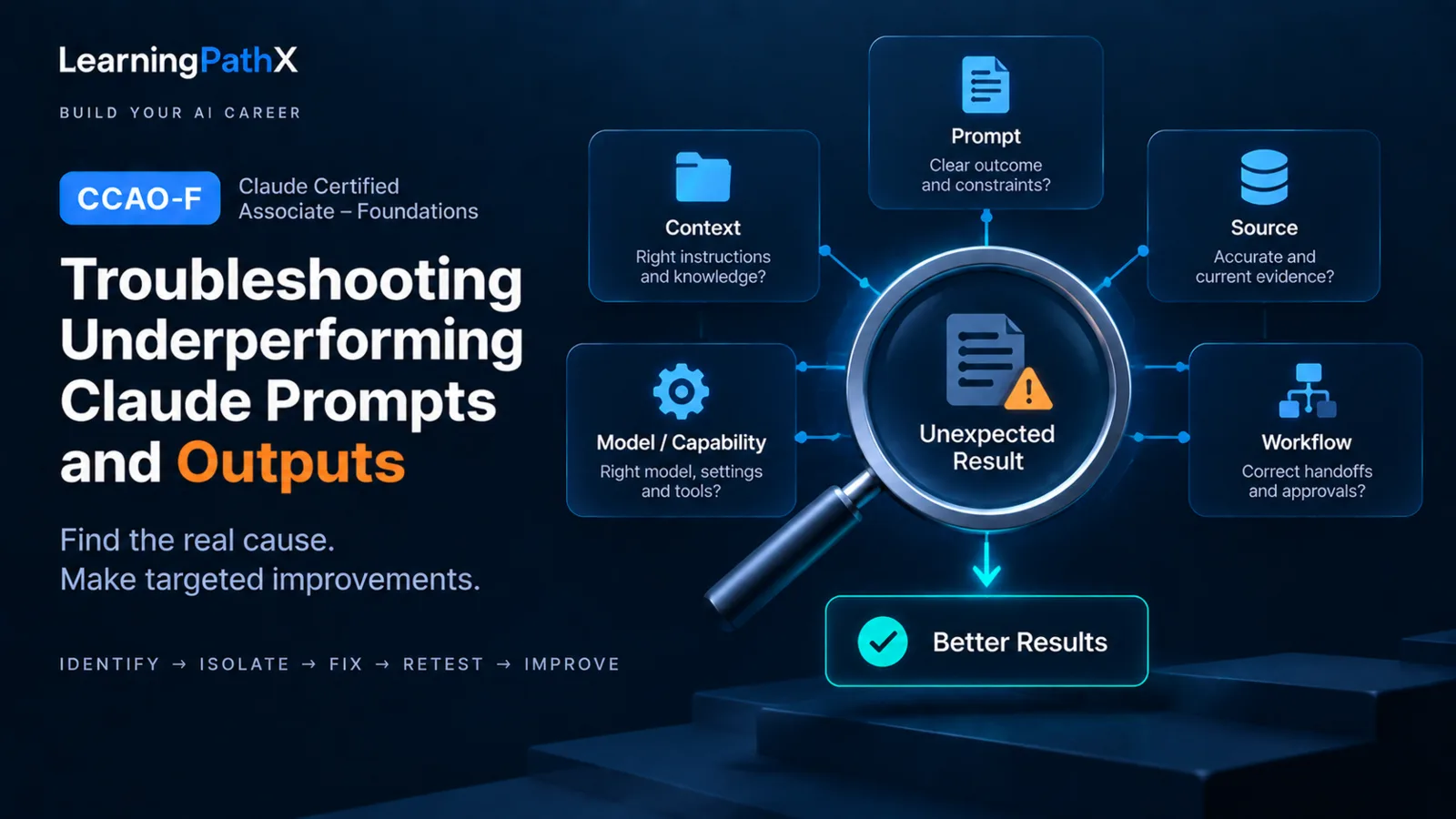
Diagnose an underperforming Claude result by starting from the observable symptom and testing five possible layers: prompt, context, source, model or capability, and workflow. State the expected and actual result, select the earliest layer supported by the evidence, change the smallest relevant variable, and retest the same case against unchanged acceptance criteria. Escalate instead of guessing when the required evidence, access, feature, subject expertise, or decision authority is unavailable.
A symptom does not identify its cause by itself. A brief response may reflect an underspecified coverage requirement, missing context, or a handoff that discarded part of the request. An incorrect current claim may reflect weak source evidence or the absence of an appropriate current-information capability. The diagnostic goal is therefore not to rewrite everything or immediately choose a more intensive model. It is to isolate the smallest plausible failing layer and learn whether one controlled correction changes the result.
The Symptom-to-Layer Troubleshooting Method
Begin with a reproducible case. Record the prompt, necessary conversation or Project context, named sources, selected model and settings, enabled capabilities, workflow stage, expected result, and actual result. Use approved or synthetic data in the diagnostic record and omit secrets that the troubleshooting environment is not authorized to hold.
Then use this sequence:
- Describe one observable symptom. Replace “the answer is bad” with a checkable difference, such as a missing section, a claim unsupported by its citation, a named document not used, an unavailable connector action, or a downstream format rejection.
- Choose the first plausible layer. Follow the evidence in the table below. Start with the prompt only when the symptom points there; do not force every failure into prompt wording.
- Apply one smallest-variable correction. Preserve every condition that is not part of the hypothesis. This makes the retest informative.
- Retest the original case. Use the same acceptance criteria and compare the relevant before-and-after evidence.
- Stop, continue, or escalate. Stop when the criterion passes. If it does not, revert an unhelpful experiment when appropriate and test the next evidence-supported layer. Escalate when the next test requires authority or information the user does not have.
| Layer | Observable signals | Small confirming test | Smallest-variable correction | Escalate when |
|---|---|---|---|---|
| Prompt | The response misses a stated audience, format, constraint, success criterion, or task step; a broad request receives a generic or too-brief answer | Compare the prompt with a short requirements checklist and identify the first requirement that was absent or ambiguous in the request | Add only the missing outcome, constraint, coverage item, or decomposition boundary | The requirement owner cannot resolve conflicting goals or define an acceptable result |
| Context | The response follows irrelevant earlier instructions, ignores a named item in project knowledge, or changes after unrelated conversation history is removed | Retry in a fresh chat with only the necessary approved context, or ask a narrow question whose answer is explicit in one named Project source | Remove the conflicting history, provide the one missing approved item, or name the relevant document or passage | The controlling instruction, source version, or Project configuration cannot be inspected or changed by the user |
| Source | A material claim is unsupported, stale, contradicted, or not actually established by its citation | Open the original source and compare the claim with its date, version, scope, and qualifications | Replace one weak source, constrain the answer to named authoritative evidence, or allow an “insufficient evidence” outcome | Authoritative sources conflict, evidence is inaccessible, or the decision needs qualified high-impact review |
| Model or capability | The task needs more complex reasoning, current web information, or permitted external-service data or actions; a setting or tool is unavailable; the direct source service and Claude show different access | Keep prompt, context, and source constant while changing one eligible model or effort setting, enabling one approved capability, or checking the connected identity's direct source access | Change one model or effort control, use web search for a current-information need, or select one already approved connector capability that fits the task | The required model, setting, capability, organization approval, source permission, or supported action is unavailable |
| Workflow | A response passes in isolation but fails after a handoff; a requirement, source, approval, or output field disappears between stages | Freeze the upstream input and compare the handoff artifact with the next stage's required inputs and acceptance criteria | Restore the one missing field, source reference, owner, or approval checkpoint, then rerun only the failing stage | No owner can authorize the correction, the task is unsuitable for delegation, or the residual risk exceeds the workflow's review authority |
The layers interact, but a controlled test keeps them distinguishable. For example, adding a current source and changing the model in the same retry may improve the answer without showing whether the source, the model, or both mattered.
Diagnose Common Symptoms
The response is incomplete or too brief
Treat missing coverage as a prompt-layer signal first when the required sections or depth were never stated. Anthropic's prompt-design guidance explains that Claude needs specific instructions because it does not begin with context about the user, task, or organization. The smallest correction is to add the missing coverage criterion, not to replace every part of the prompt.
If a useful response stops before the requested work is complete, preserve the evidence from that exchange. Anthropic's brief-response guidance recommends retooling the prompt and supplying the prior prompt and response when asking Claude to continue. Retest whether the previously missing section is now present. If the user cannot define how much coverage is enough, escalate to the person who owns the deliverable rather than repeatedly asking for “more detail.”
A claim is incorrect, misleading, or weakly cited
Start at the source layer when a factual claim is the symptom. Anthropic notes that Claude can produce plausible but incorrect or misleading statements, sometimes called hallucinations, and advises users not to treat Claude as a singular source of truth. Its accuracy guidance also says to inspect cited original sources because they may contain context omitted or misinterpreted in a synthesis.
Open the cited source and check whether it supports the exact claim, version, date, and qualification. The smallest correction may be to replace one unsupported claim, supply one controlling source, or instruct Claude to report insufficient evidence. If the fact is time-sensitive and the approved environment provides it, web search can ground a response in live-web sources and citations; the user must still open and evaluate those sources. Conflicting authoritative evidence or high-stakes advice requires qualified human review, not another unsupported generation.
Project knowledge is missing from the answer
Separate availability from retrieval. Anthropic describes Projects as self-contained workspaces with their own chat histories, instructions, and knowledge bases. When project knowledge approaches context limits, retrieval-augmented generation (RAG) can retrieve relevant portions through a project knowledge search tool. A file's presence therefore does not prove that its controlling passage informed a particular response.
Use a narrow test whose answer appears explicitly in one named, current document. If Claude finds that passage, inspect competing instructions, stale duplicates, unrelated conversation history, or an overbroad original query. If it does not, name the document or relevant passage for the retest. Durable knowledge curation and instruction maintenance belong to the Project configuration process; escalate when the user cannot inspect the Project or determine which source is authoritative.
The selected model or capability does not fit the task
Suspect the model or capability layer only after the prompt, required context, and source evidence are adequate. Anthropic's current model, effort, and thinking guidance treats these as separate controls and states that a change takes effect on the next response. Keep the case fixed and change only one eligible control. A more intensive setting cannot repair a missing source, an ambiguous requirement, or an unauthorized action.
For current information, test an approved web-search path rather than expecting model knowledge alone to establish a current fact. For external-service data or actions, inspect the capability and access boundary instead of rewriting the task prompt. Anthropic documents that connectors inherit each person's permissions from the connected service and expose connector-specific supported actions. Verify that the connected identity can access the item directly and capture the exact connector error or missing action. Escalate to the appropriate owner when authentication, organization enablement, source permission, or the required supported tool is absent; do not broaden access to make the test pass.
A good response fails after a workflow handoff
Treat a successful isolated response followed by a downstream failure as a workflow-layer signal. Compare the accepted response with the exact handoff artifact: required fields, source references, constraints, approvals, and ownership. Locate the earliest stage where necessary information disappears or changes meaning.
Correct only that boundary and rerun the failing stage. Do not redesign the whole workflow while diagnosing one result. If the next stage requires a decision no assigned person is authorized to make, or if the handoff would delegate an unsuitable high-impact judgment, stop and escalate with the expected result, actual result, missing authority, and remaining uncertainty.
Controlled Retesting and Escalation
A retest is valid only when it can answer the current diagnostic question. Preserve the original failing example, acceptance criteria, and all unaffected conditions. Record the single changed variable and the resulting evidence. If the criterion still fails, the experiment has narrowed the diagnosis even when it did not fix the output.
Use this stop rule:
- Pass: The same case now meets the unchanged acceptance criterion, and the correction does not introduce an obvious new defect in the checked result.
- Continue: The criterion still fails, but the test rules out or weakens one hypothesis. Move to the next evidence-supported layer.
- Escalate: The next test needs unavailable evidence, permission, configuration access, subject expertise, policy judgment, or approval authority.
An escalation package should be small and reproducible: expected versus actual result, the exact non-sensitive inputs and settings, the observable symptom, variables already tested, relevant source or error evidence, and the decision or access needed. This gives the receiving owner a diagnosis to continue instead of an unstructured complaint.
Common Troubleshooting Mistakes
- Rewriting the entire prompt before identifying which requirement is missing
- Changing the prompt, model, sources, and Project context in one retry
- Selecting a more intensive model to compensate for absent or unreliable evidence
- Adding more Project files when the real problem is conflicting source authority
- Accepting a web-search citation without opening the original source
- Treating a connector permission or unsupported-action error as a wording problem
- Broadening connector access solely to make a diagnostic test succeed
- Replacing a defined acceptance criterion with a vague request for a “better” answer
- Turning one-result troubleshooting into proactive benchmarking or established-workflow optimization, which belongs to CCAO-F: Optimizing Claude Workflows for Efficiency and Effectiveness
Certification Relevance
For Claude Certified Associate – Foundations (CCAO-F), this method applies D7.1 issue diagnosis and resolution and D7.2 adjustment based on feedback and results. It also uses D1.3 prompt iteration and D3.4 context-limit judgment as supporting skills. The focus is corrective: isolate why one result is weak, make one justified change, and retest. Designing full prompts, validating an accepted output, selecting a model architecture, maintaining Project knowledge, and authorizing connectors remain owned by their dedicated articles.
A useful original practice exercise is to create a weak result with synthetic or approved content, define one observable acceptance failure, and diagnose it through the five layers. Record the first evidence-supported layer, one-variable correction, retest result, and escalation condition. The exercise should assess the troubleshooting method rather than imitate or reconstruct an exam item.
Conclusion
Reliable troubleshooting starts with the symptom, not a preferred fix. Map the evidence to the prompt, context, source, model or capability, or workflow layer; change the smallest plausible variable; and retest the same case against the same criterion. Stop when the result passes, continue when a controlled test narrows the cause, and escalate when evidence, access, expertise, or authority is missing.
Authoritative Sources
- Introduction to prompt design
- Claude's response to my prompt is too brief
- Claude is providing incorrect or misleading responses
- Change the model, effort, and thinking settings
- What are projects?
- Retrieval augmented generation (RAG) for projects
- Enable and use web search
- Use connectors to extend Claude's capabilities
Related Reading
- CCAO-F: Claude Connectors, Permissions, and Data Access
- CCAO-F: Optimizing Claude Workflows for Efficiency and Effectiveness
- CCAO-F: Prompting and Task Execution with Claude
- CCAO-F: Evaluating and Validating Claude Outputs
- CCAO-F: Choosing Claude Models and Managing Context
- CCAO-F: Configuring Claude Projects, Instructions, and Knowledge