
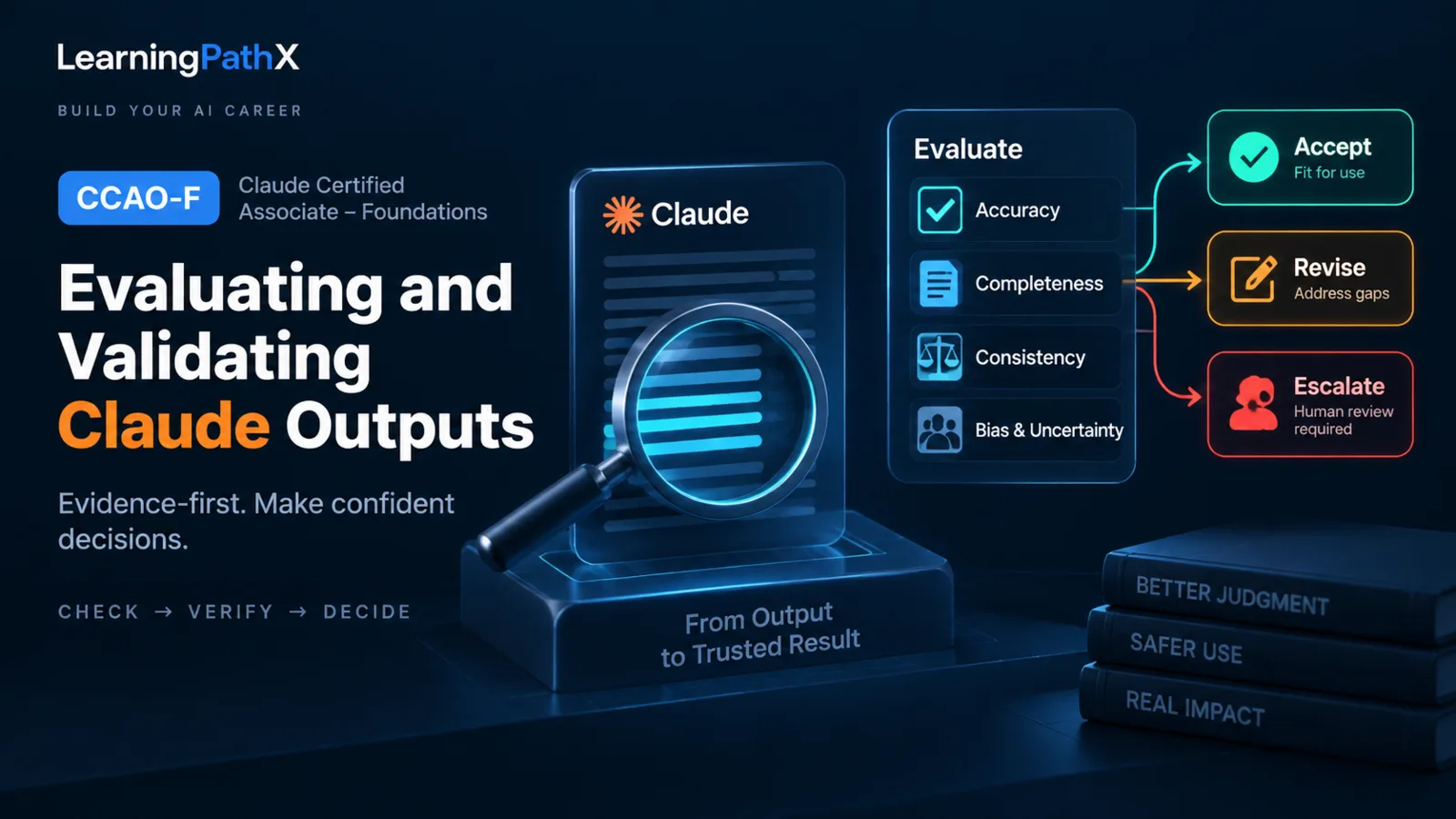
A knowledge worker should validate a Claude output with a risk-proportionate, evidence-first procedure: define what the output must establish, check it against the request, isolate every material claim, verify those claims in current authoritative sources, inspect inconsistencies and bias, and then accept, hold, revise, or escalate the output. Authoritative fact-checking is required whenever a claim materially affects the intended use; qualified human review is required when the consequences, subject matter, conflicting evidence, or unresolved uncertainty exceed the user's authority or expertise.
This separation between generation and acceptance matters because fluent prose is not proof. Anthropic explains that Claude can produce plausible but incorrect or misleading statements, often called a hallucination. Anthropic also advises users not to treat Claude as a single source of truth or to accept high-stakes advice without careful scrutiny. The following procedure determines whether a current output is acceptable; it does not refine that output for an audience, set organization-wide governance, or diagnose the root cause of a weak response.
What Claude Output Validation Must Establish
Validation asks whether the output is fit to rely on, not whether it sounds polished. Four questions control that judgment:
| Validation dimension | Acceptance question | Evidence of failure |
|---|---|---|
| Accuracy | Are material facts and source interpretations correct? | A claim conflicts with the original source, invents a detail, or exceeds the evidence. |
| Completeness | Does the output address every required element and limitation? | A requirement, exception, dependency, or unresolved item is missing. |
| Consistency | Do claims, dates, quantities, terms, and conclusions agree? | Different sections cannot all be true or the conclusion does not follow from the stated evidence. |
| Bias and uncertainty | Does the output preserve relevant perspectives, limits, and uncertainty? | It presents an assumption as universal, omits a materially affected perspective, or states a qualified result as certain. |
These dimensions are independent. An answer can be accurate but incomplete, fully structured but internally inconsistent, or supported by sources that do not justify its conclusion. Passing one check never compensates for failing another.
Step 1: Define the Intended Use and Validation Threshold
Start by recording how the output will be used and what would happen if it were wrong. This is an output-level review decision, not a substitute for the organization's broader policies.
Use three practical questions:
- What action or decision depends on this output? A private idea list and a customer commitment do not need the same evidence.
- How harmful or difficult to reverse would an error be? Greater consequence or lower reversibility calls for stronger evidence and review.
- Who has the authority and expertise to approve the result? The person using an output may not be qualified to validate legal, medical, financial, security, safety, personnel, or other specialist conclusions.
Set the threshold before inspecting the prose. A low-impact draft may need a requirements and consistency check. A material external claim needs authoritative fact-checking. A high-impact judgment needs both authoritative evidence and review by someone qualified for that domain and accountable for the decision. Anthropic's guidance is explicit that users should carefully scrutinize high-stakes advice rather than rely on Claude alone.
Step 2: Check the Output Against the Request
Convert the original request into a short acceptance checklist. Include the required outcome, allowed evidence, constraints, exclusions, and any questions that the output was expected to resolve. Then mark each item:
- Present and supported: The output addresses the requirement and the permitted evidence supports it.
- Present but unsupported: The output makes the requested statement, but the available evidence does not establish it.
- Missing: The output omits the requirement.
- Not applicable: The requirement does not apply, with a recorded reason.
This check distinguishes completeness from plausibility. A polished report can omit a required limitation. It also separates a missing passage from missing evidence: revision can restore information that exists in an approved source, but it cannot turn an unsupported assumption into a fact.
Stay focused on acceptance. Whether a validated result should later be shortened, reordered, compared with another draft, or delivered inline, as structured data, or as an Artifact belongs to Refining Claude Outputs for Audience and Delivery Format.
Step 3: Extract Material Claims Before Fact-Checking
A material claim is one that could change the output's use, interpretation, or resulting decision. Extract these claims before checking sources so polished transitions do not hide unsupported precision.
Look for:
- names, dates, quantities, deadlines, prices, and version statements;
- quotations and attributed positions;
- requirements, prohibitions, permissions, and eligibility claims;
- comparisons, causal statements, and recommendations presented as evidence-based;
- claims about current events or facts that may postdate the selected model's knowledge cutoff.
Claude models have model-specific knowledge cutoffs, and Anthropic warns that a model may not know events or information after its cutoff. The exact dates and model lineup are time-sensitive, so check the current training-data guidance rather than assuming that a familiar model has current knowledge.
A compact claim record keeps the review traceable:
| Claim | Why it matters | Required source | Verification result |
|---|---|---|---|
| The policy takes effect on a stated date | Controls the implementation schedule | Current policy issued by the responsible authority | Supported, contradicted, or unresolved |
| A quoted rule requires a named action | Changes an approval or obligation | Original rule in context | Supported, contradicted, or unresolved |
| A recent event changed the recommendation | May be newer than model knowledge | Current primary reporting or responsible authority | Supported, contradicted, or unresolved |
This table is a review aid, not evidence by itself. The source and its applicability determine the result.
Step 4: Verify Claims in Original Authoritative Sources
For each material claim, open the best available original source and compare the claim with the source in context. Prefer the responsible authority, official product documentation, governing policy, original dataset, or primary record over a summary that merely repeats the claim.
Check five things:
- Existence: Does the source actually contain the claimed fact or quotation?
- Meaning: Does the output preserve qualifications, exceptions, and uncertainty?
- Applicability: Does the source cover the correct product, version, jurisdiction, population, and time period?
- Currency: Is the source current enough for this intended use?
- Agreement: Do other necessary authoritative sources conflict with it?
Claude web search can ground a response in live web content and return citations. Anthropic's web-search documentation still instructs users to cross-reference cited sources and use authoritative sources for critical decisions. Open the cited page: a citation shows where information came from, but the original content is where the reviewer checks context, quality, and support. Anthropic likewise notes that an original website may contain important detail omitted from Claude's synthesis.
Record supported, contradicted, or unresolved for each claim. Never convert unresolved to supported because multiple secondary pages repeat the same assertion or because Claude states it confidently.
Step 5: Inspect Hallucinations, Inconsistencies, and Bias
Fact-checking individual claims is necessary but not sufficient. Read the output as a whole for patterns that weaken acceptance.
Hallucination warning signs
- a precise number, deadline, feature, quotation, or citation that the named source does not contain;
- an authoritative-sounding source that is broken, irrelevant, or fabricated;
- current-event detail offered without current evidence;
- a source summary that changes may to must, drops an exception, or adds a conclusion.
Do not ask Claude to certify its own answer as the sole check. A self-review may expose a contradiction, but it does not create independent evidence.
Internal inconsistency checks
Compare headings, tables, examples, and conclusions. Recalculate important quantities from the underlying data. Confirm that names and dates stay consistent and that every recommendation follows from the evidence stated for it. If two sections conflict, hold the output even when one version appears more plausible.
Bias and uncertainty checks
Ask whether the output selects evidence unevenly, treats one experience as universal, omits a materially affected perspective, turns correlation into causation, or hides uncertainty behind confident wording. Bias review does not prove that an output is universally fair; it identifies framing or evidence gaps that require correction or qualified contextual judgment.
Step 6: Make an Explicit Acceptance or Escalation Decision
End the review with one recorded outcome. Do not allow an unverified draft to drift into use because nobody formally rejected it.
| Outcome | Use when | Next action |
|---|---|---|
| Accept | All requirements and material claims meet the predefined threshold; no material inconsistency or unresolved bias concern remains. | Use the validated content within its stated evidence and time boundaries. |
| Revise and revalidate | The evidence exists, but the output omits it, misstates it, or contains a bounded inconsistency. | Request the smallest correction, then rerun every affected validation check. |
| Hold for further verification | A material claim lacks current authoritative evidence or authoritative sources conflict. | Keep the claim or output out of use until the conflict is resolved or the uncertainty is made acceptable for the intended use. |
| Escalate for qualified human review | The decision is high impact, requires specialist interpretation, or exceeds the user's authority or competence. | Send the output, original sources, claim record, unresolved items, and intended decision to the appropriate qualified reviewer. |
Qualified human review means more than asking any available person to read the prose. The reviewer should have the subject expertise needed to judge the claim, the context needed to understand its use, and the authority to accept or reject the result. Human review does not eliminate the need for evidence; it interprets that evidence and owns the consequential judgment.
This decision ends the validation procedure. If the output fails, record what failed and route it for correction or investigation. Diagnosing whether the underlying cause was the prompt, context, capability, model choice, or another workflow condition belongs to Troubleshooting Underperforming Claude Prompts and Outputs.
Common Output Validation Mistakes
- Treating confidence, detail, or polished prose as proof of accuracy
- Checking grammar while leaving material claims unverified
- Confirming that a citation exists without opening and reading the source
- Using a current source that applies to the wrong version, jurisdiction, or population
- Treating Claude's self-critique as independent evidence
- Ignoring missing requirements because the included sections are strong
- Accepting unresolved facts because the output labels them as likely
- Asking an unqualified reviewer to approve a specialist or high-impact conclusion
- Quietly rewriting an unsupported claim instead of sourcing, removing, or escalating it
- Starting audience or format refinement before the factual acceptance decision is complete
Conclusion
Evaluating and validating Claude outputs is an evidence-first acceptance procedure: set a risk-proportionate threshold, check the request, extract material claims, inspect original authoritative sources, test the whole output for inconsistencies and bias, and record an acceptance or escalation decision. The key distinction is simple: a plausible statement is only a draft; a material statement becomes usable when its evidence and review level match the consequences of relying on it.
Authoritative Sources
- Claude is providing incorrect or misleading responses
- Enable and use web search
- How up-to-date is Claude's training data?
Related Reading