
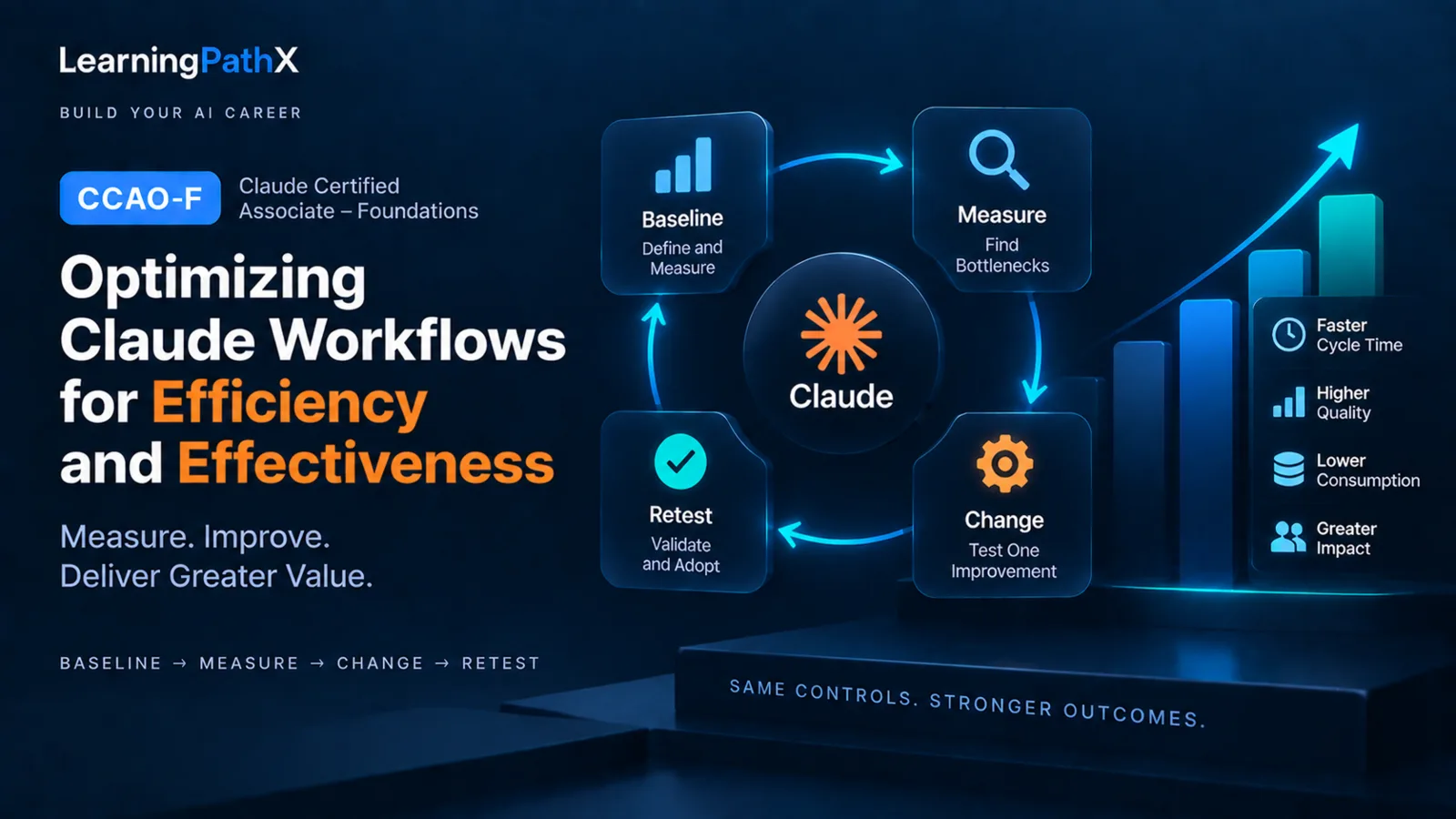
Optimize an established Claude workflow with a controlled baseline–measure–change–retest cycle: freeze a representative workload and its existing acceptance criteria, measure effectiveness and effort at each stage, identify the largest evidence-backed bottleneck, change one relevant lever, and retest the same workload. Adopt the change only when it meets the organization's own improvement target while continuing to pass every existing quality, governance, permission, and human-review threshold.
This procedure is for a workflow that already functions, not for repairing one weak response or designing the first version of a process. Diagnose an isolated failure with CCAO-F: Troubleshooting Underperforming Claude Prompts and Outputs, and establish roles, gates, and escalation paths with CCAO-F: Designing Human-in-the-Loop Workflows with Claude before optimizing. There is no universal target for acceptable time, consumption, context, handoffs, or review effort: each organization must set those targets from its workload, risk classification, service commitments, available capacity, and current approved environment.
The Optimization Cycle
The optimization architecture has four repeating stages:
- Baseline: Select representative completed work, freeze the inputs and acceptance criteria, and record how the current workflow performs.
- Measure: Separate quality outcomes from the effort used to produce them, then locate the stage responsible for the most material gap.
- Change: Form one testable hypothesis and alter one prompt, context, routing, capability, handoff, model setting, or review rule without changing the safeguards.
- Retest: Run the same cases through both the baseline and candidate paths, compare results, check guardrails, and adopt, reject, or revise the change.
The cycle converts user feedback and operating evidence into a controlled experiment. A stakeholder comment such as “this takes too long” is an input to investigate, not proof that a particular step should be removed. Translate the comment into a measurable stage, observable outcome, and owner before selecting a change.
Build a Representative Baseline
A useful baseline describes normal work rather than one especially good or bad run. Group cases by factors that can materially change the workflow, such as task type, risk class, source volume, required freshness, connector need, output format, and approval path. Preserve the mix so the candidate is not tested on easier work than the baseline.
For every case, capture the minimum reproducible record:
- approved input and source boundary;
- prompt, maintained instructions, and necessary Project or conversation context;
- selected Claude surface, model, effort, thinking, and enabled capabilities;
- workflow route, stage owners, handoff artifacts, and required approvals;
- acceptance criteria and validation evidence;
- start, handoff, review, and acceptance times;
- available consumption evidence; and
- revision, rejection, escalation, and final disposition.
Use approved or synthetic data in the measurement record and follow the existing retention and access rules. Optimization evidence does not create permission to copy sensitive prompts, source records, or outputs into an unapproved analytics system.
Measure Effectiveness and Effort Together
Efficiency means using less time, consumption, context, handoff effort, or review effort for an acceptable result. Effectiveness means the result continues to meet the workflow's purpose and acceptance criteria. Measure both, because an apparently faster route that increases material defects is not an improvement.
The following measurement frame is deliberately organization-specific. Select only the measures that help answer the current hypothesis, define them before the experiment, and calculate baseline and candidate values the same way.
| Dimension | Organization-specific measure examples | Evidence to retain | Guardrail |
|---|---|---|---|
| Quality | First-reviewed-pass acceptance rate; required-field completeness; material-defect rate; source-validation pass rate | Acceptance rubric, validator result, defect class, disposition | Existing acceptance and severity thresholds remain unchanged |
| Cycle time | Elapsed time from approved input to accepted output; active work time; queue time and processing time by stage | Stage timestamps and rework intervals | Do not bypass a required wait, approval, or escalation to improve time |
| Consumption | Consumption per accepted output or workload class; consumption by surface, model, or effort setting when available | Approved analytics or usage report matched to the test window | Do not treat lower consumption as success when quality or risk results regress |
| Context | Rework linked to missing, stale, conflicting, or unnecessary context; repeated context-preparation effort; context supplied per accepted case | Named source versions, Project state, input inventory, context-related finding | Required evidence and controlling instructions must remain available |
| Routing | Cases sent to the intended model, effort, capability, or human path; reroutes and fallbacks | Route decision, reason, capability availability, final route | Unsupported, unauthorized, or high-risk cases retain their escalation route |
| Handoffs | Queue time, rejected handoffs, missing required fields, and rework caused at each boundary | Handoff artifact, sender, receiver, acceptance or rejection reason | Required provenance, owner, constraints, and approval state cannot be dropped |
| Review burden | Reviewer active time, review rounds, escalations, and findings per accepted output and risk class | Review record, finding category, reviewer role, decision | Mandatory independent or qualified review remains mandatory |
Choose comparison periods and sample sizes that reflect the organization's volume and variability; this article does not prescribe a percentage, duration, or universal benchmark. Record the target and guardrails before testing so the team cannot redefine success after seeing a favorable result.
Locate the Bottleneck Before Changing a Lever
Map each measurement to the workflow stage that produced it. Total cycle time alone does not show whether the delay came from Claude processing, a source lookup, a queue, a rejected handoff, or required human review. Total consumption alone does not show whether the workload used overly intensive settings, repeated large context, or a broader research route than the task needed.
Use the first material divergence from the target as the working bottleneck. Then write a hypothesis in this form:
For this workload class, changing one named lever at one stage is expected to improve one primary measure while maintaining the listed quality and control thresholds.
If the evidence points to several stages, rank them and test one at a time. Bundling a new prompt, a new Project, a different model, and a removed review step into one candidate may change the outcome, but it will not reveal which change caused it.
Choose One Evidence-Backed Change
Prompt and context changes
Repeated clarifications, inconsistent formats, or missing organizational constraints can justify a maintained prompt change. Anthropic's prompt-design guidance explains that Claude does not begin with context about the user, task, or organization and therefore benefits from specific instructions. Test the smallest durable clarification—such as one acceptance criterion, source boundary, or output contract—rather than adding every possible instruction.
When teams repeatedly assemble the same approved background, test whether a Project is the appropriate maintained context boundary. Anthropic describes Projects as self-contained workspaces with their own chat histories, instructions, and knowledge bases. Measure whether the candidate reduces context-preparation work or context-related rework, while checking source freshness, conflicting instructions, access, and the accepted output just as before. A larger context collection is not automatically a better one.
Model, effort, and capability routing
Treat model, effort, and thinking as selectable controls rather than permanent quality levels. Anthropic's model, effort, and thinking guidance states that higher effort can produce more thorough responses but takes longer and uses more tokens. For a defined workload class, change only one eligible setting and compare quality, cycle time, and consumption against the frozen baseline. Keep the current path when a less intensive candidate fails the acceptance or risk guardrail.
Route information work according to the need. Anthropic distinguishes web search, extended thinking, and research: straightforward current facts fit web search, complex reasoning without recent web information can fit extended thinking, and broader multi-source investigation can fit research. Use those documented distinctions to form a routing hypothesis, then verify the result's sources and acceptance criteria. Do not route every task to the broadest capability merely because it is available.
Consumption must be measured in the organization's actual environment. Anthropic's Claude Enterprise consumption guide identifies model and effort selection as consumption levers and documents organization analytics and spend-report views. Where those controls and reports are available, segment evidence by workload and accepted outcome instead of interpreting total spend alone. Plan, role, surface, and administrator settings can change which measurements and choices are available.
Connector, handoff, and review changes
A connector can reduce manual transfer when the workflow needs permitted external data or a supported action, but the optimization hypothesis must include its access and approval boundary. Anthropic documents that connectors inherit each person's source-system permissions and can be narrowed by organization tool controls. Measure retrieval or action success, cycle time, and handoff effort only after verifying the current connector capability, connected identity, requested permissions, and required confirmation. Never broaden access merely to make a candidate route faster.
For human or system handoffs, change the contract rather than removing accountability. A candidate handoff can include the accepted output, source identifiers and versions, unresolved items, risk class, validation result, next owner, and approval state in one consistent artifact. Retest whether the receiving stage starts with fewer clarification loops or rejected transfers.
Review can also be routed by established risk class, but a lower review count is not inherently better. Measure whether the right reviewer receives a complete package and reaches a supported decision with less avoidable rework. Preserve every mandatory review, separation-of-duties rule, escalation trigger, and validation threshold.
Retest, Compare, and Decide
Run the frozen representative cases through the unchanged baseline and the candidate path. Keep the workload, acceptance criteria, source versions, risk classification, and unaffected controls aligned. When model variability could affect the result, use the organization's chosen repeat-run method for both paths and document it rather than comparing one favorable candidate run with one unfavorable baseline run.
Decide by the predeclared rule:
- Adopt: The candidate meets the organization-specific improvement target, passes all quality and validation criteria, and introduces no governance, permission, or review regression.
- Reject: The candidate misses the target or violates a guardrail. Restore the baseline route and retain the evidence.
- Revise and retest: The result supports the hypothesis but reveals a bounded adjustment. Freeze the revised candidate and run a new comparison instead of silently editing the result.
- Escalate: The evidence is inconclusive, the change needs unavailable authority or access, or the residual risk exceeds the experiment owner's decision rights.
After adoption, monitor the same primary measure and guardrails for the organization's chosen observation period. Record the changed workflow version, owner, effective date, evidence, rollback condition, and next review point. A candidate that works only in a controlled test but fails under the live workload mix should be rolled back or re-enter the cycle.
Preserve Governance and Validation Controls
Optimization may change how work reaches a control, but it must not redefine an unacceptable result as acceptable. Keep the existing source requirements, data-classification rules, connector permissions, human decision ownership, mandatory approvals, validation rubrics, defect-severity thresholds, escalation paths, and audit evidence unless the authorized governance process changes them independently.
Treat these outcomes as valid:
- insufficient evidence;
- permission or approval required;
- capability unavailable;
- acceptance criteria not met; and
- qualified human decision required.
Suppressing these outcomes can make a dashboard appear faster while moving cost and risk downstream. When a proposed efficiency improvement depends on removing a safeguard, stop the experiment and route the proposal to the control owner rather than counting the removed step as an optimization.
Common Optimization Mistakes
- Optimizing from one poor response instead of a representative functioning workflow
- Changing several variables and attributing the result to one preferred explanation
- Comparing a hard baseline workload with an easier candidate workload
- Measuring output volume without measuring accepted quality
- Using total cycle time or consumption without locating the responsible stage
- Treating more context, a more intensive setting, or broader research as automatically better
- Applying one target across different workload or risk classes without organizational evidence
- Removing a handoff field, approval, or review gate to improve a time metric
- Declaring success from one favorable run or an unsupported external benchmark
- Letting a local improvement increase downstream rework or reviewer burden
Certification Relevance
For Claude Certified Associate – Foundations (CCAO-F), this cycle applies D7.2 adjustment from feedback and results and D7.3 workflow optimization for efficiency and effectiveness, with supporting D4.2 process-optimization judgment. The key skill is not choosing the fastest Claude configuration. It is establishing a defensible baseline, measuring outcome and effort together, changing one justified lever, and proving through a controlled retest that the workflow improved without weakening its controls.
An original practice exercise can use synthetic or approved cases from one established workflow. Define organization-specific quality and effort measures, identify one bottleneck, state one hypothesis, compare baseline and candidate results, and write an adopt, reject, revise, or escalate decision. The exercise should demonstrate the method and must not imitate or reconstruct an exam item.
Conclusion
Sustainable Claude workflow optimization is a measurement discipline. Baseline a representative functioning process, measure quality together with cycle time, consumption, context, routing, handoffs, and review burden, change one evidence-backed lever, and retest under the same criteria. Adopt only improvements that meet the organization's own target while preserving every governance and validation threshold.
Authoritative Sources
- Introduction to prompt design
- Change the model, effort, and thinking settings
- Claude Enterprise consumption guide
- When should I use web search, extended thinking, and research?
- What are projects?
- Use connectors to extend Claude's capabilities