
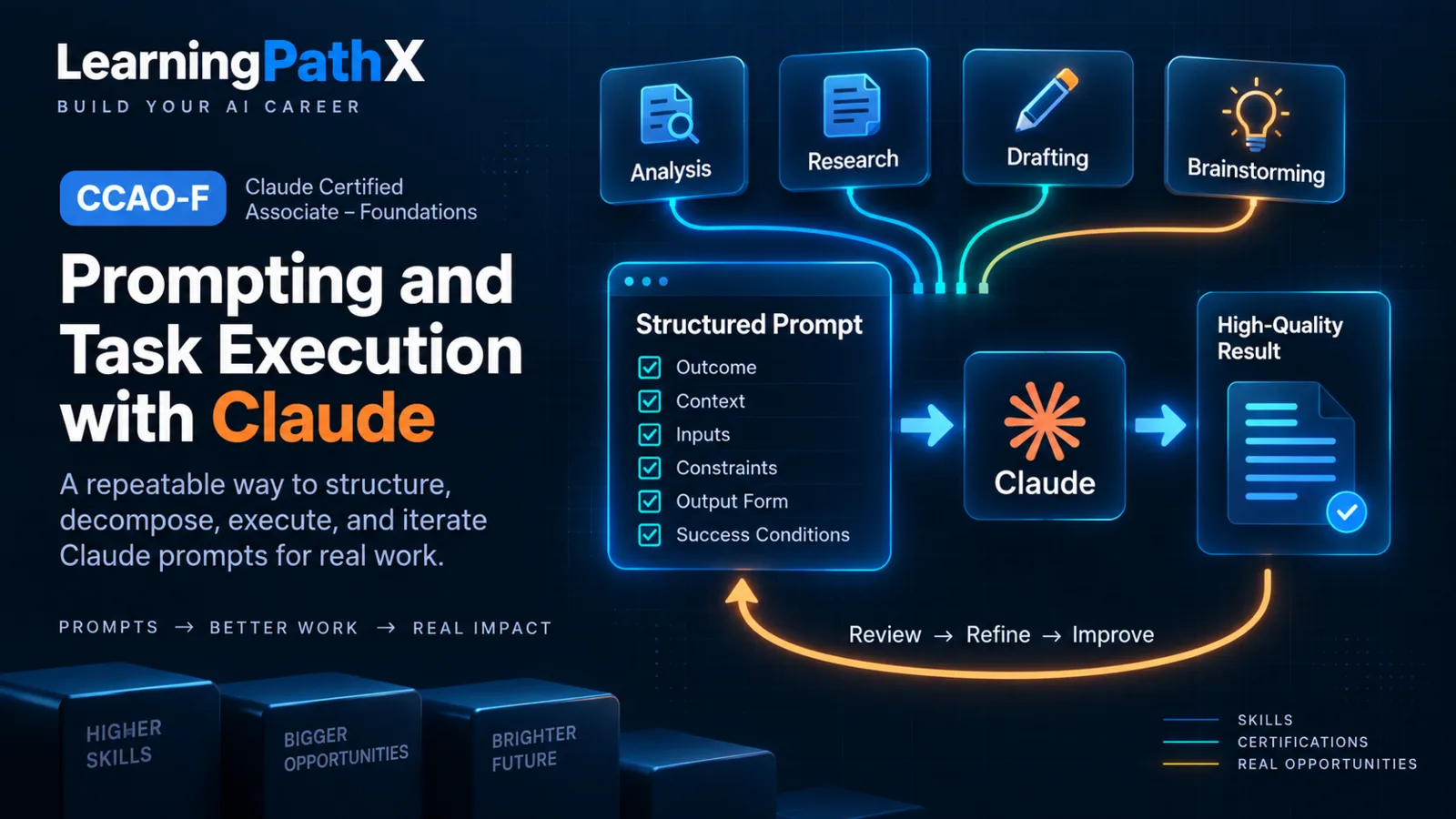
A knowledge worker can structure, decompose, and iterate a Claude prompt with one repeatable procedure: define the outcome and success conditions, supply the relevant context and constraints, divide complex work into reviewable stages, adapt those stages to the task type, and revise the instruction that caused an observed gap. This turns prompting into controlled task execution rather than a search for a magic phrase.
Anthropic's Get started with Claude describes prompts as natural, conversational requests that can range from simple questions to multi-step analysis or creative work, and recommends being specific and iterating. The prompt-design introduction adds a useful mental model: treat Claude like a newly hired contractor who lacks unstated context about you, the task, and the organization. The procedure below applies that model to analysis, research, drafting, and brainstorming while leaving factual acceptance, final audience refinement, persistent configuration, product selection, and workflow design to their dedicated articles.
What Structured Prompting Means
Structured prompting is the practice of turning an intended result into instructions that another capable worker could follow and that a reviewer could inspect. A strong prompt makes six elements clear:
- Outcome: What should exist when the task is complete?
- Context: What situation, audience, or business need controls the work?
- Inputs: Which documents, data, or supplied facts may Claude use?
- Constraints: What rules, exclusions, terminology, or uncertainty behavior apply?
- Output form: What reviewable structure should Claude return?
- Success conditions: What observable qualities should the response satisfy?
These elements are a diagnostic checklist, not a mandatory six-part form. A simple request may need only an outcome and one constraint. A complex assignment usually needs more explicit context, source boundaries, stages, and success conditions.
Step 1: Frame the Outcome and Success Conditions
Begin with the result the work must produce, not merely the topic. A topic request such as “Summarize our launch notes” names an activity but leaves the purpose, audience, evidence boundary, and usable deliverable unclear.
A framed request is more actionable:
Create a launch-readiness brief for regional sales leads. Use only the attached approved release notes. Separate customer-visible changes, known limitations, and actions that still need an owner. Flag missing dates or owners instead of guessing.
This version defines the deliverable, intended reader, allowed input, sections, and behavior for missing information. It does not tell Claude exactly which words to use; it states the conditions that make the result useful.
Use success conditions that a reviewer can observe. “Make it excellent” gives no test. “Keep each recommendation tied to an identified constraint and label unsupported assumptions” gives the reviewer something concrete to inspect. Deciding whether the final claims are accurate and acceptable is a separate validation step, but the prompt should make that later review possible.
Step 2: Supply Relevant Context and Constraints
Provide the smallest set of information that controls the task. Useful context can include the audience, purpose, approved source material, decision already made, terminology to preserve, or assumptions that must not be introduced. Unrelated history can obscure the main instruction rather than improve it.
State source and uncertainty boundaries explicitly when they matter:
- Use only the supplied policy and label questions the policy does not answer.
- Treat the attached worksheet as the source of record for quantities.
- Separate confirmed facts from assumptions or proposed language.
- Do not infer a customer commitment from internal planning notes.
This framing reduces avoidable ambiguity, but it does not guarantee that every generated statement is correct. Anthropic warns that Claude can produce incorrect or misleading responses that sound plausible, so important outputs still require source inspection and appropriate human judgment. The official guidance on incorrect or misleading responses specifically advises users not to treat Claude as a single source of truth and to scrutinize high-stakes advice. Evaluating and Validating Claude Outputs provides the detailed acceptance and escalation method.
Keep one-time task context inside the current request. Stable Project or organization instructions introduce different maintenance, precedence, permission, and freshness concerns; Configuring Claude Projects, Instructions, and Knowledge covers that persistent configuration rather than this prompt-level procedure.
Step 3: Decompose Complex Work into Reviewable Stages
Decompose a request when later work depends on an earlier judgment, when multiple kinds of reasoning are mixed together, or when a reviewer needs to locate the source of an error. Each stage should produce an intermediate result that can be inspected before the next stage uses it.
For example, instead of asking Claude to review and rewrite a proposal in one undifferentiated step, use this sequence:
- Extract the explicit customer requirements from the supplied material.
- Map each requirement to the current proposal section that addresses it.
- Identify requirements with missing or weak evidence.
- Draft corrections only for confirmed gaps.
- Return the requirement-to-section map with the revised passages for review.
If a requirement is absent from the final draft, this structure helps the reviewer identify whether extraction, mapping, or revision introduced the gap. The task can still run in one conversation, but the stages make dependencies and handoffs visible.
Avoid decomposing mechanically. Separate stages should reduce ambiguity, expose a meaningful checkpoint, or isolate a distinct operation. Splitting a simple request into many tiny steps adds coordination overhead without improving control.
Step 4: Adapt the Prompt to the Task Type
The same framing procedure applies across workplace tasks, but each task type needs different context, stages, and success conditions. The following patterns are recommendations for organizing the work, not claims that one sequence fits every situation.
| Task type | Frame first | Useful decomposition | Reviewable intermediate result |
|---|---|---|---|
| Analysis | Decision or question, evidence set, comparison criteria, exclusions | Extract observations, apply criteria, separate findings from interpretation | Evidence-to-finding map |
| Research | Research question, scope, source boundary, time period, unresolved questions | Gather sources, extract relevant claims, compare evidence, synthesize | Claim-and-source record before synthesis |
| Drafting | Audience, purpose, approved facts, tone constraints, required sections | Outline, draft, check against the brief, revise named gaps | Outline or section draft tied to the brief |
| Brainstorming | Problem, constraints, desired breadth, prohibited directions, selection criteria | Generate varied options, group them, surface trade-offs, shortlist | Categorized option set before selection |
Analysis
Ask Claude to distinguish observations in the supplied material from interpretations based on those observations. Name the question and criteria before requesting conclusions. This prevents an analysis prompt from becoming an open-ended summary with no decision relevance.
Research
Define what must be learned, which sources or source types are permitted, how current the evidence must be, and what remains unresolved. Request a claim-and-source record before the synthesis when traceability matters. Reviewing whether those sources support the claims remains a separate acceptance activity.
Drafting
Specify the reader, purpose, approved facts, and constraints before asking for prose. For a substantial deliverable, approve or inspect an outline before expanding it. Final tone, audience fit, and delivery-format refinement belong to Refining Claude Outputs for Audience and Delivery Format; this stage only makes the draft reviewable.
Brainstorming
State the problem and constraints without narrowing the answer to one preferred idea. Ask for meaningful variation, then have Claude group options and surface trade-offs before shortlisting. Treat generated ideas as proposals to evaluate, not as commitments or verified facts.
Step 5: Iterate Against an Observed Gap
Iteration should change the instruction connected to a visible problem while preserving what already works. Use four moves:
- Name the gap: Describe what the response did or omitted.
- Preserve correct work: Identify the content, structure, or assumptions that should remain.
- Change one relevant variable: Clarify the missing context, constraint, stage, format, or success condition.
- Run the task again: Compare the new response with the same stated conditions.
For example:
The brief combines confirmed features with planned features. Keep the audience, length, and three-section structure. Classify only items explicitly marked released as customer-visible; place the rest under known limitations or flag their status as unresolved.
This feedback is more useful than “make it better” because it identifies the problem, protects correct work, and changes one decision rule. Anthropic's getting-started guidance explicitly encourages refining prompts and asking follow-up questions; disciplined iteration makes each follow-up testable.
Prompt iteration improves the fit between the instruction and the response. It does not prove factual correctness, diagnose every model or context failure, or replace a human acceptance decision. If repeated prompt-level changes do not address the symptom, Troubleshooting Underperforming Claude Prompts and Outputs provides a broader troubleshooting path.
A Reusable Prompting Checklist
Before sending a substantial workplace prompt, ask:
- Is the outcome explicit and useful to a named reader or decision?
- Have I supplied only the relevant and permitted context?
- Are the allowed inputs, exclusions, and uncertainty behavior clear?
- Does the task need reviewable stages or an intermediate checkpoint?
- Does the output form support review without overcontrolling the wording?
- Are the success conditions observable?
- Have I adapted the stages to analysis, research, drafting, or brainstorming?
After receiving a response, record the first material gap, preserve correct work, revise the corresponding instruction, and compare the next response against the same conditions. Change several variables at once only when the original framing is unusable; otherwise, a focused change makes the effect easier to understand.
Common Prompting Mistakes
- Naming a broad topic without defining a deliverable or intended use
- Omitting the audience, evidence boundary, or rule for uncertainty
- Combining dependent stages without an inspectable intermediate result
- Applying the same prompt pattern unchanged to analysis, research, drafting, and brainstorming
- Relying on a long list of micro-instructions that competes with the core outcome
- Treating an example as the requirement instead of stating the governing rule
- Asking Claude to “improve” a result without identifying the observed gap
- Assuming a better prompt turns an unverified output into an accepted one
- Moving one-time task instructions into persistent configuration without a maintenance plan
Conclusion
Structured prompting and task execution with Claude is a repeatable operating procedure: frame the outcome, provide relevant context and constraints, decompose complex work into reviewable stages, adapt the sequence to the task type, and iterate against observed gaps. The procedure makes analysis, research, drafting, and brainstorming easier to direct and review while preserving clear boundaries for factual acceptance, final refinement, persistent configuration, product selection, and workflow-scale design.
Authoritative Sources
- Get started with Claude
- Introduction to prompt design
- Claude is providing incorrect or misleading responses