
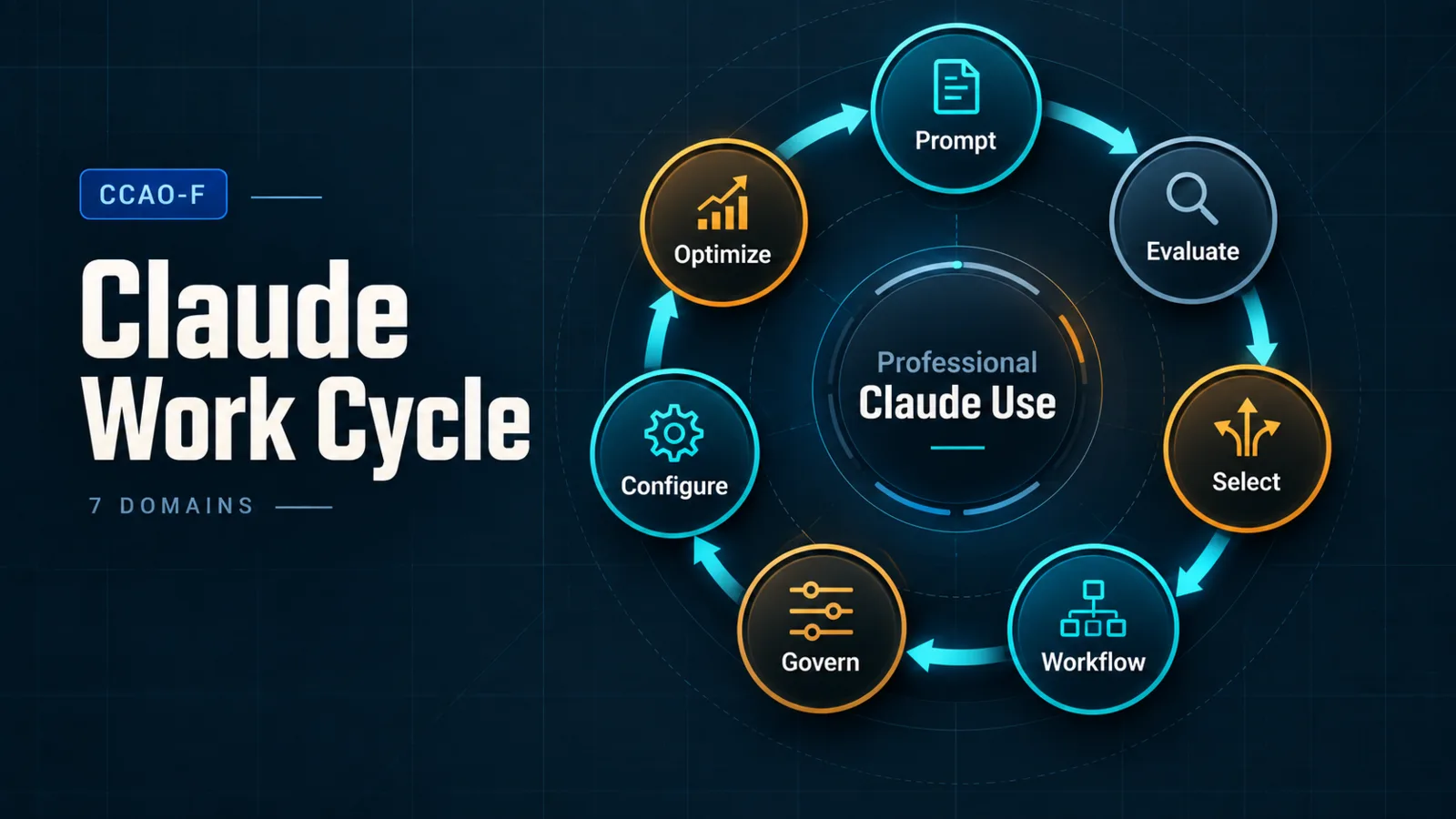
The Claude Certified Associate – Foundations credential, identified by exam code CCAO-F, validates practical judgment in using Claude for professional business and productivity work with minimal guidance. It is designed for knowledge workers with limited to moderate technical expertise, not API developers or solution architects. Readers should navigate its seven-domain learning sequence as one operating cycle: frame work, evaluate and refine outputs, choose the right Claude capabilities, design the workflow, apply governance and context controls, then troubleshoot and optimize the result.
The official CCAO-F Exam Guide v1.0, effective July 2026, defines 30 detailed objectives across those seven domains. This overview explains how that published scope fits together and where the rest of this series develops each skill; it does not reproduce sample items, teach every method, or extend into Anthropic's Developer and Architect certification tracks.
What the CCAO-F Certification Validates
Anthropic's certification page describes the credential as an Associate, Foundations-level assessment of everyday Claude use. The validated work includes prompting and task execution, evaluating and refining output, selecting products and models, integrating Claude into workflows, setting up Projects and knowledge sources, applying responsible artificial intelligence (AI) principles, and troubleshooting.
The common thread is operating judgment. A credential holder is expected to translate a business objective into an effective interaction, select an approach that balances quality, efficiency, and cost, inspect the result critically, and recognize when human expertise or a more technical specialist is required. Producing fluent text is not enough; the process and deliverable must be suitable for their intended use.
The track boundary matters. The Partner Certifications catalog positions the Associate role for professionals who guide use cases and help work succeed with Claude. Building production applications with the Claude API belongs to the Developer track, while designing end-to-end enterprise solutions belongs to the Architect track.
Current Credential and Exam Baseline
The current public baseline was verified on August 24, 2026. The certification page and the Certification FAQ identify the following details:
| Item | Current official detail |
|---|---|
| Credential and exam code | Claude Certified Associate – Foundations; CCAO-F |
| Exam guide | Version 1.0, effective July 2026 |
| Format and time | 60 multiple-choice and multiple-response items; 120 minutes |
| Delivery | Online proctored or at a Pearson test center |
| Passing score | 720 on a scaled range of 100–1,000 |
| Language | English |
| Price | USD 99 before any applicable partner discount |
| Credential validity | 12 months from the award date |
Certification access is currently limited to people at Claude Partner Network organizations. Registration requires a partner-company email address on a domain recognized in the organization's partner record; a personal email address does not meet that access requirement. The Associate certification also does not count toward Claude Partner Network tier eligibility. Because access, pricing, and policy can change, prospective candidates should confirm them in the current official pages before registering.
Who CCAO-F Is For
CCAO-F is intended for professionals who use Claude as a productivity tool in operations, marketing, project management, education, communications, consulting, sales, delivery, and other knowledge-work settings. The candidate profile includes internal staff who maintain AI-assisted workflows and external consultants who help identify use cases or redesign processes.
The exam guide sets no mandatory prerequisite, required course, software-development experience, or API experience. It recommends regular professional use of Claude plus foundational understanding of structured problem-solving, workflow design, AI limitations, context constraints, and data sensitivity. The Claude Certified Associate – Foundations Prep Course reinforces that applied profile and recommends Claude 101, AI Fluency: Framework & Foundations, and AI Capabilities and Limitations as preparation rather than requirements.
Claude itself is available through web, desktop, and mobile surfaces according to Anthropic's Get started with Claude guidance. Actual access, models, controls, and capabilities can vary by location, plan, organization settings, surface, and time. That is why the certification guide establishes the skill scope while current product documentation must establish current product behavior.
The Seven-Domain CCAO-F Learning Map
The blueprint contains 30 objectives in a 4/6/4/5/4/4/3 distribution. The weights describe the approximate share of scored items, while the objective counts describe the published task scope; neither should be treated as a shortcut to confidential exam content.
| Domain | Weight | Published objectives | Destination in this series |
|---|---|---|---|
| Prompting and Task Execution | 14% | 4 | Prompting and Task Execution with Claude builds a repeatable prompting and task-decomposition procedure. |
| Output Evaluation and Validation | 21% | 6 | Evaluating and Validating Claude Outputs owns factual acceptance and escalation; Refining Claude Outputs for Audience and Delivery Format owns audience refinement and delivery format. |
| Product and Model Selection | 12% | 4 | Choosing Claude Products and Capabilities for Work covers product capabilities; Choosing Claude Models and Managing Context covers model, effort, and context decisions. |
| Workflow Integration and Solution Design | 16% | 5 | Designing Human-in-the-Loop Workflows with Claude connects requirements, human ownership, approvals, and stakeholder communication. |
| Configuration and Knowledge Management | 12% | 4 | Configuring Claude Projects, Instructions, and Knowledge covers persistent context; Claude Connectors, Permissions, and Data Access covers connectors and permissions. |
| Governance, Risk, and Responsible Use | 15% | 4 | Governance, Risk, Privacy, and Responsible Claude Use provides the appropriateness-and-controls decision framework. |
| Troubleshooting and Optimization | 10% | 3 | Troubleshooting Underperforming Claude Prompts and Outputs diagnoses weak results; Optimizing Claude Workflows for Efficiency and Effectiveness improves an established workflow with measured feedback. |
This decomposition is intentionally more precise than one article per domain. Four broad domains contain different reader outcomes that should not be collapsed: validating an answer differs from adapting a validated deliverable, product selection differs from model and context selection, Project knowledge differs from external connector access, and correcting a poor result differs from optimizing a functioning workflow.
How to Navigate the Learning Sequence
Follow the series in dependency order rather than sorting only by exam weight:
- Start with Prompting and Task Execution with Claude to define outcomes, context, constraints, and reviewable task stages.
- Use Evaluating and Validating Claude Outputs and Refining Claude Outputs for Audience and Delivery Format to separate factual acceptance from audience-ready refinement and formatting.
- Use Choosing Claude Products and Capabilities for Work and Choosing Claude Models and Managing Context to select the product capability, model family, effort setting, and context strategy that fit the task.
- Move to Designing Human-in-the-Loop Workflows with Claude to place those choices inside a business workflow.
- Apply Governance, Risk, Privacy, and Responsible Claude Use before operational configuration so suitability, data sensitivity, policy, and accountability constrain the design.
- Configure persistent context with Configuring Claude Projects, Instructions, and Knowledge and permissioned external access with Claude Connectors, Permissions, and Data Access.
- Diagnose weak results with Troubleshooting Underperforming Claude Prompts and Outputs, then improve established workflows with Optimizing Claude Workflows for Efficiency and Effectiveness.
- Finish with the CCAO-F Skills Roadmap, Practice Labs, and Documentation Plan, which turns all 30 objectives into a current-documentation and original-practice roadmap.
This order prevents a common mistake: treating prompting as the entire discipline. A strong prompt cannot make an unsuitable task appropriate, provide a missing authoritative source, override a permission boundary, or replace the person accountable for a consequential decision.
Practical Value of the Credential Scope
The seven domains form a reusable professional workflow beyond certification preparation. The sequence begins with a defined outcome and ends with evidence-based improvement, with source validation, human review, governance, and permissions placed inside the operating model rather than added after delivery.
That progression also creates useful escalation points. An Associate can identify when a task needs stronger source evidence, a policy decision, a source-system owner, or a Developer or Architect. Knowing where one's authority and expertise end is part of reliable Claude use, not a failure to complete the task independently.
Common Learning Challenges
- Memorizing domain names without practicing the decisions that connect them
- Confusing a fluent output with a verified and acceptable output
- Selecting a feature or model before defining the task, context, and risk
- Treating Projects, Artifacts, connectors, and Skills as interchangeable
- Configuring knowledge or external access before resolving governance and ownership
- Trying to optimize a workflow before isolating the cause of a weak result
- Using the exam guide as evidence for product behavior instead of checking current product documentation
Conclusion
CCAO-F validates disciplined use of Claude across the full lifecycle of professional work: task framing, output acceptance, selection, workflow design, governance, configuration, troubleshooting, and improvement. It serves non-developer knowledge workers who need to use Claude reliably and recognize escalation boundaries. Study the seven domains as a connected sequence, then use the final roadmap to test each published objective through current documentation and original hands-on work.
Authoritative Sources
- Claude Certified Associate – Foundations Certification
- Certification FAQ
- Partner Certifications
- Claude Certified Associate – Foundations Exam Guide
- Claude Certified Associate – Foundations Prep Course
- Get started with Claude