
Introduction
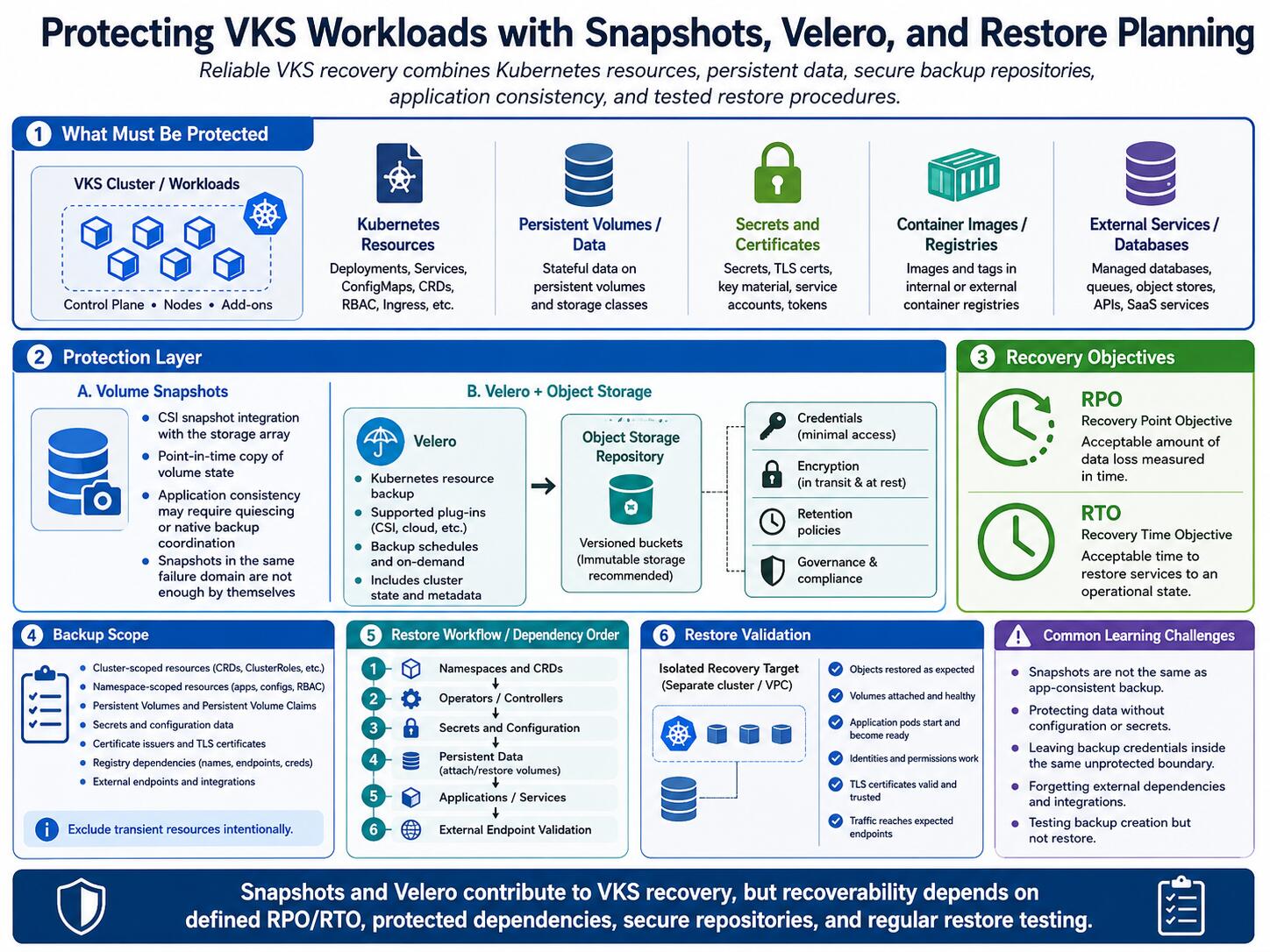
Data protection for VMware vSphere Kubernetes Service (VKS) must cover more than virtual machines or persistent volumes. A recoverable application can depend on Kubernetes objects, persistent data, secrets, certificates, external services, container images, and application-consistency procedures. Snapshots and Velero can contribute to this design, but neither automatically defines a complete recovery plan.
What Is VKS Data Protection
VKS data protection coordinates infrastructure storage capabilities with Kubernetes-aware backup. Volume snapshots can preserve supported persistent-volume state at a point in time. Velero can protect Kubernetes resources and, with the required plug-ins and object storage, coordinate supported backup and restore workflows.
The exact capabilities depend on VCF, VKS, Container Storage Interface (CSI), Velero, and storage versions. Validate the supported architecture and procedure before production use.
Why Restore Planning Matters
A backup is useful only when it can meet a defined recovery objective. Recovery Point Objective (RPO) describes acceptable data loss, while Recovery Time Objective (RTO) describes acceptable restoration time. These requirements determine schedule, retention, replication, and validation frequency.
Restore order also matters. Namespaces, custom resource definitions, operators, secrets, configuration, persistent data, and external endpoints can have dependencies that a single snapshot does not capture.
Core Concepts
Volume Snapshots
CSI snapshot integration can create point-in-time representations of eligible volumes. Snapshot consistency depends on workload behavior. Databases may require application quiescing or native backup coordination to achieve a usable recovery point.
Snapshots stored in the same failure domain as primary data may not protect against a site or administrative failure. Retention and replication must match the threat model.
Velero and Object Storage
Velero protects selected Kubernetes resources and can coordinate data movement or snapshots through supported plug-ins. Its backup repository, credentials, network access, encryption, and lifecycle require the same governance as production data.
Backup Scope
Inventory cluster-scoped and namespace-scoped resources, persistent volumes, secrets, certificate issuers, registry dependencies, external databases, and manual prerequisites. Exclude transient resources intentionally and document why.
Restore Validation
Test restoration into an isolated, supported target. Validate not only that objects appear, but that applications start, storage attaches, identities work, certificates are valid, and traffic reaches expected endpoints.
Target Audience
This topic is intended for platform operators, storage teams, application owners, security teams, and disaster-recovery planners.
Career or Technical Value
A layered recovery model allows teams to distinguish snapshot, backup, replication, and disaster recovery instead of treating the terms as interchangeable.
Common Learning Challenges
- Equating a storage snapshot with an application-consistent backup
- Protecting data without Kubernetes configuration or secrets
- Keeping backup credentials inside the same unprotected boundary
- Omitting external services and registry dependencies
- Testing backup creation but never testing restore
- Deleting a cluster without checking volume reclaim and retention behavior
Conclusion
Reliable VKS recovery combines Kubernetes resources, persistent data, secure repositories, application consistency, and tested procedures. Use snapshots and Velero according to supported capabilities, define RPO and RTO, protect dependencies, and prove recoverability through regular restore exercises.