
Introduction
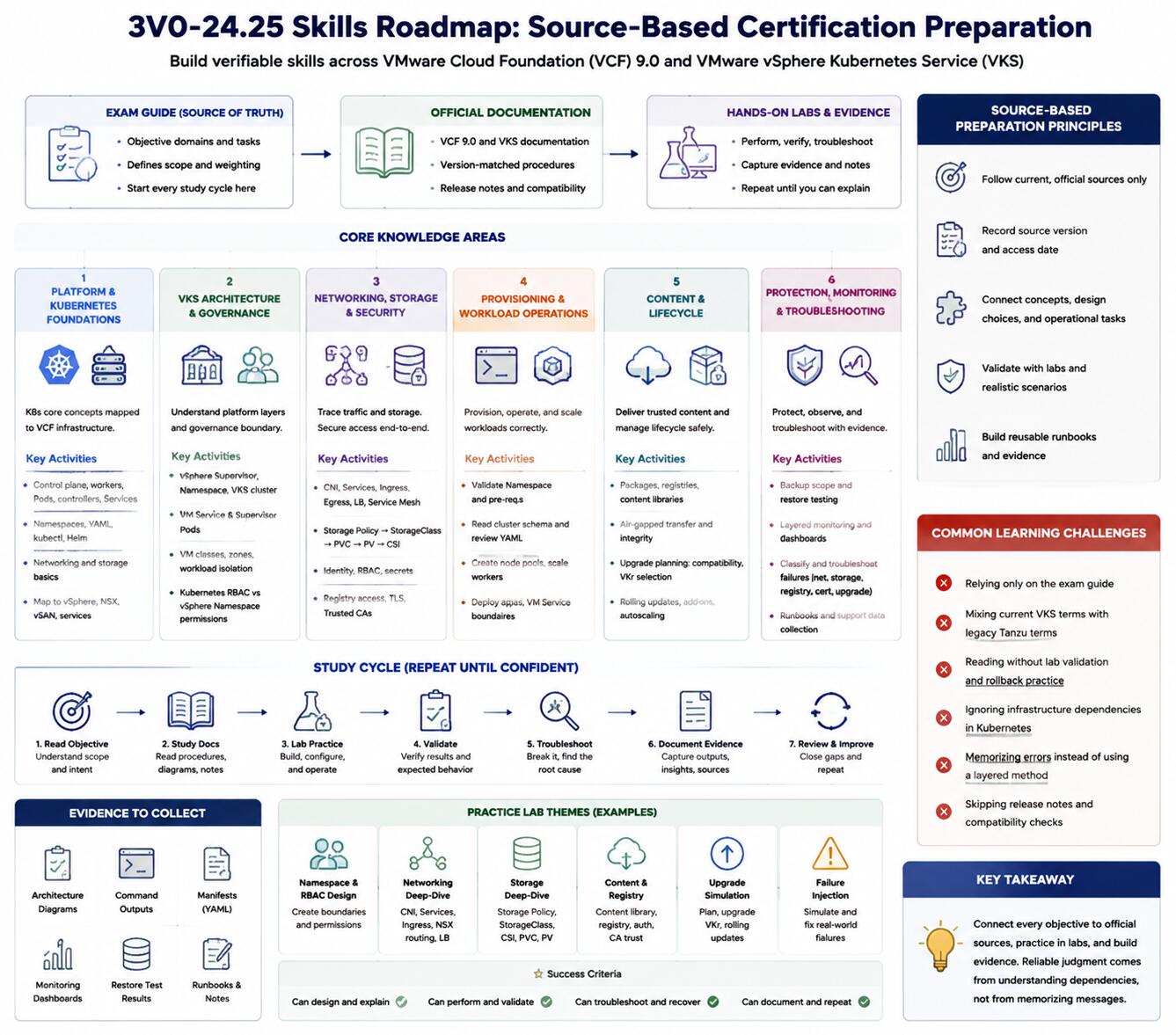
Preparation for VMware Certified Advanced Professional vSphere Kubernetes Service (3V0-24.25) should build demonstrable technical skills across VMware Cloud Foundation (VCF) 9.0 and VMware vSphere Kubernetes Service (VKS). The most effective roadmap combines the official exam guide, version-matched product documentation, structured labs, and evidence-based troubleshooting.
This roadmap organizes study activity without reproducing or predicting exam questions. Certification objectives define scope; official technical documentation and hands-on work establish product behavior.
What Is Source-Based Certification Preparation
Source-based preparation starts with the current official exam guide and maps every objective to authoritative documentation and a practical task. It separates three forms of knowledge:
- Concepts that must be explained accurately
- Design decisions that must be evaluated from requirements
- Operational tasks that must be performed, verified, and troubleshot
A study record should include the source version and access date because interfaces, terminology, compatibility, and procedures can change.
Why a Skills Roadmap Matters
Advanced platform work crosses Kubernetes and VMware infrastructure. Memorizing isolated terms does not show whether a practitioner can trace a failed PersistentVolumeClaim, design a namespace boundary, plan an upgrade, or distinguish certificate trust from registry authentication. A skills roadmap exposes these gaps early.
Core Knowledge Areas
Platform and Kubernetes Foundations
Explain Kubernetes control-plane and worker roles, Pods, controllers, Services, Kubernetes namespaces, YAML, kubectl, Helm, networking, and storage. Then map those concepts to VCF compute, VMware NSX, VMware vSAN, and operations services.
VKS Architecture and Governance
Draw the relationships among vSphere Supervisor, vSphere Namespace, VKS cluster, VM Service, Supervisor Services, VM classes, zones, and vSphere Kubernetes release (VKr) versions. Clearly separate vSphere Namespace governance from Kubernetes namespace and Role-Based Access Control (RBAC).
Networking, Storage, and Security
Trace workload traffic through Container Network Interface (CNI), Kubernetes Services, ingress, egress, load balancing, and optional service mesh. Trace storage from vSphere Storage Policy through StorageClass, PersistentVolumeClaim, PersistentVolume, and the vSphere Container Storage Interface (CSI) Driver. Explain identity, permissions, secrets, registry access, TLS, and trusted certificate authorities.
Provisioning and Workload Operations
Practice validating a vSphere Namespace, reading a version-matched cluster schema, reviewing YAML, selecting VM classes and node pools, scaling workers, and deploying supported Kubernetes applications. Include VM Service and Supervisor Pod boundaries without conflating the workload models.
Content and Lifecycle
Document how packages, images, registries, content libraries, and air-gapped transfers make trusted artifacts available. Build an upgrade checklist covering compatibility, VKr selection, capacity, disruption, rolling updates, add-ons, autoscaling, and post-change validation.
Protection, Monitoring, and Troubleshooting
Define backup scope and test restore behavior for Kubernetes objects and persistent data. Build layered dashboards and diagnostic runbooks. Practice classifying provisioning, network, storage, registry, certificate, and upgrade failures from conditions, events, logs, and infrastructure evidence.
Target Audience
This roadmap is intended for advanced administrators, architects, and support professionals with hands-on responsibility for VKS environments. It assumes foundational vSphere, networking, storage, container, and Kubernetes knowledge.
Career or Technical Value
The roadmap creates reusable platform-engineering skills beyond a certification event. Architecture diagrams, reviewed manifests, runbooks, restore evidence, and incident analyses can become operational assets when sanitized and approved for organizational use.
Common Learning Challenges
- Using the exam guide as the sole source for product behavior
- Studying current and legacy Tanzu terminology without distinguishing them
- Reading procedures without performing validation and rollback exercises
- Practicing Kubernetes without connecting it to vSphere infrastructure dependencies
- Memorizing error messages instead of learning a layered diagnostic method
- Skipping release notes and compatibility checks
Conclusion
Prepare for 3V0-24.25 by building a verified chain from official objective to documentation, lab task, expected evidence, and troubleshooting exercise. Cover platform architecture, Kubernetes fundamentals, governance, networking, storage, security, lifecycle, protection, and operations as connected skills. The goal is reliable technical judgment grounded in current sources and hands-on practice.