
Introduction
VMware vSphere Kubernetes Service (VKS) delivers Kubernetes clusters through a vSphere-integrated platform. Its architecture separates infrastructure governance, cluster lifecycle, and application operations while connecting them through declarative interfaces. Understanding those boundaries is more useful than memorizing a component list because most design and troubleshooting decisions cross more than one layer.
Architecture Overview
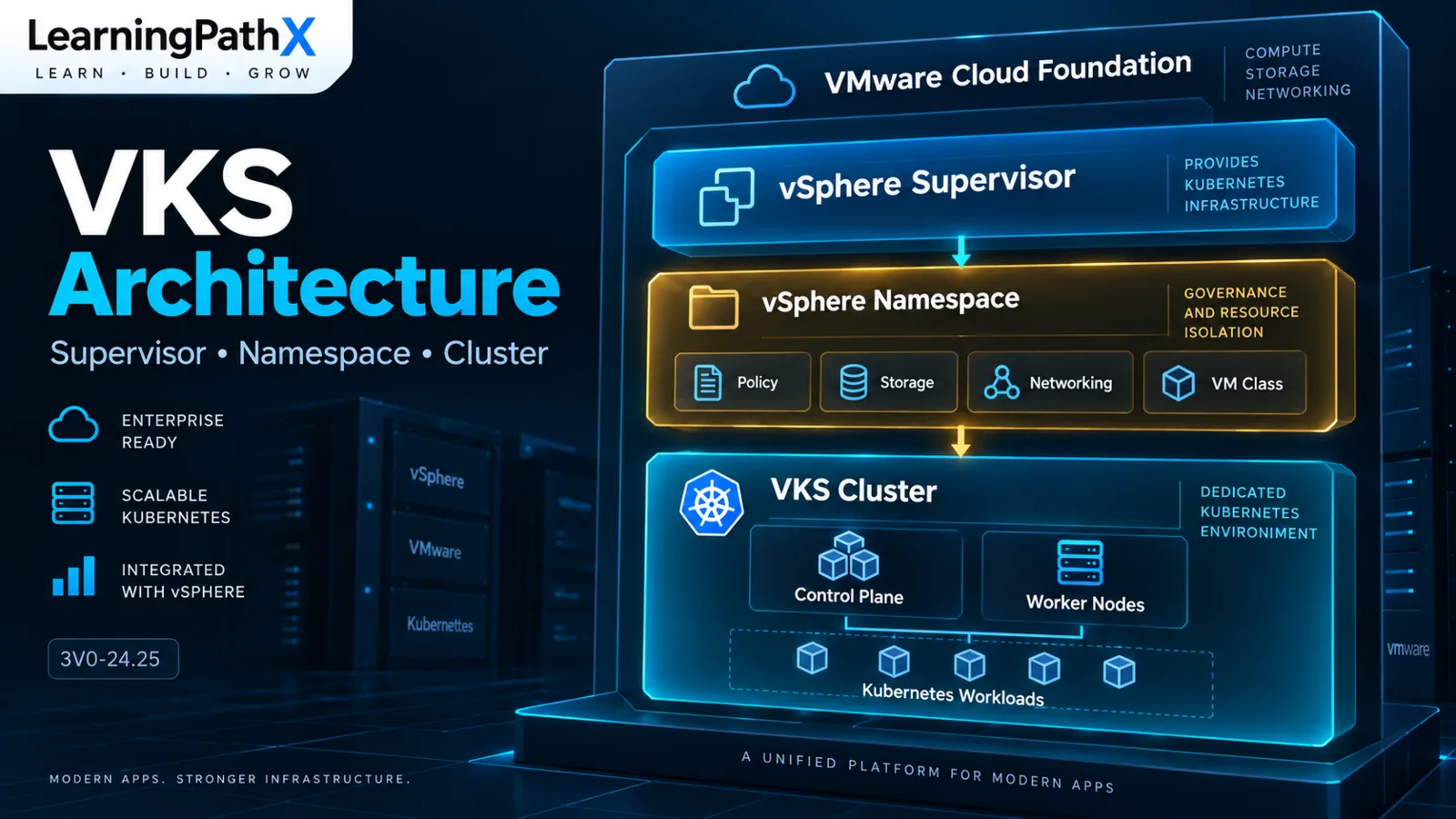
VKS runs within VMware Cloud Foundation (VCF) and depends on vSphere Supervisor capabilities. Administrators enable and operate the platform at the infrastructure layer, assign resources and policy through vSphere Namespaces, and provision VKS clusters for Kubernetes consumers.
Each VKS cluster has its own Kubernetes control plane and worker nodes. These cluster nodes are virtual machines managed through vSphere-backed lifecycle controllers. Inside the cluster, standard Kubernetes APIs govern applications. Outside it, vSphere provides compute placement, policy-based storage, identity integration, networking dependencies, and lifecycle coordination.
Core Components
Component Explanation
- vSphere Supervisor: Provides the Kubernetes-enabled platform control layer and Supervisor Services used to deliver supported workloads.
- vSphere Namespace: Defines a governed vSphere boundary for permissions, capacity, VM classes, storage policies, networking, and content access.
- VKS cluster: Provides a dedicated Kubernetes API, control-plane nodes, worker nodes, and cluster-level services for application workloads.
- vSphere Kubernetes release (VKr): Identifies a supported Kubernetes release used by VKS cluster nodes. Tanzu Kubernetes release (TKr) is legacy terminology.
- VM class and cluster plan: Describe available virtual-machine sizing choices and supported cluster shape decisions.
- Container Network Interface (CNI): Implements Pod networking behavior in the Kubernetes cluster.
- vSphere Container Storage Interface (CSI) Driver: Connects Kubernetes storage requests to vSphere policy-based storage.
- Cloud Provider Interface (CPI): Integrates Kubernetes node and infrastructure information with the vSphere environment.
- kubectl and VCF CLI: Provide interfaces for Kubernetes and platform-oriented administration, subject to the operator's role and supported workflow.
How Components Work Together
An infrastructure administrator first prepares a Supervisor with suitable compute, networking, storage, and load-balancing dependencies. A vSphere Namespace then receives permissions and resource policies. When a user submits a valid VKS cluster specification, platform controllers reconcile the request by creating and configuring the required control-plane and worker virtual machines.
The selected VKr supplies the supported Kubernetes software baseline. Network and storage integrations are applied so nodes can communicate, Pods can receive connectivity, and persistent claims can map through assigned vSphere Storage Policies. After the cluster becomes ready, application teams authenticate to its Kubernetes API and deploy standard Kubernetes resources.
This creates two related reconciliation domains. VKS and vSphere controllers manage cluster infrastructure and node lifecycle; Kubernetes controllers inside the VKS cluster manage application desired state. A healthy virtual machine does not prove that a Kubernetes workload is healthy, and a valid application manifest cannot compensate for missing namespace infrastructure policy.
Design Considerations
Architecture decisions should start with failure domains, capacity, address management, identity, storage policy, and lifecycle compatibility. The design must also clarify operational ownership: who manages the Supervisor, who grants namespace access, who changes cluster specifications, and who owns workloads inside each VKS cluster.
Multi-zone designs can improve failure-domain awareness, but they require aligned compute, network, and storage topology. Network selection affects address pools, load balancer placement, isolation, and policy capabilities. Storage policies determine which datastores and service levels can satisfy Kubernetes claims.
Best Practices
- Define vSphere Namespace boundaries around governance and ownership rather than application labels alone.
- Validate network ranges, Domain Name System resolution, routing, and load-balancer dependencies before provisioning.
- Expose only approved VM classes and storage policies to each namespace.
- Treat cluster specifications as version-controlled configuration.
- Confirm VKr and platform compatibility before upgrades.
- Monitor both the vSphere layer and the Kubernetes API because each exposes different failure evidence.
Common Mistakes
- Confusing the Supervisor with a VKS cluster
- Treating a vSphere Namespace as a Kubernetes namespace
- Assuming all cluster lifecycle changes occur entirely inside Kubernetes
- Selecting a VM class without checking namespace availability and infrastructure capacity
- Designing storage or networking after cluster provisioning has already begun
- Using legacy Tanzu terminology without identifying it as legacy
Certification Relevance
The 3V0-24.25 scope expects advanced practitioners to understand how VCF, vSphere Supervisor, vSphere Namespaces, and VKS clusters relate. Source-based preparation should focus on drawing the control boundaries, tracing a provisioning request, and identifying which layer owns networking, storage, identity, cluster lifecycle, and workload lifecycle.
Conclusion
VKS architecture joins standard Kubernetes clusters to vSphere governance and infrastructure services. The Supervisor provides the platform layer, vSphere Namespaces apply policy and access, and VKS clusters provide dedicated Kubernetes environments. Clear separation of these roles leads to better designs and faster fault isolation.