
Introduction
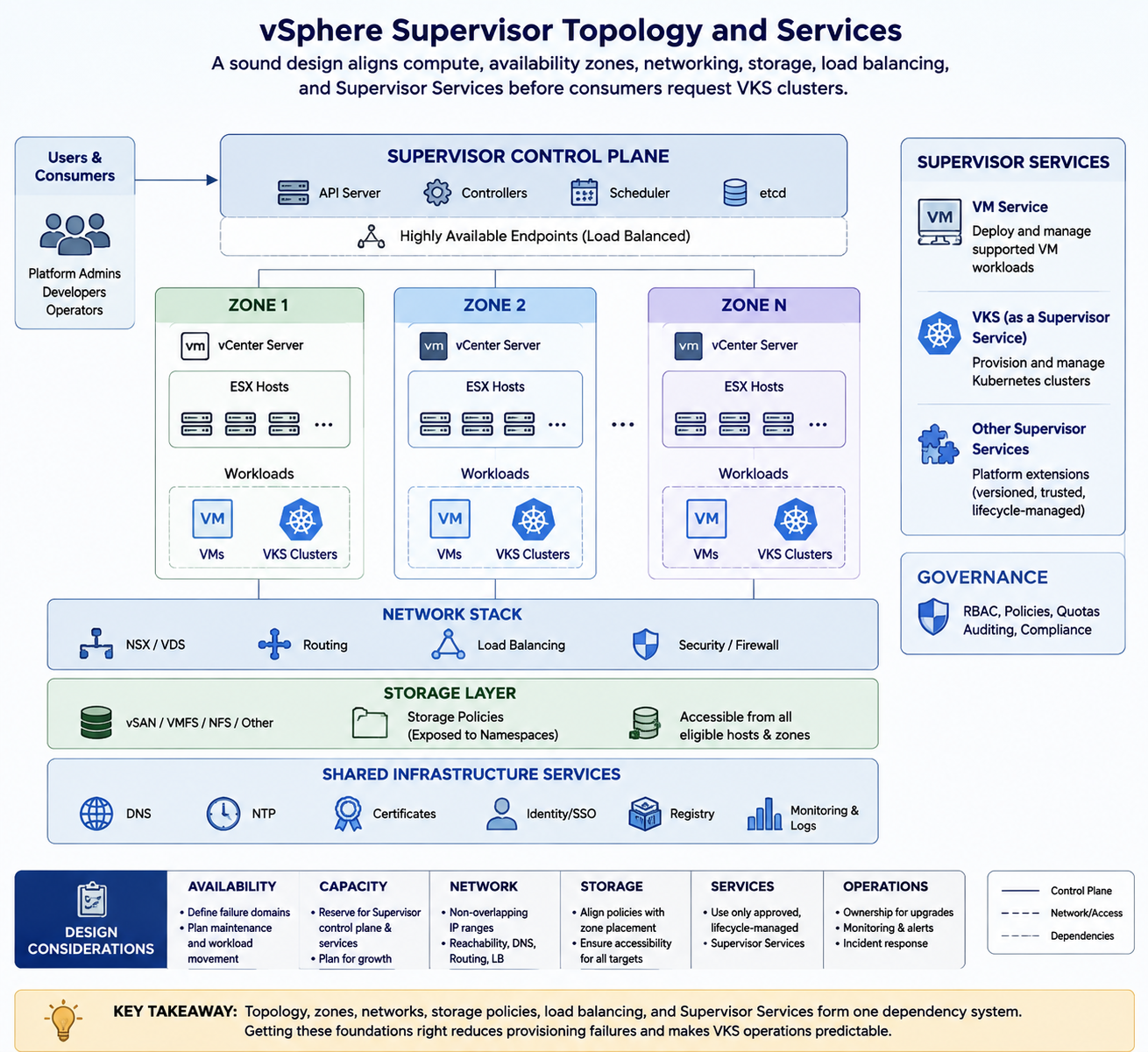
vSphere Supervisor is the platform foundation for VMware vSphere Kubernetes Service (VKS). A sound design must align compute placement, availability zones, networking, storage, load balancing, and Supervisor Services before consumers request VKS clusters. These choices determine the platform's failure behavior and the policies available to vSphere Namespaces.
Architecture Overview
The Supervisor adds a Kubernetes control plane and workload services to eligible vSphere infrastructure. In VMware Cloud Foundation (VCF) 9.0, it operates as part of an integrated private-cloud platform rather than as an isolated Kubernetes installation.
A topology can use infrastructure from one cluster or span supported zones, depending on platform capabilities and design requirements. The topology choice affects control-plane placement, maintenance planning, storage accessibility, and network reachability. It should therefore follow a documented availability model rather than a preference for the largest possible deployment.
Core Components
Component Explanation
- Supervisor control plane: Hosts the APIs and controllers that reconcile namespaces, supported workloads, and services.
- vCenter Server and ESX hosts: Supply inventory, scheduling, virtual-machine lifecycle, and infrastructure visibility.
- Zones: Represent failure-domain and placement boundaries used by supported Supervisor and workload configurations.
- VM Service: Allows authorized users to deploy and manage supported virtual-machine workloads through declarative interfaces.
- Supervisor Services: Extend Supervisor capabilities and must be versioned, trusted, and lifecycle-managed.
- Network stack: Uses a supported VMware NSX or vSphere Distributed Switch (VDS) design with required routing and load-balancing services.
- Storage policies: Expose eligible storage capabilities to namespaces and workloads.
How Components Work Together
Supervisor enablement binds selected vSphere infrastructure to the required management and workload networks. Control-plane endpoints need reachable addressing, name resolution, time synchronization, and certificate trust. Assigned storage policies must be accessible from the participating hosts and, in a zonal design, must match the intended placement behavior.
Supervisor Services run as managed platform extensions. VKS itself is delivered through a Supervisor Service, so service health and compatibility directly influence cluster provisioning and lifecycle operations. VM Service and Supervisor Pods represent different workload models and should be enabled only where their governance and operational requirements are understood.
Design Considerations
Begin with availability objectives. Identify which failures the platform should tolerate, which maintenance events require workload movement, and where operational dependencies remain shared. A multi-zone label does not remove dependencies on management, network, storage, identity, or load-balancing services.
Capacity planning must reserve resources for the Supervisor control plane and platform services as well as future VKS clusters. Address plans must account for platform endpoints, nodes, Pods, Services, and load balancer virtual addresses according to the selected network model.
Best Practices
- Validate the supported topology and compatibility matrix for the exact VCF release.
- Keep management, workload, and service address ranges documented and non-overlapping.
- Confirm forward and reverse name resolution, time synchronization, routing, and certificate chains before enablement.
- Align storage accessibility and policy assignment with zone placement.
- Limit Supervisor Services to approved, lifecycle-managed versions.
- Record ownership for platform upgrades, service upgrades, capacity, and incident response.
Common Mistakes
- Selecting zones without validating shared network and storage dependencies
- Underestimating address consumption and load-balancer requirements
- Exposing storage policies that are not reachable from every eligible placement target
- Treating a Supervisor Service as an ordinary application with an independent lifecycle
- Enabling workload models without defining permissions and support ownership
- Beginning namespace and cluster provisioning before Supervisor health is verified
Certification Relevance
For 3V0-24.25 preparation, practitioners should be able to explain Supervisor topology choices, identify infrastructure prerequisites, and connect services to their compute, network, storage, and trust dependencies. Useful practice includes diagramming failure domains and validating a design against official version-matched documentation.
Conclusion
A well-designed vSphere Supervisor converts infrastructure capabilities into a governed application platform. Topology, zones, networks, storage policies, load balancing, and Supervisor Services must be designed as one dependency system. Getting those foundations right reduces provisioning failures and makes later VKS operations predictable.