
Introduction
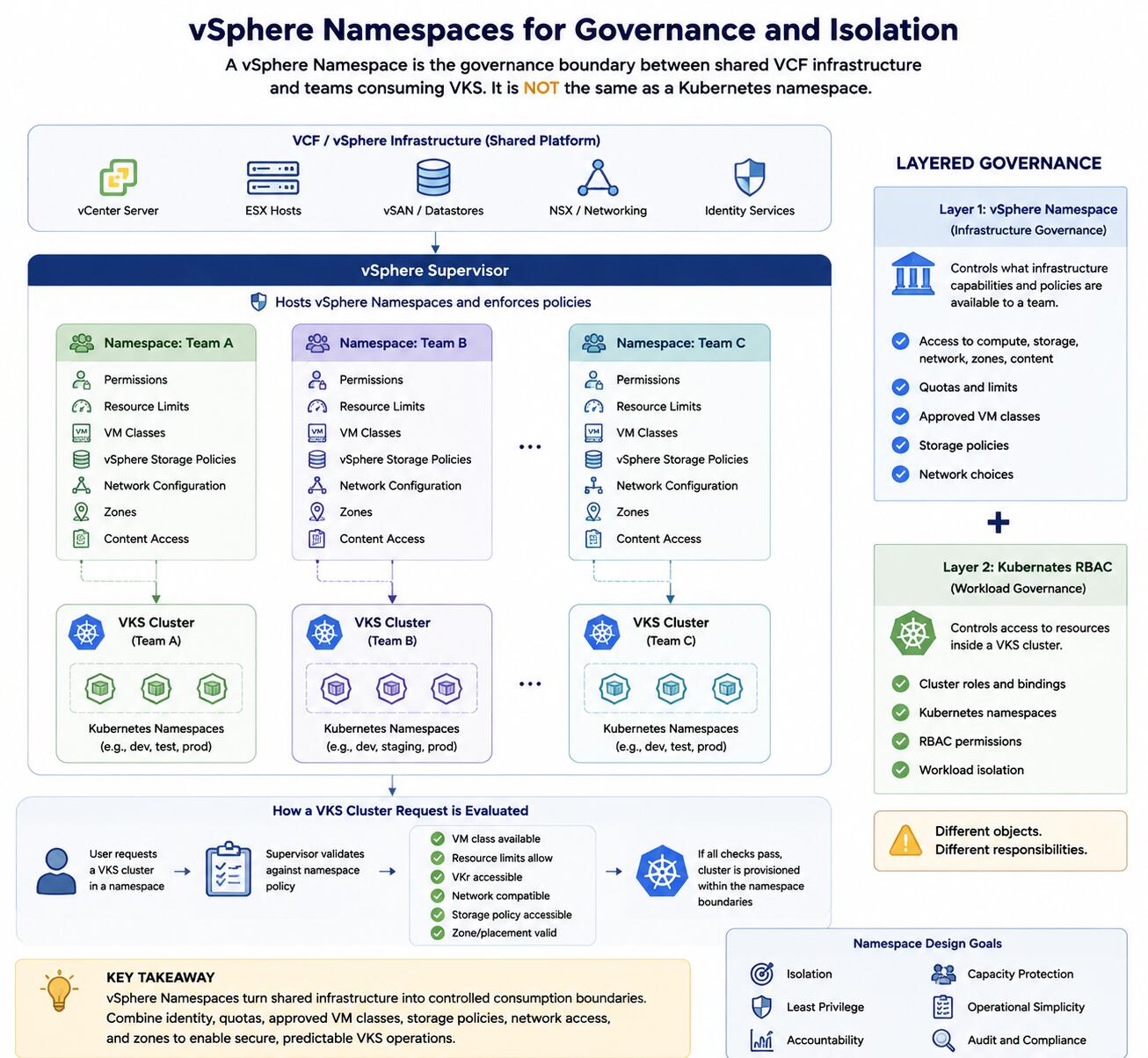
A vSphere Namespace is the primary governance boundary between shared VMware Cloud Foundation (VCF) infrastructure and teams consuming VMware vSphere Kubernetes Service (VKS). Its design controls who can use platform resources, which infrastructure policies are available, and how workloads are separated. It is not the same object as a Kubernetes namespace inside a VKS cluster.
Architecture Overview
The vSphere Supervisor hosts vSphere Namespaces. Administrators assign permissions, resource limits, VM classes, vSphere Storage Policies, network choices, zones, and content access to each namespace. Authorized users can then create supported workloads, including VKS clusters, within those boundaries.
Governance is layered. The vSphere Namespace constrains access to infrastructure-backed capabilities, while Kubernetes Role-Based Access Control (RBAC) and Kubernetes namespaces govern resources inside a VKS cluster. Both layers are necessary in a multi-team platform.
Core Components
Component Explanation
- Permissions: Identify users or groups allowed to view, edit, or consume namespace capabilities.
- Resource limits: Bound compute consumption and protect shared platform capacity.
- VM classes: Offer approved virtual-machine shapes for VKS control-plane and worker nodes or VM Service workloads.
- vSphere Storage Policies: Determine which storage capabilities can be requested through Kubernetes storage classes.
- Network configuration: Assigns the supported connectivity and isolation model available to namespace workloads.
- Zones: Constrain or distribute placement according to the Supervisor topology.
- Content access: Controls access to eligible images or libraries needed by supported workloads.
How Components Work Together
When a user requests a VKS cluster, the specification is evaluated against namespace policy. The requested VM class must be available, resource limits must permit the nodes, a compatible vSphere Kubernetes release (VKr) must be accessible, and network and storage assignments must support the requested topology.
After provisioning, application administrators connect to the VKS cluster and use Kubernetes-native controls. A vSphere Namespace permission does not automatically define every permission inside the workload cluster. Conversely, a Kubernetes cluster role cannot grant infrastructure resources that the parent vSphere Namespace does not expose.
Design Considerations
Define namespaces around trust, ownership, cost, lifecycle, and isolation boundaries. A single namespace shared by unrelated teams may simplify initial setup but complicate quotas, audit, change control, and incident containment. Excessively granular namespaces can create operational overhead and fragmented capacity.
Storage and network policies should use least privilege. Offer only the service levels and connectivity models a team requires. Where zones are used, verify that assigned policies and capacity are available across the intended placement domains.
Best Practices
- Map each namespace to an accountable owner and documented purpose.
- Use directory groups instead of individual permissions where supported by the identity design.
- Set resource limits from measured demand and retain operational headroom.
- Publish a small, governed catalog of VM classes and storage policies.
- Separate production and non-production trust boundaries.
- Review namespace permissions and policy assignments regularly.
- Document the distinction between vSphere Namespace and Kubernetes namespace responsibilities.
Common Mistakes
- Using one namespace for teams with different trust or lifecycle requirements
- Assuming namespace quotas automatically enforce application-level fairness inside a cluster
- Granting broad storage or network access for convenience
- Assigning a VM class that underlying hosts cannot satisfy at required scale
- Ignoring zone-aware storage and placement constraints
- Treating vSphere permissions as a replacement for Kubernetes RBAC
Certification Relevance
The 3V0-24.25 knowledge scope includes namespace permissions, quotas, VM classes, storage policies, networking, zones, and isolation. Preparation should emphasize designing a namespace from requirements and tracing how its policy affects VKS cluster admission and later workload operations.
Conclusion
vSphere Namespaces turn shared infrastructure into controlled consumption boundaries. Effective designs combine identity, resource limits, approved compute shapes, storage policies, network access, and zone placement. Keeping this layer distinct from Kubernetes namespaces produces clearer security and operational ownership.