
Introduction
Kubernetes gives application teams a consistent way to deploy and manage containerized workloads, but the Kubernetes control plane is only one part of a production platform. Compute capacity, networking, persistent storage, identity, security, lifecycle management, and operational visibility must also work together.
VMware vSphere Kubernetes Service (VKS) addresses this broader platform requirement by integrating Kubernetes with VMware Cloud Foundation (VCF). It allows organizations to run Kubernetes clusters on the same private cloud foundation used for virtual machines while applying infrastructure policies and operational practices through familiar VMware technologies.
This VMware VKS overview uses VMware Cloud Foundation 9.0 as its technical baseline. It explains the role of VKS, the main platform layers, and the knowledge areas administrators and architects need before moving into detailed design or configuration.
What Is VMware VKS
VMware vSphere Kubernetes Service is the Kubernetes runtime included with VMware Cloud Foundation. VMware describes VKS as a Cloud Native Computing Foundation (CNCF)-certified, conformant Kubernetes runtime in its official VKS overview. Conformance matters because VKS retains standard Kubernetes behaviors and APIs while adding integration with the vSphere platform.
VKS does not replace Kubernetes with a VMware-specific orchestration model. Application and platform teams still work with familiar Kubernetes resources and tools. The integration occurs around the clusters: vSphere provides the virtual infrastructure, the vSphere Supervisor exposes platform capabilities, and VCF services support networking, storage, identity, lifecycle, and operations.
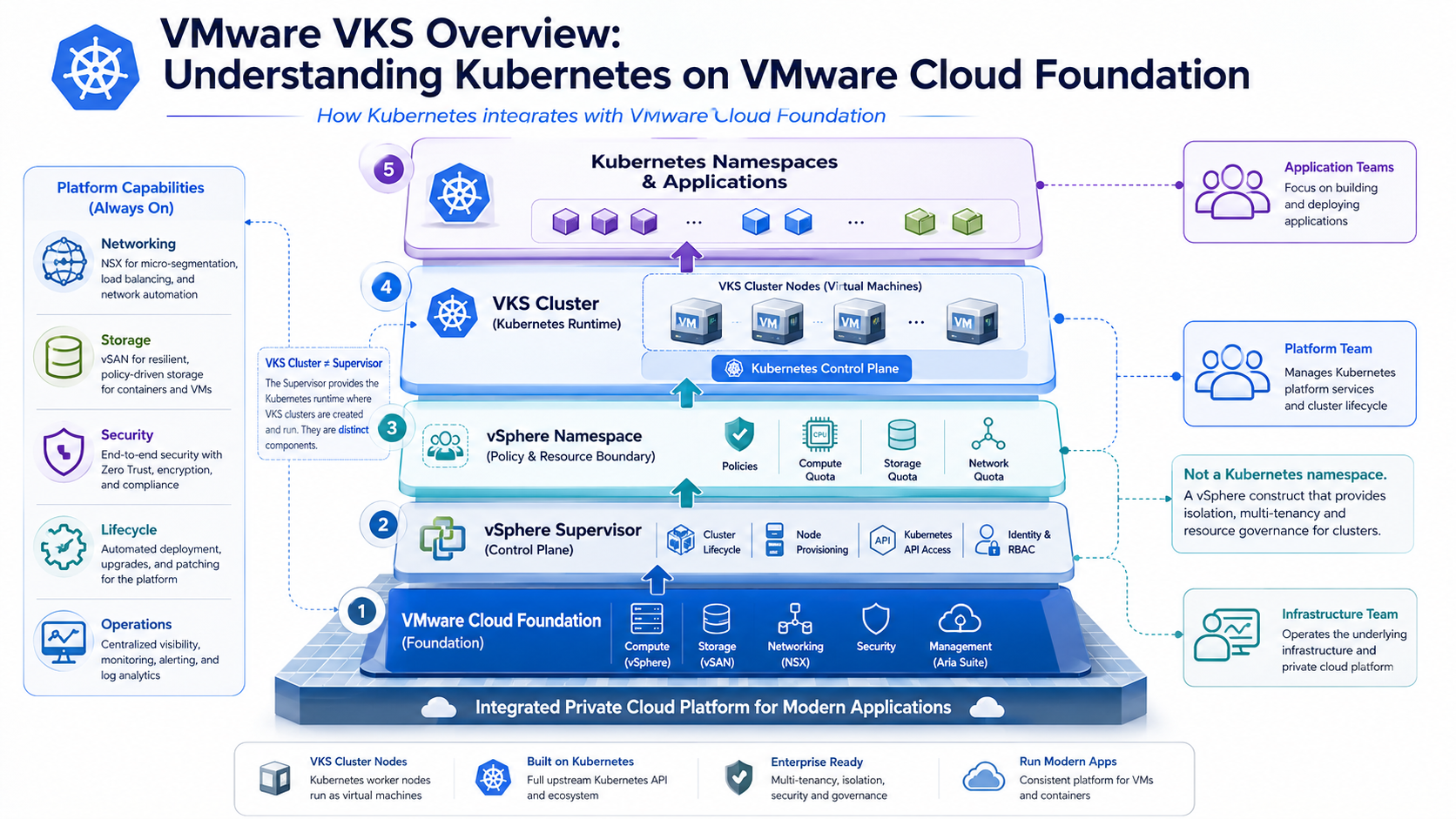
A VKS cluster contains Kubernetes control plane and worker nodes implemented as virtual machines. These cluster nodes can run alongside conventional virtual machines on the same VCF platform. This model allows infrastructure teams to continue managing physical and virtual resources while platform teams consume Kubernetes clusters through declarative interfaces.
Why VMware VKS Matters
Running Kubernetes requires coordination across several technical domains. A cluster may be operational from a Kubernetes perspective but still fail to meet application requirements because of an incorrect network path, unavailable storage class, insufficient infrastructure capacity, or mismatched access policy. VKS brings these dependencies into an integrated private cloud architecture.
The vSphere Supervisor is central to that integration. It provides a consistent API and control layer for modern workloads, including VKS clusters and virtual machines. The VMware Cloud Foundation 9.0 modern applications overview describes how the Supervisor supports declarative management, infrastructure abstraction, integrated services, and workload isolation through vSphere Namespaces.
This design creates a practical division of responsibilities. Infrastructure teams can define capacity, networking, storage, and access guardrails. Platform teams can provision and operate Kubernetes clusters within those boundaries. Application teams can then deploy workloads using standard Kubernetes methods. The exact responsibility model varies by organization, but the platform provides clear control points for separating infrastructure administration from workload consumption.
Core Concepts
Understanding VKS begins with the relationship between platform layers. Similar terms sometimes represent different scopes, so each object should be identified by its role rather than by name alone.
Concept Details
| Platform layer or object | Primary role | Typical responsibility |
|---|---|---|
| VMware Cloud Foundation | Provides the integrated private cloud platform, including compute, networking, storage, lifecycle, and operations capabilities | Cloud infrastructure and architecture teams |
| vSphere Supervisor | Enables Kubernetes-based platform services and provides the control layer used to provision and manage modern workloads | vSphere and platform administrators |
| vSphere Namespace | Defines an infrastructure resource, access, storage, and network policy boundary on the Supervisor | Infrastructure or platform administrators |
| VKS cluster | Provides a conformant Kubernetes environment for containerized workloads | Kubernetes platform and operations teams |
| Kubernetes namespace | Organizes and isolates workload resources inside a Kubernetes cluster | Application and Kubernetes teams |
The vSphere Supervisor is not the same object as a VKS cluster. The Supervisor enables platform services and governs the infrastructure used to create workload clusters. A VKS cluster is a separate Kubernetes cluster consumed by platform or application teams. Its control plane and worker nodes run as virtual machines on vSphere.
A vSphere Namespace is also distinct from a Kubernetes namespace. A vSphere Namespace establishes a resource and policy boundary on the Supervisor. Administrators can associate permissions, storage policies, compute capacity, and supported network configuration with it. A Kubernetes namespace exists inside a VKS cluster and scopes Kubernetes objects such as Deployments, Services, Secrets, and ConfigMaps.
Networking connects Kubernetes objects to the VCF network design. Depending on the supported deployment architecture, Supervisor and VKS networking can use VMware NSX constructs or a vSphere Distributed Switch (VDS) with an appropriate load-balancing design. Related concepts include NSX Virtual Private Cloud (VPC), NSX Segment, Container Network Interface (CNI), ingress, egress, and service exposure. These choices affect address allocation, isolation, routing, and connectivity to external systems.
Storage integration maps Kubernetes storage requests to vSphere-backed storage. vSphere Storage Policies express infrastructure capabilities and placement requirements, while the vSphere Container Storage Interface (CSI) Driver supports Kubernetes persistent volume operations. VMware vSAN or Virtual Machine File System (VMFS)-backed datastores may provide the underlying capacity, subject to the environment design and supported configuration. Kubernetes users normally consume these capabilities through storage classes and persistent volume claims rather than selecting datastores directly.
Security spans both platform and cluster layers. Identity integration, Role-Based Access Control (RBAC), certificates, registry trust, secrets, and network policy contribute to the overall security model. Effective access design must account for permissions on the vSphere Supervisor and vSphere Namespace as well as authorization inside each VKS cluster.
Lifecycle management covers more than creating and deleting clusters. Administrators must manage supported Kubernetes releases, cluster scaling, updates, package repositories, add-ons, certificates, backup, and recovery. A vSphere Kubernetes release (VKr) defines a supported Kubernetes release for VKS cluster deployment. Release availability and compatibility should always be verified against documentation for the installed VCF and VKS versions.
Operations cross all these layers. A cluster provisioning failure may originate in the Kubernetes specification, the vSphere Namespace, network services, content availability, storage policy assignment, or infrastructure capacity. Monitoring and troubleshooting therefore require both Kubernetes-level evidence and visibility into the supporting VMware environment.
Target Audience
This topic is relevant to vSphere administrators who are extending existing infrastructure to Kubernetes, Kubernetes platform engineers responsible for clusters on VCF, and cloud architects designing a shared platform for virtual machines and containers. It also applies to support and operations professionals who must trace issues across Kubernetes and VMware infrastructure layers.
Application engineers benefit from understanding the platform boundaries even when they do not administer VCF. Knowing how a Kubernetes storage class, load balancer, identity provider, or cluster version maps to infrastructure services makes application requirements easier to communicate and diagnose.
Readers preparing for VMware Certified Advanced Professional - VMware Cloud Foundation VKS (3V0-24.25) can use this overview as a foundation for deeper study. The expected knowledge extends beyond product vocabulary to Kubernetes architecture, networking, storage, security, lifecycle operations, and troubleshooting.
Career or Technical Value
VKS knowledge develops skills at the boundary between private cloud infrastructure and cloud-native platforms. That boundary is technically valuable because production Kubernetes services depend on coordinated decisions across compute, networking, storage, identity, and operations.
For a vSphere administrator, learning VKS adds Kubernetes resource models and declarative operations to existing infrastructure expertise. For a Kubernetes specialist, it adds an understanding of how cluster requirements map to virtual infrastructure and enterprise policy. Architects gain a common model for discussing ownership, isolation, capacity, availability, and lifecycle across teams.
These skills also improve troubleshooting. Instead of treating every symptom as a cluster problem, an operator can identify whether the failing dependency belongs to the workload, VKS cluster, vSphere Namespace, Supervisor, or underlying VCF service. That layered reasoning is useful in both routine administration and complex incident analysis.
Common Learning Challenges
The first challenge is terminology. vSphere Supervisor, vSphere Namespace, VKS cluster, and Kubernetes namespace are related but serve different purposes. Treating them as interchangeable leads to incorrect assumptions about where resources and policies are configured.
The second challenge is crossing administrative boundaries. Kubernetes objects express application intent, while VCF services supply the infrastructure that fulfills that intent. Learners need to trace a requirement through both layers—for example, from a persistent volume claim to a storage class, vSphere Storage Policy, and backing datastore.
Networking is another frequent source of confusion because supported designs may use different combinations of NSX networking, VDS, load balancers, address ranges, and CNI components. It is important to learn the selected topology as a complete traffic path rather than memorizing isolated component names.
Version awareness also matters. VKS capabilities, supported integrations, vSphere Kubernetes releases, and lifecycle procedures change over time. Documentation must be matched to the installed VCF version, and legacy terminology should not be carried into a current design without context.
A productive learning sequence starts with Kubernetes fundamentals, then establishes the VCF platform hierarchy before moving into networking, storage, security, lifecycle, and troubleshooting. Hands-on observation should connect Kubernetes resources to their corresponding vSphere objects and policies.
Conclusion
VMware vSphere Kubernetes Service provides conformant Kubernetes as an integrated capability of VMware Cloud Foundation. The essential architecture is layered: VCF supplies the private cloud foundation, the vSphere Supervisor enables modern workload services, vSphere Namespaces define infrastructure policy boundaries, and VKS clusters run Kubernetes workloads.
That model lets infrastructure, platform, and application teams work at different levels while sharing a coordinated set of services. A sound understanding of the boundaries between those levels is the starting point for designing networks and storage, securing access, managing cluster lifecycle, and troubleshooting VKS environments. The rest of the technical series builds on this foundation with progressively deeper coverage of each domain.