
Introduction
VMware vSphere administrators already understand resource pools, virtual machines, networks, and policy-based storage. Kubernetes uses the same underlying compute, network, and storage resources, but exposes them through a declarative application platform. Understanding that change in operating model is essential before designing or operating VMware vSphere Kubernetes Service (VKS).
This article introduces the Kubernetes concepts that appear throughout a VKS environment. It focuses on the vocabulary, object relationships, and administrative boundaries that infrastructure professionals need before moving into platform-specific architecture and operations.
What Is Kubernetes
Kubernetes is an orchestration system for running containerized applications across a cluster of machines. Instead of an administrator placing each process on a specific server, a desired-state document declares what should run. Kubernetes controllers compare that declaration with current state and continually work to close the difference.
A virtual machine packages an operating system and virtual hardware. A container normally packages an application and its runtime dependencies while sharing the host operating-system kernel. In VKS, Kubernetes nodes are virtual machines, and application containers run inside Pods scheduled onto those nodes.
Why Kubernetes Fundamentals Matter for VKS
VKS integrates Kubernetes lifecycle with VMware infrastructure, but it does not replace Kubernetes concepts. A vSphere administrator may provision the underlying cluster through vSphere, while a platform or application team uses Kubernetes application programming interfaces (APIs) to deploy workloads.
Effective operations require both views. A failed application can originate in a Kubernetes manifest, a node condition, a network policy, a storage claim, or an infrastructure dependency. Knowing which layer owns an object prevents teams from troubleshooting the wrong control plane.
Core Concepts
Control Plane and Worker Nodes
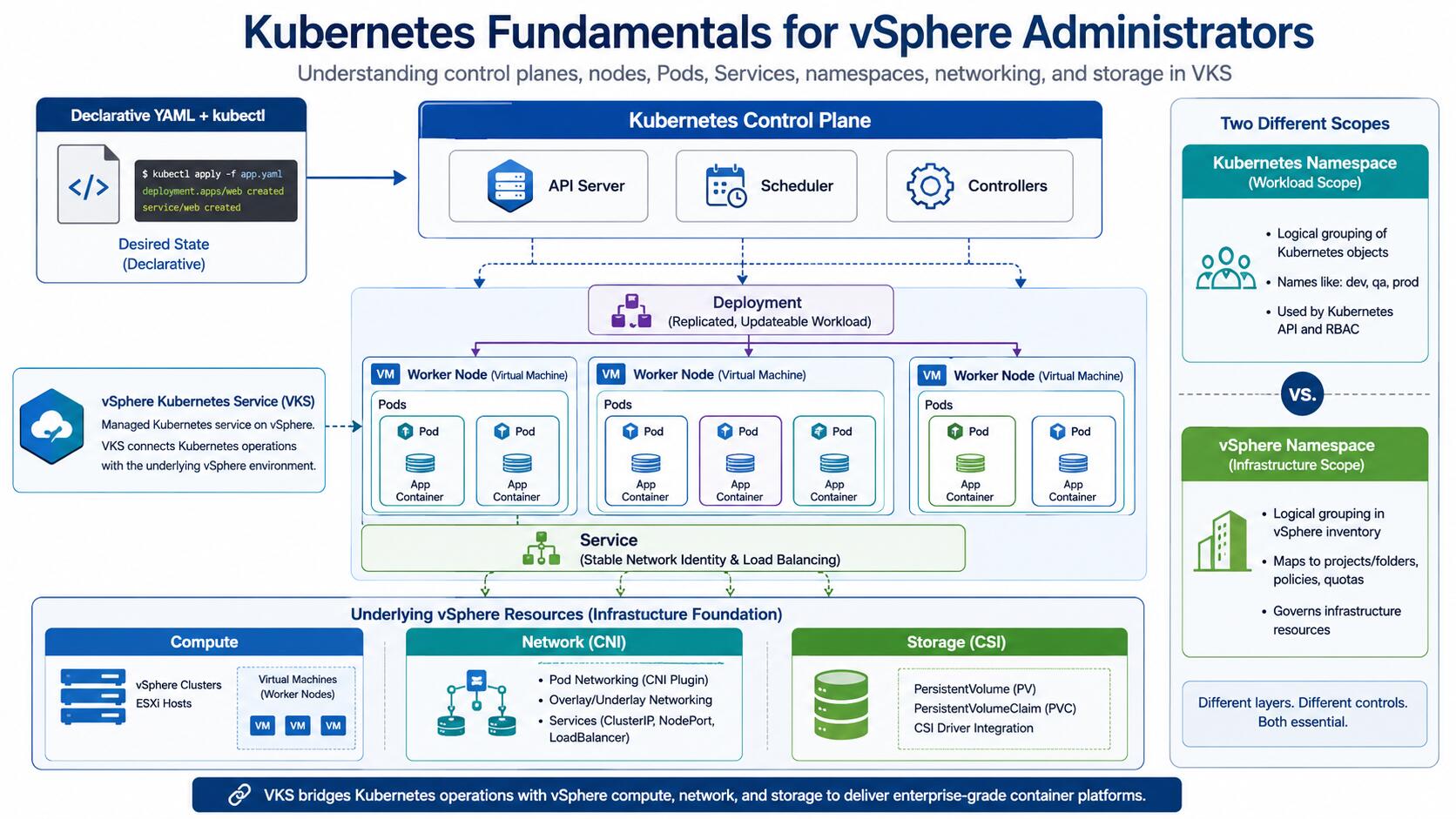
The Kubernetes control plane stores and reconciles cluster state. Its API server accepts requests, the scheduler assigns eligible Pods to nodes, and controllers act on declared state. Worker nodes provide the runtime capacity for application Pods. VKS provisions these roles as managed virtual machines according to a cluster specification.
Pods, Deployments, and Services
A Pod is Kubernetes' smallest deployable workload unit and can contain one or more tightly coupled containers. Pods are disposable; applications should not depend on a particular Pod name or address.
A Deployment describes a replicated, updateable set of Pods. Its controllers replace failed instances and coordinate rolling changes. A Kubernetes Service gives a stable network identity to a selected group of Pods, separating service discovery from changing Pod addresses.
Kubernetes Namespaces and vSphere Namespaces
A Kubernetes namespace scopes Kubernetes objects inside a cluster. It is different from a vSphere Namespace, which is a vSphere governance boundary used to assign infrastructure access, policies, and capacity to VKS clusters and other supported workloads. Treating the two as interchangeable creates authorization and troubleshooting errors.
Declarative YAML and kubectl
Kubernetes resources are commonly represented in YAML. A manifest identifies an API version and object kind, supplies metadata, and declares a specification. The kubectl command-line tool submits and inspects these resources through a Kubernetes API server.
Declarative management works best when manifests are version-controlled and reviewed. Direct changes made only in a live cluster are harder to audit and reproduce.
Helm and Packaged Applications
Helm packages related Kubernetes manifests into charts and renders configurable releases. It simplifies repeatable application installation, but it does not remove the need to understand the Kubernetes objects a chart creates. Operators should inspect chart values, permissions, storage requirements, and upgrade behavior before deployment.
Networking, Storage, and Service Mesh
A Container Network Interface (CNI) implementation connects Pods and supports cluster networking behavior. PersistentVolume and PersistentVolumeClaim objects represent durable storage independently of Pod lifetime. A Container Storage Interface (CSI) driver connects Kubernetes storage requests to an external storage platform.
A service mesh is an optional application-traffic layer that can add capabilities such as service identity, traffic policy, and telemetry. It complements rather than replaces CNI networking, Kubernetes Services, ingress, or infrastructure load balancing.
Target Audience
This foundation is intended for vSphere administrators, platform engineers, architects, and support professionals moving from virtual infrastructure into VKS operations. Readers should already understand basic IP networking, storage availability, and virtual-machine lifecycle.
Career or Technical Value
Kubernetes literacy enables infrastructure teams to trace a requirement from an application manifest to the VKS cluster and then to vSphere, VMware NSX, and VMware vSAN dependencies. It also improves collaboration: application teams can describe desired Kubernetes behavior while infrastructure teams can explain capacity, policy, availability, and failure-domain constraints.
Common Learning Challenges
- Treating a Pod as a long-lived virtual machine instead of a replaceable workload unit
- Confusing Kubernetes namespaces with vSphere Namespaces
- Focusing on commands without understanding controller-driven reconciliation
- Assuming a Kubernetes Service automatically provides external access
- Treating a PersistentVolumeClaim as the storage system rather than a request fulfilled through a storage class and CSI integration
- Installing Helm charts without reviewing the resources and privileges they create
Conclusion
Kubernetes introduces a declarative, controller-driven operating model on top of familiar infrastructure resources. For VKS administrators, the essential foundation is understanding nodes, Pods, controllers, Services, namespaces, YAML, networking, and storage as connected layers. That foundation makes later VKS architecture, provisioning, security, and troubleshooting decisions easier to reason about.