
Introduction
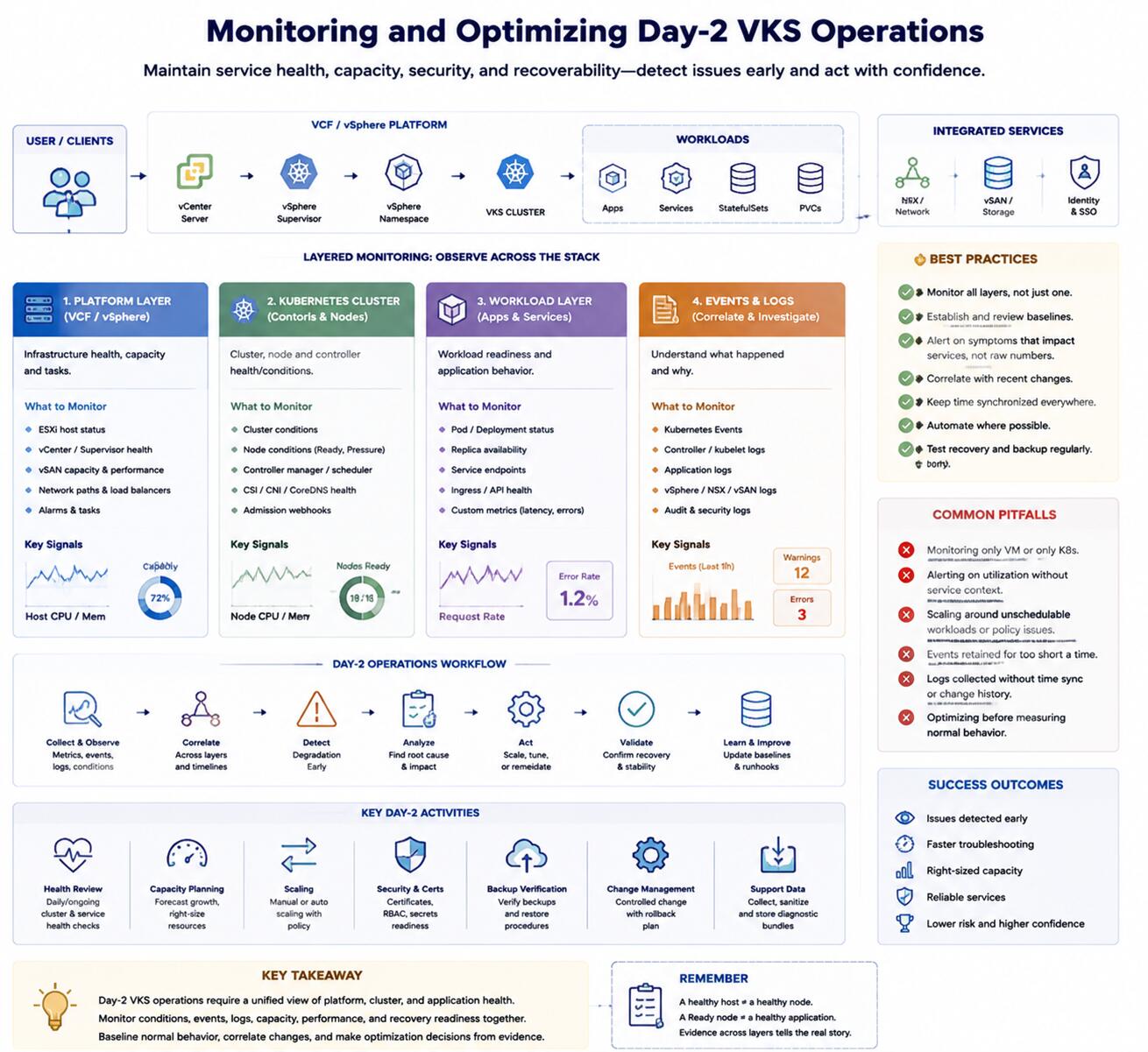
Day-2 operations begin after a VMware vSphere Kubernetes Service (VKS) cluster becomes ready. The objective is to maintain service health, capacity, security, and recoverability while detecting degradation before it becomes an outage. Effective monitoring combines VMware Cloud Foundation (VCF) infrastructure evidence with Kubernetes conditions, events, metrics, and logs.
What Are Day-2 VKS Operations
Day-2 work includes health review, capacity planning, scaling, performance analysis, certificate and content readiness, backup verification, support-data collection, and controlled change. It spans the vSphere Supervisor, vSphere Namespaces, VKS clusters, integrated network and storage systems, and applications.
Why Layered Monitoring Matters
Kubernetes and infrastructure expose different symptoms. A pending Pod may indicate application resource requests, node pressure, missing storage, policy denial, or unavailable capacity. A healthy ESX host does not prove that a VKS node is Ready, and a Ready node does not prove that an application endpoint is serving traffic.
Correlating time, object identity, and recent changes across layers turns monitoring data into operational evidence.
Core Concepts
Health and Conditions
Track Supervisor Service health, namespace readiness, VKS cluster conditions, node conditions, workload readiness, and critical controller reconciliation. Establish a baseline for normal transition times so operators can identify stuck operations.
Events and Logs
Kubernetes events explain recent object-level decisions but have limited retention. Collect relevant controller, node, application, and infrastructure logs centrally according to security and retention policy. Synchronize time across components to preserve correlation.
Capacity and Scaling
Monitor CPU, memory, storage capacity, IP pools, VM class availability, namespace quota, and load-balancer resources. Scaling decisions should distinguish sustained demand from faulty requests, memory leaks, unschedulable constraints, or unavailable dependencies.
Performance Indicators
Measure indicators tied to user outcomes, such as API responsiveness, workload latency, error rate, saturation, and recovery time. Infrastructure utilization is useful context but not a complete service-level measure.
Support Data
Maintain a repeatable process for collecting cluster descriptions, conditions, events, relevant logs, configuration versions, recent changes, and infrastructure tasks. Remove or protect secrets before sharing diagnostic bundles.
Target Audience
This operating model is for platform operations, site reliability, infrastructure, Kubernetes, and support teams responsible for VKS services.
Career or Technical Value
Day-2 discipline shifts teams from reactive command execution to evidence-driven operations. It also supplies baselines needed for faster troubleshooting and safer capacity decisions.
Common Learning Challenges
- Monitoring only virtual-machine health or only Kubernetes health
- Alerting on raw utilization without service context
- Scaling around an unschedulable policy or dependency failure
- Retaining events for too short a period to investigate recurring issues
- Collecting logs without synchronized timestamps or change history
- Optimizing before establishing a measurable baseline
Conclusion
Day-2 VKS operations require a unified view of platform, cluster, and application health. Monitor conditions, events, logs, capacity, performance, and recovery readiness together. Baseline normal behavior, correlate changes, and make optimization decisions from evidence rather than isolated metrics.