
Introduction
IPv6 uses 128-bit addresses and removes IPv4 broadcast, but it still depends on precise interface scope, prefix selection, neighbor discovery, and routing. Learning IPv6 as a separate address model is more reliable than treating it as IPv4 with longer notation.
What IPv6 Addressing Represents
IPv6 addresses are written as hexadecimal groups. Leading zeros in a group may be omitted, and one continuous run of zero groups may be compressed with ::. Expand an address before comparing prefixes so that compression does not hide a difference.
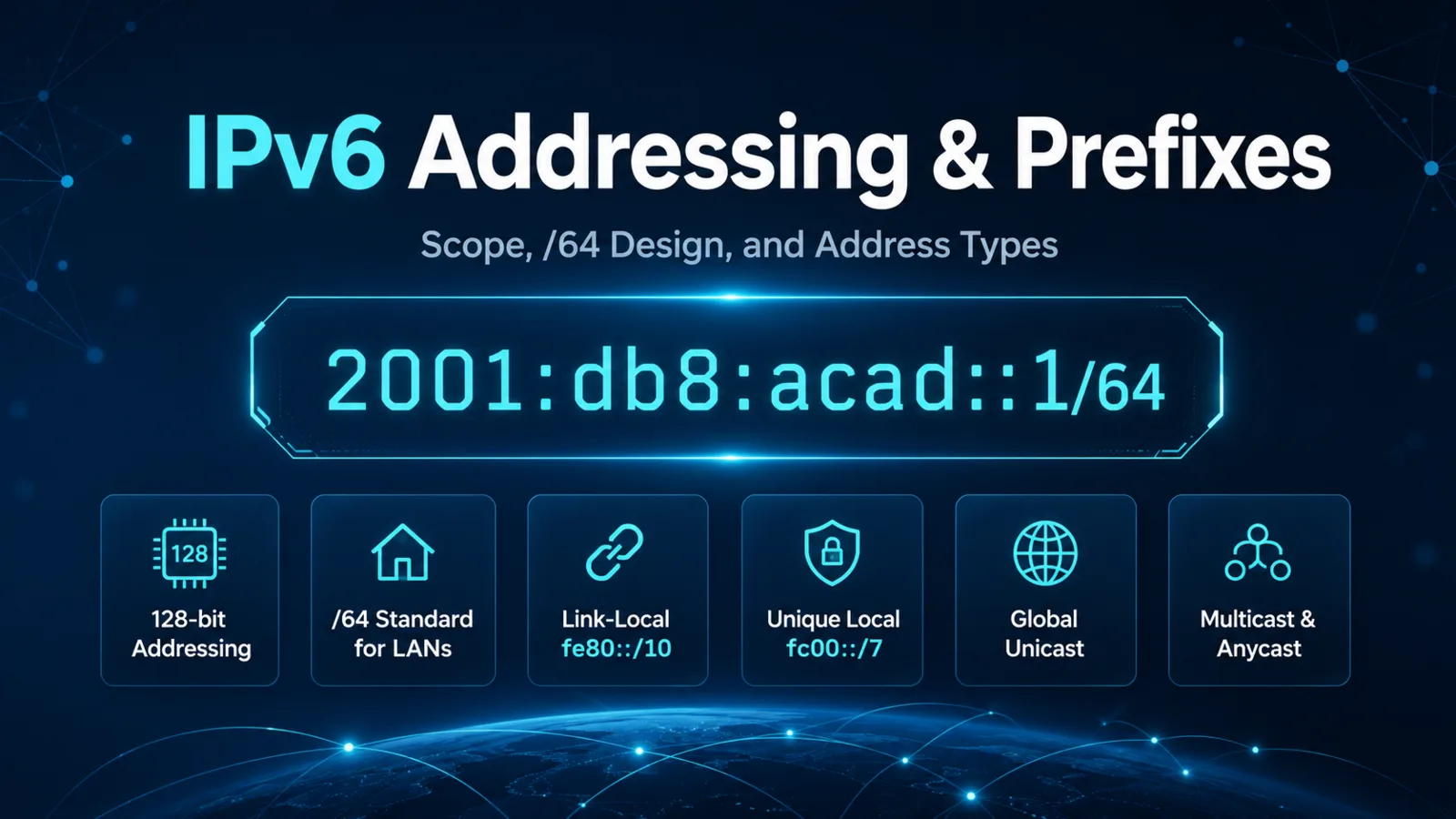
A prefix length states how many leading bits identify the network. /64 is the standard subnet size for many LAN use cases and supports Stateless Address Autoconfiguration, but published design and platform requirements should control real deployments.
Why Address Scope Matters
Global unicast addresses are intended for globally routable unicast communication. Unique local addresses use fc00::/7 for local organization use and are not intended for global Internet routing. Link-local addresses use fe80::/10 and operate only on the local link; every IPv6-enabled interface needs link-local behavior for functions such as neighbor discovery and next-hop communication.
Multicast delivers to a group and replaces several IPv4 broadcast uses. Anycast assigns the same unicast address to multiple interfaces so routing directs traffic toward an available or topologically closest instance. These are delivery semantics, not merely address formats.
Core Concepts
Configure and Verify Deliberately
An interface can receive a manually configured address, derive addressing through autoconfiguration, or obtain configuration through DHCPv6 depending on design. Modified EUI-64 can derive an interface identifier from a 48-bit MAC address by inserting fffe and changing the universal/local bit. Modern systems may instead use stable or temporary privacy-oriented identifiers, so do not assume every host address reveals a MAC address.
Verify the complete address, prefix, link-local address, interface state, and installed routes. When a link-local next hop is used, the outgoing interface can be necessary because identical link-local addresses may exist on different links.
Practical Troubleshooting
Start by comparing the source and destination prefix. Check whether neighbor discovery resolves the local next hop, then inspect the IPv6 routing table. Test by address before testing DNS. A working link-local exchange proves only the local link; it does not prove global routing.
Common Learning Challenges
- Compressing more than one zero run with ::
- Calling link-local addresses private IPv6 addresses
- Expecting routers to forward link-local traffic between links
- Confusing multicast group delivery with anycast route selection
- Assuming modified EUI-64 is mandatory for all interface identifiers
- Verifying an address without checking its prefix and route
Conclusion
IPv6 troubleshooting depends on three questions: what scope does the address have, which prefix owns the destination, and how is the next hop resolved? Answer those with interface, neighbor, and route evidence.