
Introduction
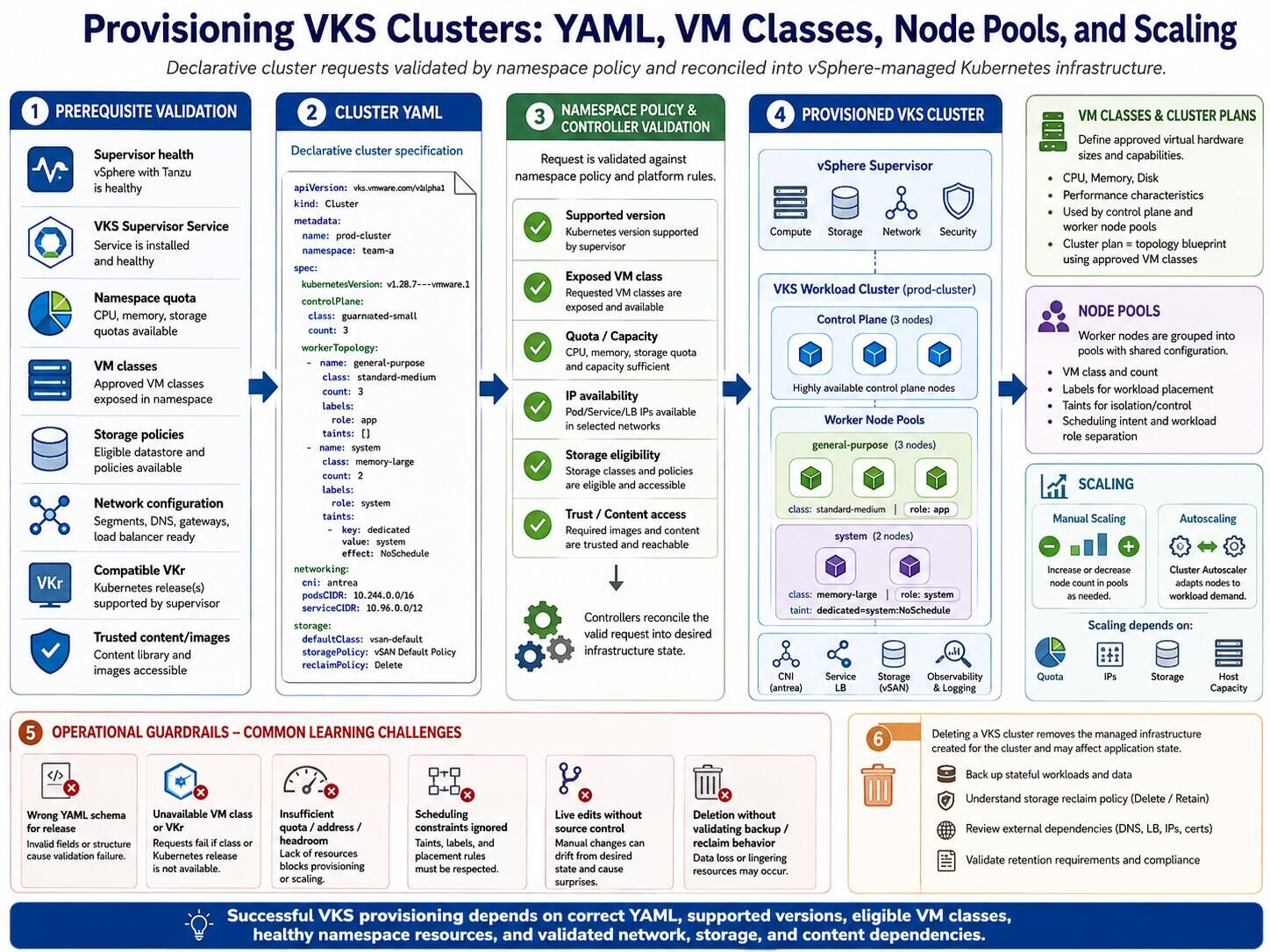
VMware vSphere Kubernetes Service (VKS) cluster provisioning is a declarative workflow. A cluster specification describes the desired Kubernetes release, control-plane and worker topology, virtual-machine sizing, networking, storage, and optional behavior. Platform controllers validate that request against the vSphere Namespace and reconcile the required virtual machines and cluster services.
The most reliable workflow begins with dependency validation and treats YAML as controlled configuration rather than an isolated command payload.
What Is VKS Cluster Provisioning
Provisioning creates a dedicated Kubernetes workload cluster on a vSphere Supervisor. The resulting VKS cluster contains its own Kubernetes API, control-plane nodes, worker nodes, and integrated networking and storage components. It consumes only the VM classes, vSphere Storage Policies, zones, content, and capacity made available through its vSphere Namespace.
Why Declarative Provisioning Matters
Declarative specifications make intent reviewable and repeatable. Controllers continuously compare desired and observed state, so operators should diagnose reconciliation conditions instead of assuming that submission is a one-time build script.
Version-controlled specifications also make changes easier to audit. Secrets and environment-specific values should still be handled through approved secure mechanisms rather than committed directly to a repository.
Core Concepts
Prerequisite Validation
Before submitting a cluster, confirm that the Supervisor and VKS Supervisor Service are healthy; the vSphere Namespace exposes sufficient quota, eligible VM classes, storage policies, network configuration, and a compatible vSphere Kubernetes release (VKr); and required images or content are reachable and trusted.
Cluster YAML
A cluster manifest identifies the supported API and kind, supplies metadata, and declares the desired topology. Field names and schema vary with the installed VKS version, so operators must use the official example and API reference that match their environment. Do not copy a manifest from a different release without validating it.
VM Classes and Cluster Plans
VM classes define approved virtual hardware sizes. Cluster plans or supported topology choices govern the shape of control-plane and worker resources. Select them from measured capacity, workload needs, availability objectives, and namespace policy rather than from maximum values.
Node Pools
Node pools group worker nodes with a common configuration. Separate pools can support different sizing, placement, or workload requirements when the installed release supports those fields. Kubernetes labels, taints, and scheduling rules must align with the intended workload placement.
Scaling
Manual scaling changes the declared worker count. Automated scaling adds controllers and constraints that respond to schedulability or resource conditions. Scaling still depends on available namespace quota, IP addresses, storage, host capacity, and compatible VM classes.
Deletion
Cluster deletion removes managed cluster infrastructure but can also remove application state. Before deletion, verify backup scope, persistent-volume reclaim behavior, external dependencies, and organizational retention requirements.
Target Audience
This workflow is intended for platform engineers and administrators authorized to create and manage VKS clusters in governed vSphere Namespaces.
Career or Technical Value
Operators who understand reconciliation can distinguish invalid specifications from capacity, content, networking, storage, or trust failures. They can also review a cluster request before it consumes production resources.
Common Learning Challenges
- Using a YAML schema from a different VKS release
- Requesting a VM class or VKr not exposed to the namespace
- Ignoring quota, address-pool, or host-capacity headroom
- Scaling nodes without checking workload scheduling constraints
- Editing live objects without retaining the intended source configuration
- Deleting a cluster before validating data-protection and reclaim behavior
Conclusion
VKS provisioning converts a declarative cluster specification into vSphere-managed Kubernetes infrastructure. Success depends on correct YAML, supported versions, eligible VM classes, adequate namespace resources, and healthy network, storage, and content services. Validate those dependencies first and manage specifications as controlled operational assets.