
Introduction
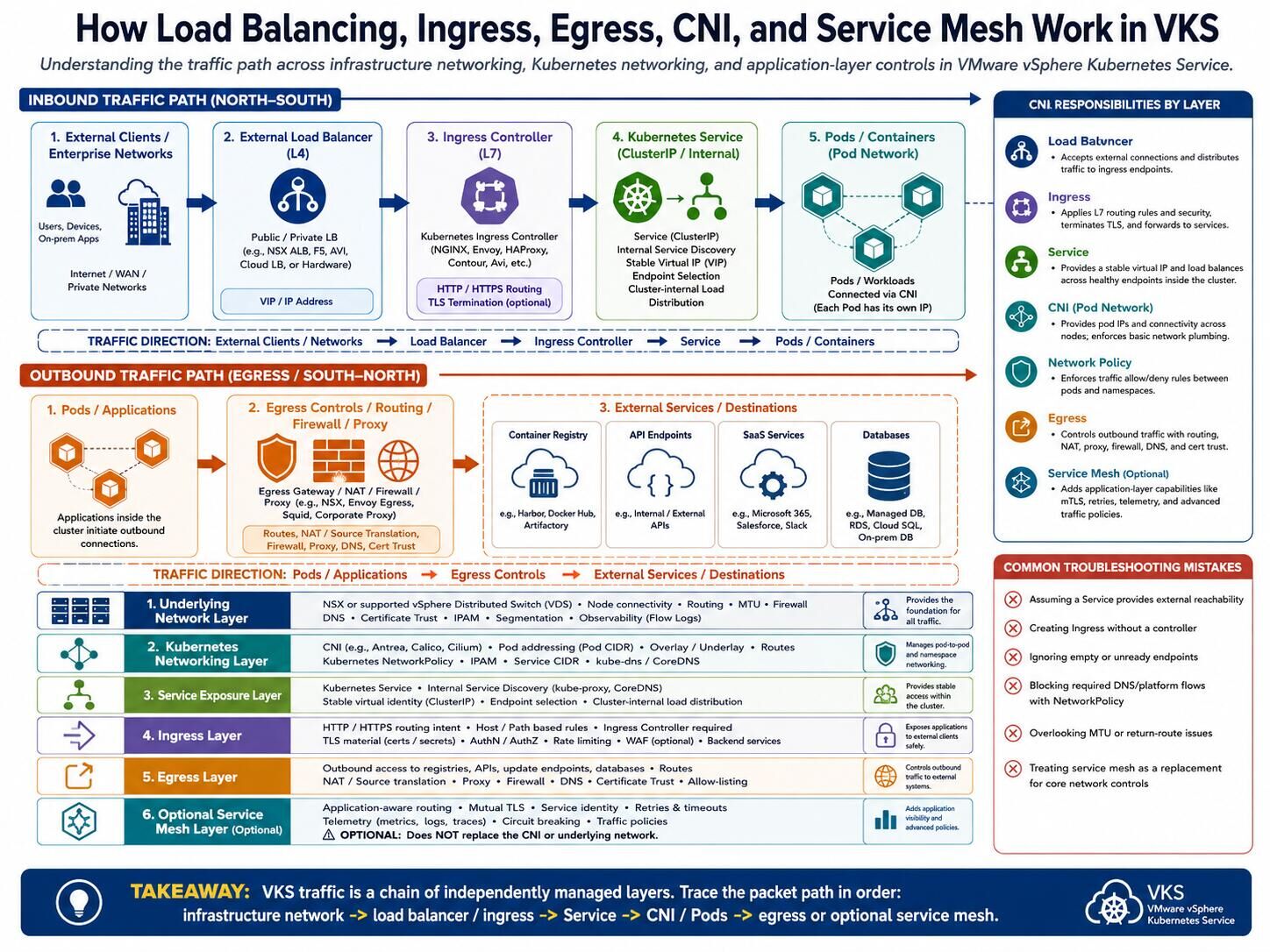
Application traffic in VMware vSphere Kubernetes Service (VKS) crosses several layers. A request can traverse an external network, a load balancer, an ingress controller, a Kubernetes Service, and a Pod network before reaching a container. Return traffic and outbound connections use their own routing and policy paths. Understanding each responsibility prevents the common mistake of treating every connectivity problem as a single “Kubernetes network” issue.
What Is the VKS Traffic Stack
The traffic stack combines infrastructure networking with Kubernetes networking. VMware NSX or a supported vSphere Distributed Switch (VDS) design provides underlying connectivity. A Container Network Interface (CNI) implementation connects Pods and may enforce network policy. Kubernetes Services provide stable service discovery and traffic distribution inside the cluster, while load balancers and ingress components expose selected applications.
An optional service mesh operates at the application-service layer, commonly adding traffic policy, service identity, and telemetry. It does not replace the CNI or the infrastructure network.
Why Traffic-Layer Boundaries Matter
Each layer can be healthy while another fails. A load balancer virtual address may respond even though an ingress rule selects no backend. A Service can resolve in Domain Name System but have no ready endpoints. A Pod can reach its default gateway yet be denied by network policy. Troubleshooting should therefore follow the packet path and check the object responsible for each transition.
Core Concepts
CNI and Pod Connectivity
The CNI implementation establishes Pod interfaces, addressing, and routes according to the VKS network model. Where supported, it also enforces Kubernetes network policies. Node reachability, MTU, address pools, and underlying routing remain infrastructure dependencies.
Kubernetes Services and Load Balancing
A Kubernetes Service selects Pods and provides a stable virtual identity. Cluster-internal service distribution differs from an external load balancer. A Service of an externally exposed type still depends on an integrated load-balancing implementation and routed reachability to the allocated virtual address.
Ingress
Ingress defines HTTP or HTTPS routing intent, but an ingress controller must implement it. The controller needs a reachable exposure path, valid backend Services, appropriate TLS material, and policy that permits traffic. An Ingress object without a matching controller does not route traffic by itself.
Egress
Egress covers traffic initiated by workloads toward external services such as registries, APIs, update endpoints, or databases. Source translation, routes, proxy requirements, firewall policy, Domain Name System, and certificate trust can all affect the path.
Network Policy
Network policy selects traffic by Kubernetes labels and namespace context. Confirm that the installed CNI supports the required policy behavior. Define explicit allowances for infrastructure services such as Domain Name System before introducing restrictive defaults.
Service Mesh
A service mesh can add application-aware routing, mutual TLS, retries, and telemetry. It introduces additional proxies or data-plane components and its own certificate and lifecycle requirements. Use it for a defined application need rather than as a substitute for basic network design.
Target Audience
This topic is intended for VKS platform engineers, network teams, application operators, and support professionals responsible for service exposure and connectivity.
Career or Technical Value
Layered traffic knowledge makes architecture reviews and incident response more precise. Teams can identify whether a symptom belongs to physical routing, NSX or VDS connectivity, load balancing, CNI behavior, Kubernetes Services, ingress, policy, or service mesh.
Common Learning Challenges
- Assuming a Kubernetes Service always creates external reachability
- Creating Ingress resources without an ingress controller
- Ignoring empty or unready Service endpoints
- Applying network policy without allowing required platform flows
- Overlooking MTU and return-route problems
- Treating service-mesh security as a replacement for infrastructure or Kubernetes controls
Conclusion
VKS traffic is a chain of independently managed layers. The underlying network carries node and endpoint traffic, the CNI connects Pods, Kubernetes Services stabilize application addressing, ingress and load balancing expose selected workloads, and optional service-mesh components add application-aware controls. Trace that chain in order to design and troubleshoot it effectively.