
Introduction
VMware vSphere Kubernetes Service (VKS) depends on trusted, version-matched content. Kubernetes releases, Supervisor Services, packages, node images, and application images must be obtainable from approved sources. Connected environments can synchronize content from external services, while air-gapped environments require controlled transfer to local libraries and registries.
Content distribution is different from lifecycle execution: this article focuses on making approved content available and trusted, not on performing cluster upgrades.
What Is the VKS Content Supply Chain
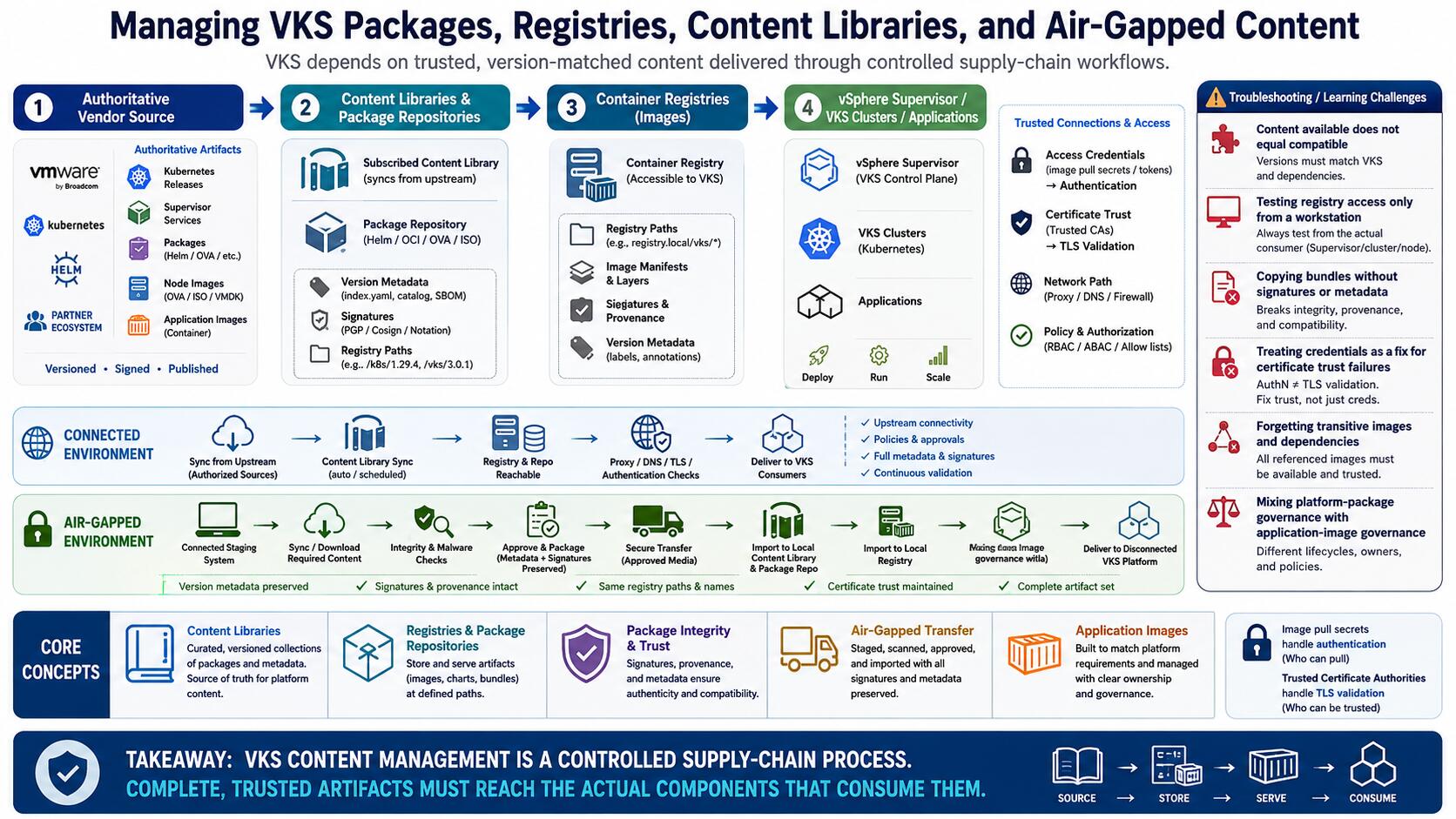
The content supply chain begins with an authoritative vendor source and ends with a Supervisor, VKS cluster, or application retrieving an expected artifact. Along that path, administrators must preserve version metadata, signatures where required, registry paths, certificate chains, and access credentials.
Subscribed content libraries can synchronize eligible upstream content in connected environments. Local content libraries support content imported and managed within the environment. Container registries store images and package bundles, while repositories and package controllers make supported add-ons available to clusters.
Why Content Management Matters
Provisioning and upgrades can fail even when compute, storage, and networking are healthy if an image is absent, a library is unsynchronized, a proxy blocks access, a certificate authority is untrusted, or registry authentication fails. Supply-chain validation should therefore be a standard readiness check.
Core Concepts
Content Libraries
Use the library type and workflow documented for the installed VCF and VKS release. Monitor synchronization status, storage capacity, and item completeness. Do not assume that seeing an item name proves that every referenced artifact is available.
Registries and Package Repositories
Registries must be reachable from the components that pull content, not merely from an administrator workstation. Validate Domain Name System resolution, routing, proxy behavior, authentication, and Transport Layer Security trust from the actual source environment.
Package Integrity and Trust
Preserve vendor-provided signatures and metadata during transfer. Current platform versions can enforce package trust; incomplete copying or missing signatures can block reconciliation. Follow the official version-specific procedure rather than recreating bundles manually.
Air-Gapped Transfer
An air-gapped workflow should document the connected staging system, malware and integrity checks, approved transport, local destination, registry namespace, certificate authority, and evidence of successful import. Every referenced image and dependency must be transferred together.
Application Images
Application registries are governed separately from platform content. Namespace and cluster policies should restrict which registries and credentials are available. Image pull secrets address authentication, while trusted certificate authorities address TLS validation.
Target Audience
This topic applies to platform operators, security teams, release managers, and administrators supporting connected or disconnected VKS environments.
Career or Technical Value
Supply-chain knowledge helps operators prevent late-stage failures and maintain traceability from an installed service back to its approved artifact source.
Common Learning Challenges
- Confusing content availability with version compatibility
- Testing registry access only from a workstation
- Copying package bundles without required signatures or metadata
- Treating credentials as a solution to certificate trust failures
- Forgetting transitive images in an air-gapped transfer
- Mixing platform packages and application-image governance
Conclusion
VKS content management is a controlled supply-chain process. Libraries, registries, repositories, credentials, and certificate authorities must deliver complete and trusted artifacts to the components that consume them. A documented connected or air-gapped workflow creates the foundation for safe lifecycle operations.