
Introduction
The adoption of Kubernetes in enterprise environments has changed the way organizations build, deploy, and manage applications. While Kubernetes provides a powerful platform for container orchestration, many enterprises still require a reliable infrastructure foundation with integrated networking, storage, security, and lifecycle management.
VMware Cloud Foundation with VMware vSphere Kubernetes Service (VKS) addresses this challenge by providing an enterprise-ready Kubernetes platform built on VMware infrastructure.
The VMware Certified Advanced Professional – VMware Cloud Foundation VKS (3V0-24.25) certification validates the skills required to design, deploy, operate, and troubleshoot VKS environments in modern enterprise data centers.
Unlike traditional infrastructure certifications that focus mainly on virtualization administration, this certification evaluates the ability to manage the complete cloud-native infrastructure stack:
- VMware Cloud Foundation
- vSphere infrastructure
- Supervisor architecture
- Kubernetes workloads
- NSX networking
- Storage integration
- Security and operations
This article explains what the 3V0-24.25 certification is, what skills it validates, and who should consider pursuing it.
What Is VMware Certified Advanced Professional – VMware Cloud Foundation VKS?
The VMware Certified Advanced Professional – VMware Cloud Foundation VKS certification is an advanced-level VMware certification focused on the administration and operation of VMware Kubernetes environments.
The exam code is:
3V0-24.25
The certification validates practical knowledge of deploying and managing Kubernetes services integrated with VMware Cloud Foundation.
The goal of this certification is not simply to test Kubernetes knowledge. Instead, it evaluates whether a professional can operate Kubernetes as an enterprise infrastructure service.
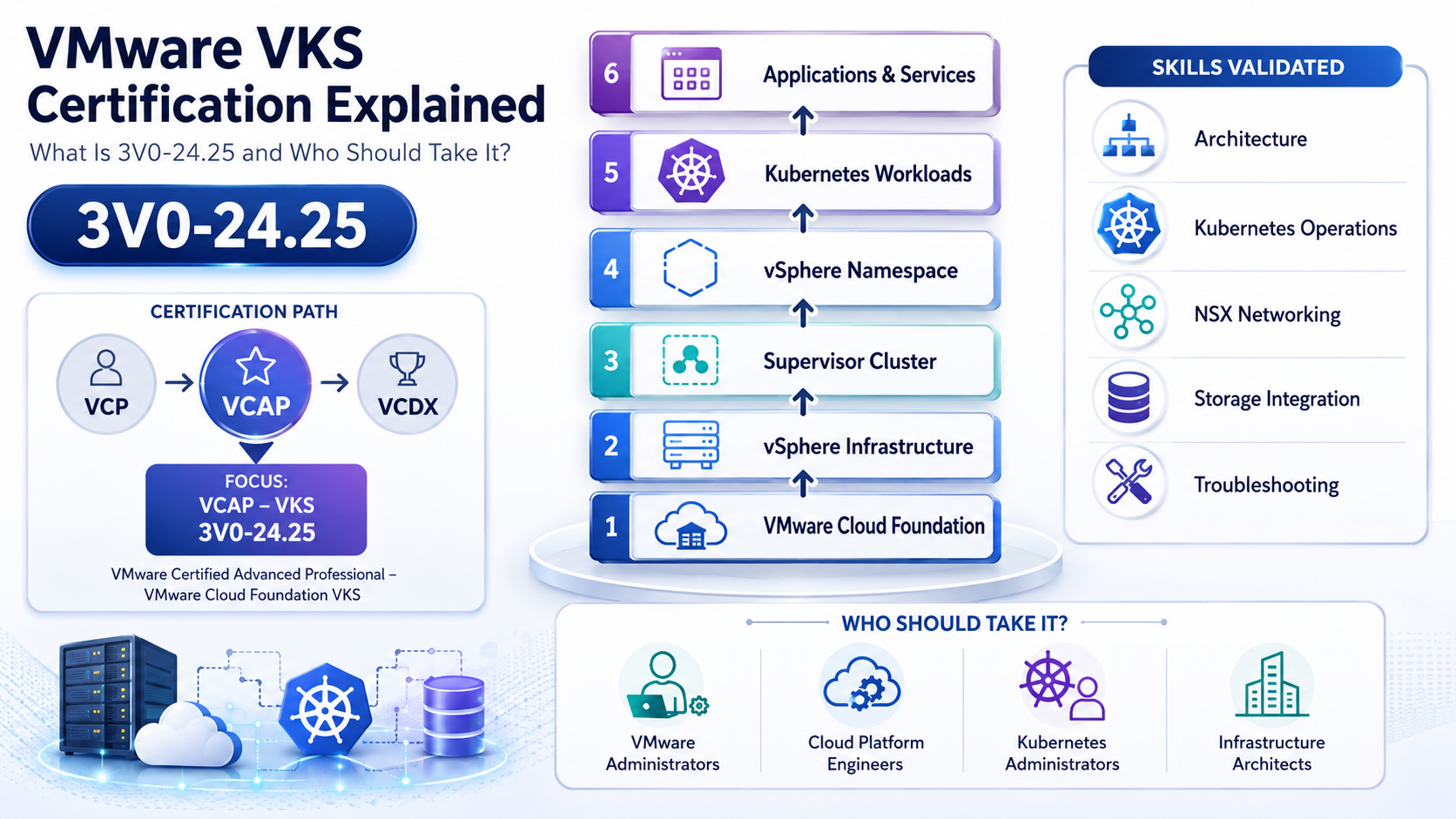
A successful candidate should understand how different components work together:
```
VMware Cloud Foundation
|
|
vSphere
|
|
Supervisor Cluster
|
|
vSphere Namespace
|
|
Kubernetes Workloads
|
|
Applications and Services
```
The certification focuses on the complete lifecycle of VKS environments, including:
- Planning and architecture
- Installation and configuration
- Administration
- Networking and storage integration
- Security management
- Troubleshooting
Where Does 3V0-24.25 Fit in the VMware Certification Path?
VMware certification paths are designed around different levels of expertise.
A simplified view:
```
VMware Certified Professional (VCP)
|
|
↓
VMware Certified Advanced Professional (VCAP)
|
|
↓
VMware Certified Design Expert (VCDX)
```
The 3V0-24.25 certification belongs to the VCAP level, which means it targets professionals who already have practical experience managing VMware environments.
At this level, candidates are expected to move beyond basic configuration tasks and understand:
- Why a specific architecture is required
- How components interact
- How to troubleshoot complex problems
- How to make operational decisions in production environments
What Skills Does the 3V0-24.25 Exam Validate?
The exam evaluates several major capability areas.
1. Understanding VMware VKS Architecture
Candidates need to understand how Kubernetes services are integrated into VMware Cloud Foundation.
Important concepts include:
- Supervisor Cluster
- Kubernetes workload clusters
- vSphere Namespaces
- Kubernetes API access
- Application lifecycle management
A key concept is understanding the relationship between VMware administrators and Kubernetes users.
VMware provides the infrastructure platform, while developers consume Kubernetes services.
2. Managing Kubernetes Workloads on VMware
The exam expects knowledge of Kubernetes operations, including:
- Deploying workloads
- Managing namespaces
- Understanding pods and services
- Working with Kubernetes resources
- Managing application requirements
However, the focus is not on becoming a Kubernetes developer.
The focus is:
> How do you provide Kubernetes as an enterprise infrastructure service?
3. Networking Integration with NSX
Networking is one of the most important areas in VKS environments.
Candidates should understand:
- Kubernetes service networking
- Load balancing
- Ingress and egress traffic
- Network policies
- Security segmentation
For example:
A user accessing an application may follow this path:
```
External Client
↓
Load Balancer VIP
↓
Kubernetes Service
↓
Application Pod
```
Understanding this traffic flow is essential for both design and troubleshooting.
4. Storage Integration
Enterprise Kubernetes requires persistent storage.
Candidates should understand:
- vSAN integration
- Storage policies
- CSI architecture
- Persistent Volumes
- Persistent Volume Claims
A typical storage workflow:
```
Application
↓
Persistent Volume Claim
↓
Persistent Volume
↓
CSI Driver
↓
vSAN Storage
```
5. Troubleshooting Enterprise VKS Environments
At the advanced level, troubleshooting becomes a major skill.
Examples include:
Kubernetes API access failure
Possible areas:
- DNS configuration
- Certificates
- Load balancer configuration
- Network connectivity
Application cannot reach external services
Possible areas:
- Egress configuration
- Network policies
- NAT configuration
- NSX connectivity
Storage provisioning failure
Possible areas:
- StorageClass configuration
- CSI components
- vSAN availability
- Permissions
Who Should Take the 3V0-24.25 Certification?
This certification is especially valuable for professionals working with modern VMware environments.
VMware Administrators
If you already manage:
- vSphere
- vCenter
- ESXi
- vSAN
- NSX
this certification provides a path toward cloud-native infrastructure skills.
Cloud Platform Engineers
Engineers responsible for internal developer platforms can benefit from understanding how VMware delivers Kubernetes services at enterprise scale.
Kubernetes Administrators Moving to VMware
Kubernetes professionals who want to work in enterprise VMware environments can use this certification to understand:
- Infrastructure integration
- Storage management
- Network architecture
- Operational workflows
Infrastructure Architects
Architects designing private cloud platforms need to understand how virtualization and Kubernetes coexist.
The certification provides insight into:
- Platform design decisions
- Resource isolation
- Security boundaries
- Operational models
How Is 3V0-24.25 Different from Traditional VMware Certifications?
Traditional VMware certifications often focus on infrastructure administration.
For example:
```
ESXi
|
vCenter
|
Virtual Machines
|
Storage
|
Networking
```
VKS introduces a broader platform model:
```
VMware Cloud Foundation
|
vSphere Infrastructure
|
Supervisor Services
|
Kubernetes Platform
|
Cloud Native Applications
```
The administrator is no longer managing only virtual machines.
The role evolves into managing a complete application platform.
Why Is VMware VKS Important for Enterprise Cloud?
Many organizations are not replacing virtualization with Kubernetes.
Instead, they are combining both technologies.
Enterprise environments need:
- Stable infrastructure
- Operational consistency
- Security controls
- Integrated storage
- Network management
- Developer-friendly platforms
VMware VKS provides Kubernetes capabilities while maintaining the operational model enterprises already rely on.
Final Thoughts
The VMware Certified Advanced Professional – VMware Cloud Foundation VKS (3V0-24.25) certification represents the evolution of VMware infrastructure management toward cloud-native platforms.
It is not simply a Kubernetes certification and not simply a VMware administration certification.
It sits at the intersection of:
- Virtualization
- Cloud infrastructure
- Kubernetes
- Networking
- Storage
- Enterprise operations
For professionals who want to work with modern private cloud platforms, VKS represents an important skill area.
The most effective preparation strategy is not memorizing isolated concepts. Instead, candidates should understand how VMware Cloud Foundation, vSphere, NSX, storage, and Kubernetes components work together as one integrated platform.