
Introduction
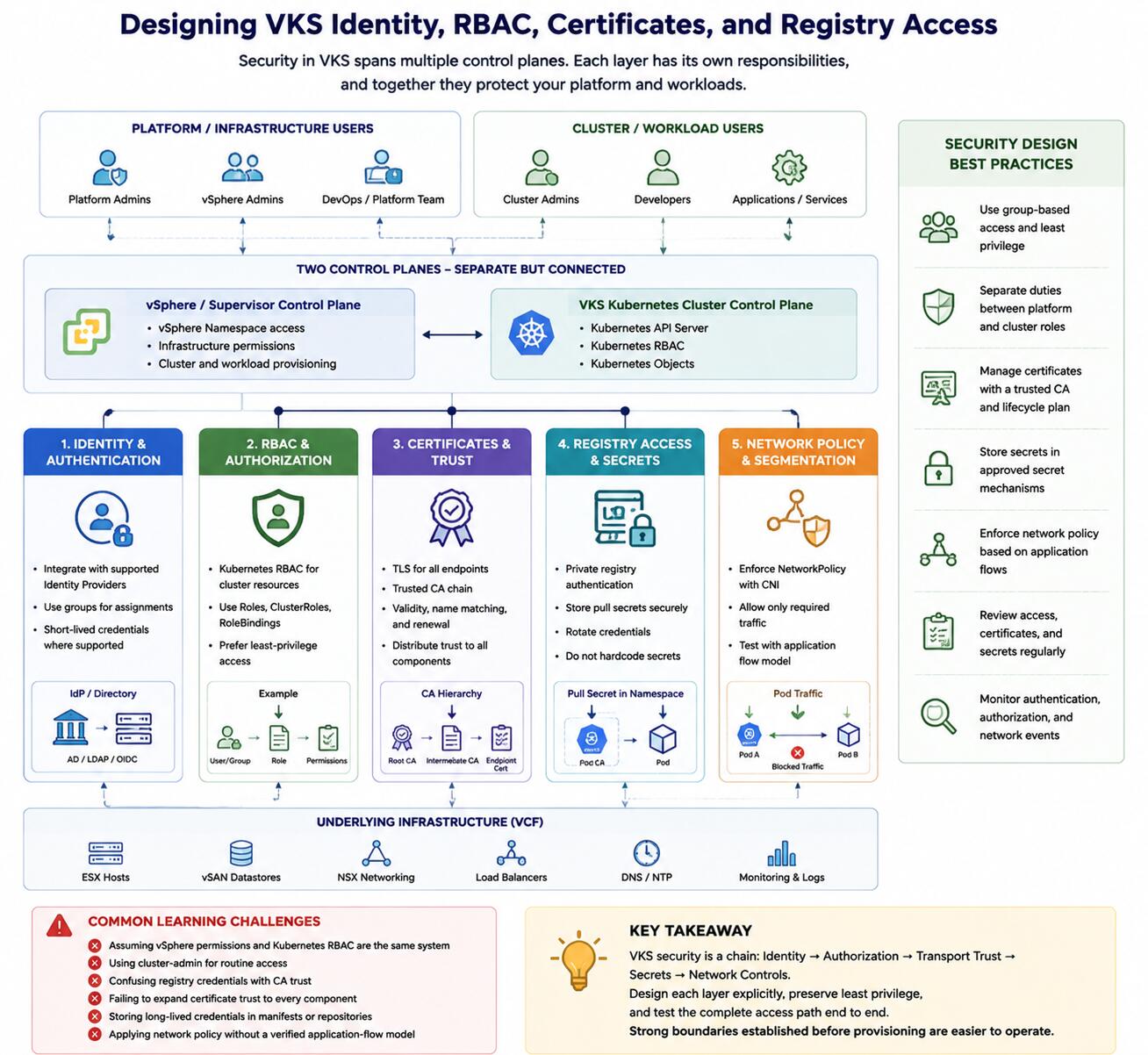
Security in VMware vSphere Kubernetes Service (VKS) spans several control planes. Users authenticate to infrastructure and Kubernetes endpoints, permissions are enforced at both vSphere and Kubernetes layers, certificate authorities establish trust, and registry credentials protect image access. A secure design connects these mechanisms without assuming that one control automatically protects every layer.
What Is the VKS Security Boundary
The platform boundary begins with identities authorized to use a vSphere Namespace and continues into the dedicated Kubernetes API of each VKS cluster. Infrastructure administrators govern namespace access and exposed resources. Cluster administrators use Kubernetes Role-Based Access Control (RBAC) to limit actions on Kubernetes objects.
Transport Layer Security (TLS) protects service endpoints and validates identities through certificate chains. Private registries add a separate authentication and trust path for image retrieval.
Why Security Design Matters
A user may be able to provision a cluster but should not automatically receive unrestricted access to every workload. A node may authenticate to a registry but still reject its TLS certificate. A valid certificate may still fail when name resolution directs traffic to an unexpected endpoint. Treating identity, authorization, secret handling, and trust as one undifferentiated issue makes both design and diagnosis harder.
Core Concepts
Identity and Authentication
Use supported identity-provider integration and group-based assignments where practical. Document how platform users obtain access to the Supervisor or vSphere Namespace and how cluster users obtain credentials for the VKS Kubernetes API. Administrator credentials should be controlled, short-lived where supported, and protected from routine use.
Role-Based Access Control
Kubernetes RBAC connects subjects to permitted API actions through roles and bindings. Grant permissions to groups and service accounts based on job function. Namespace-scoped roles are preferable when cluster-wide authority is unnecessary.
vSphere permissions remain separate. They govern infrastructure-backed operations such as namespace consumption and supported workload provisioning. Review both layers during an access investigation.
Certificates and Trusted Certificate Authorities
Every TLS connection depends on endpoint identity, validity period, name matching, and a trusted certificate chain. Maintain an inventory of platform endpoints, issuing certificate authorities (CAs), renewal ownership, and trust distribution. Avoid disabling certificate verification as a workaround.
Registry Authentication and Secrets
Private registries require both network reachability and appropriate authentication. Store credentials in approved secret mechanisms, scope them narrowly, and rotate them. A Kubernetes image pull secret is not a substitute for node or platform trust in the registry's CA chain.
Network Policy
A Container Network Interface (CNI) implementation can enforce Kubernetes network policy where supported. Policies should start from documented application flows. Overly broad rules weaken isolation, while an untested default-deny policy can interrupt Domain Name System or required service communication.
Target Audience
This design is relevant to platform security teams, vSphere administrators, Kubernetes administrators, and application owners sharing responsibility for VKS environments.
Career or Technical Value
Understanding layered security allows practitioners to distinguish authentication failure, authorization denial, TLS trust failure, registry credential failure, and network-policy denial. That distinction reduces unsafe workarounds and shortens incident response.
Common Learning Challenges
- Assuming vSphere permissions and Kubernetes RBAC are the same system
- Using cluster-admin for routine access
- Confusing registry credentials with CA trust
- Failing to expand certificate trust to every component that initiates a connection
- Storing long-lived credentials in manifests or repositories
- Applying network policy without a verified application-flow model
Conclusion
VKS security is a chain of identity, authorization, transport trust, secret management, and network controls. Design each layer explicitly, preserve least privilege, and test the complete access path. Strong boundaries established before provisioning are easier to operate than permissions and trust added after workloads are deployed.