
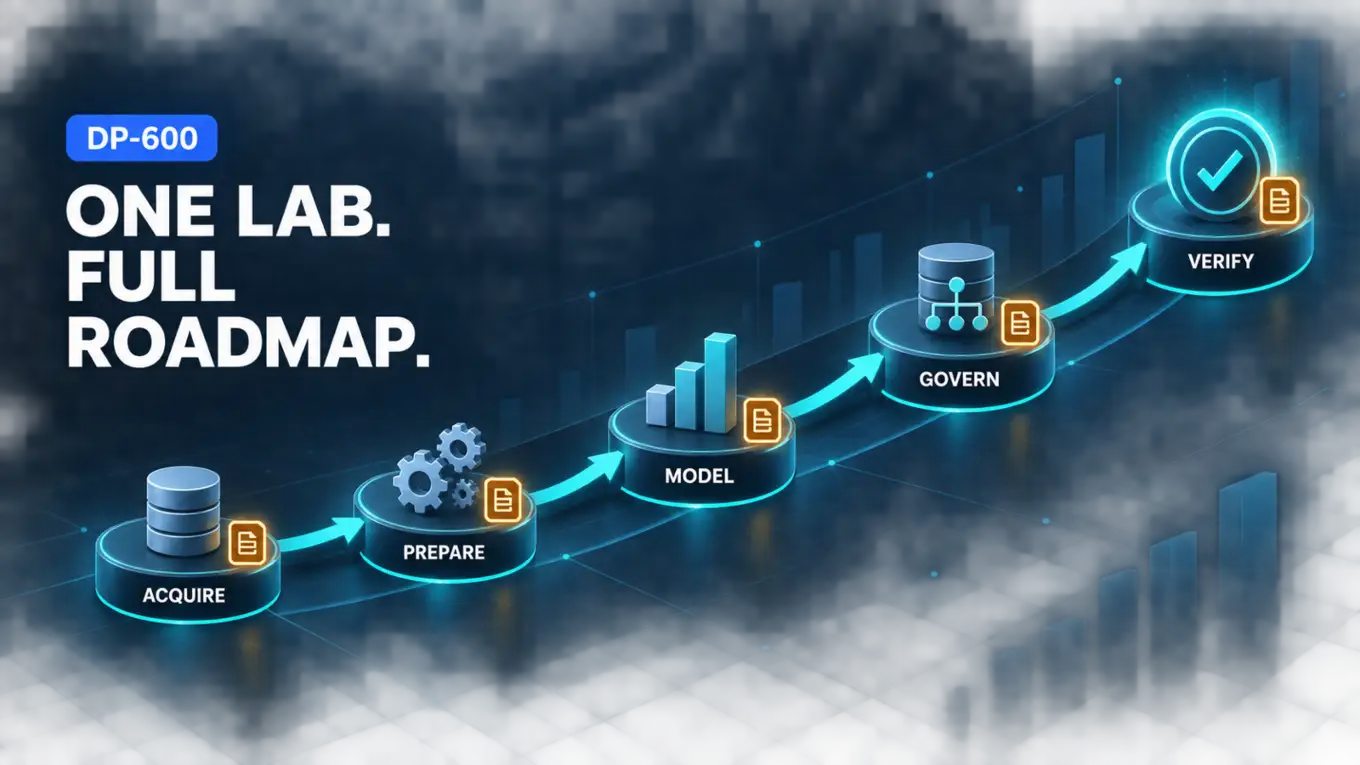
The best hands-on sequence for DP-600 is to build one governed Microsoft Fabric analytics solution from source discovery through semantic-model operations, preserving evidence at every stage. Start with a skills baseline and the current study guide, choose stores and access patterns, prepare and query the data, build the Power BI semantic model, apply security and lifecycle controls, then measure and troubleshoot the completed workload. Repeat weak stages until you can explain both the result and the design decision without relying on exam dumps or reconstructed questions.
Use one consistent business scenario so that each lab extends the previous work instead of producing disconnected demos. A practical scenario combines batch transactions, reference data, and time-stamped events; serves an agreed star schema; and exposes governed measures to a small report. The deliverables—decision notes, test results, deployment evidence, and performance baselines—show readiness more reliably than time spent watching training or memorizing feature lists.
Microsoft has announced an English exam update for October 19, 2026. Use the July 21 objective set for an exam scheduled through October 18; for a later appointment, reconcile this roadmap with the updated study-guide objectives before treating the checklist as final.
Establish the Current Scope and a Skills Baseline
Begin with the current DP-600 study guide. It defines the skills measured as of July 21, 2026 and groups them into three domains: Maintain a data analytics solution, Prepare data, and Implement and manage semantic models. Use the published domain weights to allocate attention, but do not interpret them as a promise about any individual exam form.
Create a baseline inventory with one row for each published skill and three evidence columns:
- Explain: Can you describe the purpose, boundary, and main tradeoff in your own words?
- Implement: Can you produce or configure a small working example in an approved practice environment?
- Verify: Can you demonstrate the expected result, identify a failure signal, and explain how you would investigate it?
Mark a skill as untested until evidence exists. Confidence is useful for prioritization, but it is not evidence. A candidate who can define Direct Lake yet cannot identify the model architecture or verify its query behavior still has a practical gap.
Before provisioning resources, use a nonproduction workspace and an approved capacity or trial arrangement. Record who may access the lab, avoid sensitive production data, and set an end date for cleanup. These are recommended practice controls; your organization's security, licensing, and cost policies remain authoritative.
Design One Integrated Fabric Lab
Choose a scenario complex enough to exercise the platform layers without becoming a software-development project. For example, model sales or service activity with these inputs:
- Batch transaction files with dates, amounts, products, customers, and locations.
- Reference data containing descriptive attributes and a controlled history change.
- A time-stamped event stream or event-shaped dataset for trend and anomaly exploration.
- A small set of business measures and access requirements for two user groups.
Write acceptance criteria before building. Define the fact-table grain, freshness target, expected row counts, data-quality rules, security boundaries, report questions, and a simple performance target. Then sketch which work belongs in a lakehouse, Warehouse, Eventhouse, and Power BI semantic model. The goal is not to force every item into production architecture; it is to demonstrate that you can choose an item because its data shape, engine, latency, and consumer needs fit. Use DP-600: Choosing Microsoft Fabric Analytics Stores: Lakehouse, Warehouse, Eventhouse, and Semantic Models when the selection rationale is unclear.
Preserve a short architecture record containing the chosen item, rejected alternatives, identity used for connections, movement-versus-in-place decision, and expected consumers. This record becomes the reference for later security, lifecycle, and troubleshooting checks.
Follow the Hands-On Build Sequence
The sequence below follows the dependency path of a real analytics solution. Complete each stage with working evidence before adding the next layer.
Discover, connect to, and acquire data
First, locate governed analytical assets through OneLake Catalog and discover event sources through Real-Time hub where appropriate; document their owner, classification, freshness, and intended use. Create connections with a deliberate runtime identity. For each source, decide whether to copy, transform while loading, stream, or expose data in place. If you use a OneLake shortcut, record the source, target path, identity boundary, format, and reason a copy is unnecessary.
Build a repeatable acquisition path with a Data Factory pipeline, Dataflow Gen2, or the suitable real-time path. Rerun it and verify that it handles expected duplicate, missing, late, or changed input without silently corrupting the target. Capture configuration notes, run history, row-count reconciliation, and one deliberately induced failure with its diagnosis.
Transform data into analytical structures
Land raw data separately from validated, conformed outputs. Apply explicit data types, null handling, duplicate rules, joins, filters, enrichment, and aggregations. Where the design benefits from it, organize the route from raw to enriched to business-ready data according to medallion principles rather than updating every layer with unrelated logic.
Implement a star schema in a lakehouse or Warehouse. State the business process and fact grain before defining dimension tables. Add appropriate keys, test referential behavior, and implement one history requirement deliberately. Validate totals at the source, transformed layer, and fact grain so that a technically successful pipeline cannot hide a semantic mismatch.
Query the right analytical layer
Use the Visual Query Editor or SQL for a relational selection, filter, grouping, and aggregation task. Use Kusto Query Language (KQL) for a time-oriented event analysis in an Eventhouse or KQL database. Use Data Analysis Expressions (DAX) for a calculation whose meaning depends on semantic-model relationships and filter context.
For each result, write why that surface is appropriate and why the other surfaces are not equivalent substitutes. Compare results at common grains and investigate discrepancies. Query fluency for DP-600 is not merely syntax recall; it is the ability to match the engine and semantic layer to the analytical request.
Build the semantic model from verified grain
Create a Power BI semantic model over the business-ready data. Assign clear fact and dimension roles, establish relationship cardinality from verified keys, and control filter direction. Include a bridge table or many-to-many pattern only if the scenario truly requires it; otherwise, explain the condition that would justify one.
Add reusable base measures, then extend them with variables, an iterator, or a table-filter pattern where the business rule warrants the complexity. Demonstrate the distinct jobs of a calculation group, a dynamic format string, and a field parameter without treating them as interchangeable. Test totals, filtered results, empty states, and boundary dates against known expected values.
Choose the table storage architecture with an explicit workload matrix covering performance, freshness, memory, source load, and feature requirements. If Direct Lake is used, record whether the model uses Direct Lake on OneLake or Direct Lake on SQL endpoints, then test framing, refresh expectations, security behavior, and the applicable fallback or guardrail outcome. Do not transfer assumptions from one Direct Lake architecture to the other.
Apply security, governance, and lifecycle controls
Return to the access requirements from the lab design. Apply least-privilege workspace and item access, then test the relevant row-, column-, object-, or file-level boundary with separate identities or roles. Add sensitivity and endorsement decisions based on the asset's meaning and readiness. Record both an allowed result and a denied result; configuration screenshots alone do not prove that the effective access path is correct.
Place suitable artifacts under source control and document how a Power BI Desktop project (PBIP), Tabular Model Definition Language (TMDL), deployment pipeline, impact analysis, and XML for Analysis (XMLA) endpoint fit the lifecycle. You do not need to force every mechanism into one change. Instead, make one controlled model change, inspect dependencies, promote it through the available nonproduction stages, validate the target, and retain a rollback route. The detailed workflow in DP-600: Managing the Microsoft Fabric Analytics Development Lifecycle helps keep source control, deployment, and reusable assets in their proper roles.
Measure, diagnose, and improve the workload
Create a baseline for a representative visual, DAX measure, source query or Direct Lake path, and refresh operation. Then introduce or identify one measurable bottleneck. Reduce the workload until you can locate the delay in the visual, calculation, model, source or storage path, refresh process, or capacity layer.
Apply one targeted correction and rerun the same test. Preserve the before-and-after evidence and verify that correctness, security, freshness, and cost have not regressed. Use the symptom-to-layer method in DP-600: Optimizing and Troubleshooting Enterprise-Scale Power BI Semantic Models before treating a slow result as proof that a favorite tuning technique is required.
Map Lab Evidence to the Three DP-600 Domains
Use the following evidence map to find coverage gaps. An artifact can support more than one domain, but only if you can explain the connection.
| DP-600 domain | Minimum practical evidence | Readiness signal |
|---|---|---|
| Maintain a data analytics solution | Tested access matrix, governance decisions, dependency record, version-controlled change, promotion validation, and rollback notes | You can trace who can access an asset, predict the impact of a change, and move that change safely between environments |
| Prepare data | Store-selection rationale, connection identity, repeatable acquisition, quality checks, star schema, OneLake integration decision, and SQL/KQL query results | You can move from source requirements to trusted analytical tables and select the correct store, transformation tool, and query surface |
| Implement and manage semantic models | Relationship tests, verified DAX results, reusable model features, storage-mode decision, Direct Lake evidence where applicable, refresh checks, and performance baseline | You can defend model semantics and storage choices, then isolate and correct a measurable operational problem |
Return to the official study guide after completing the build. Map every published subobjective to a specific artifact, demonstration, or remediation task. If a skill is only mentioned in notes, it is not yet demonstrated. If the lab scenario does not naturally require a feature, create a small isolated proof and explain when it would or would not belong in the integrated design.
Use a Repeatable Readiness Review
Readiness is strongest when you can perform, explain, and troubleshoot the skill under modest variation. Review each skill with this cycle:
- Reproduce: Rebuild or reconfigure the smallest useful example without following a click-by-click script.
- Explain: State the requirement, chosen component, important boundary, and rejected alternative.
- Verify: Show an expected result and the evidence that proves it.
- Vary: Change the data shape, latency, security, or freshness requirement and predict what should change.
- Diagnose: Start from one failed or slow outcome, collect evidence, and locate the responsible layer.
- Remediate: Study the specific weak objective, repeat the lab, and update the evidence inventory.
Use documentation-based prompts such as “Which store fits this requirement, and what tradeoff follows?” or “Which layer would you inspect first, and what evidence would separate two causes?” These are study prompts about public skills, not attempts to reproduce exam questions. Avoid question banks presented as leaked, recalled, or guaranteed exam content; they do not provide trustworthy evidence of platform competence and may violate exam-security rules.
Build a Version-Check Habit
Microsoft Fabric and Power BI are continuously updated cloud services, while the exam guide has an explicit skills-measured date. Treat version checking as part of every study session rather than a final administrative task.
Maintain a small change log with these fields: date checked, study-guide date, documentation page, relevant feature or term, observed change, affected lab artifact, and required retest. Before a lab, confirm the objective in the study guide and verify implementation behavior in current product documentation. After a material documentation change, update the lab note and rerun only the affected evidence.
Perform a final version pass close to the scheduled exam date:
- Recheck the certification page for current status and renewal information.
- Recheck the study guide for its skills-measured date and any objective changes.
- Review product documentation for every feature on which your design or troubleshooting explanation depends.
- Replace outdated interface memorization with the current concept, boundary, and verified behavior.
- Record unresolved changes as gaps instead of guessing how a feature works.
The official certification page and study guide establish the current credential and public exam scope. Product documentation—not an old lab screenshot—establishes current service behavior.
Complete the Final Preparation Pass
Finish with two concise reviews. First, present the integrated solution as if handing it to another analytics engineer: explain architecture, lineage, security, deployment, semantic behavior, performance evidence, and known limitations. Second, remove your notes and perform selected tasks again from requirements, using official documentation when needed.
You are ready to schedule the exam when the evidence inventory has no unexplained domain gaps, you can justify major design choices, you can verify both success and failure behavior, and you can diagnose a problem without jumping immediately to a fix. This is not a pass guarantee. It is a defensible indicator that your preparation covers the current public skills through practical work.
Conclusion
A strong DP-600 study plan turns one integrated Fabric project into a chain of verifiable skills. The candidate discovers and acquires data, prepares analytical structures, chooses query surfaces, builds and secures a semantic model, manages its lifecycle, and improves it through measurement. Each stage leaves evidence that can be mapped back to the current study guide.
The roadmap remains exam-safe because it develops public, transferable skills instead of reconstructing protected questions. Keep the skills-measured date and product documentation under review, remediate gaps with focused labs, and judge readiness by what you can implement, explain, verify, and troubleshoot.
Authoritative Sources
- Microsoft Certified: Fabric Analytics Engineer Associate
- Study guide for Exam DP-600
- Course DP-600T00-A
- What is Microsoft Fabric?
- Data storage options in Microsoft Fabric
- Data security overview
- Introduction to CI/CD in Microsoft Fabric
- Dataflow Gen2 overview
- Pipeline overview
- Medallion architecture for Fabric with OneLake
- Dimensional modeling in Fabric Data Warehouse
- Real-Time Intelligence overview
- Semantic models in Microsoft Fabric
- Understand star schema in Power BI
- Semantic model modes in the Power BI service
- How Direct Lake works
- Optimization guide for Power BI