
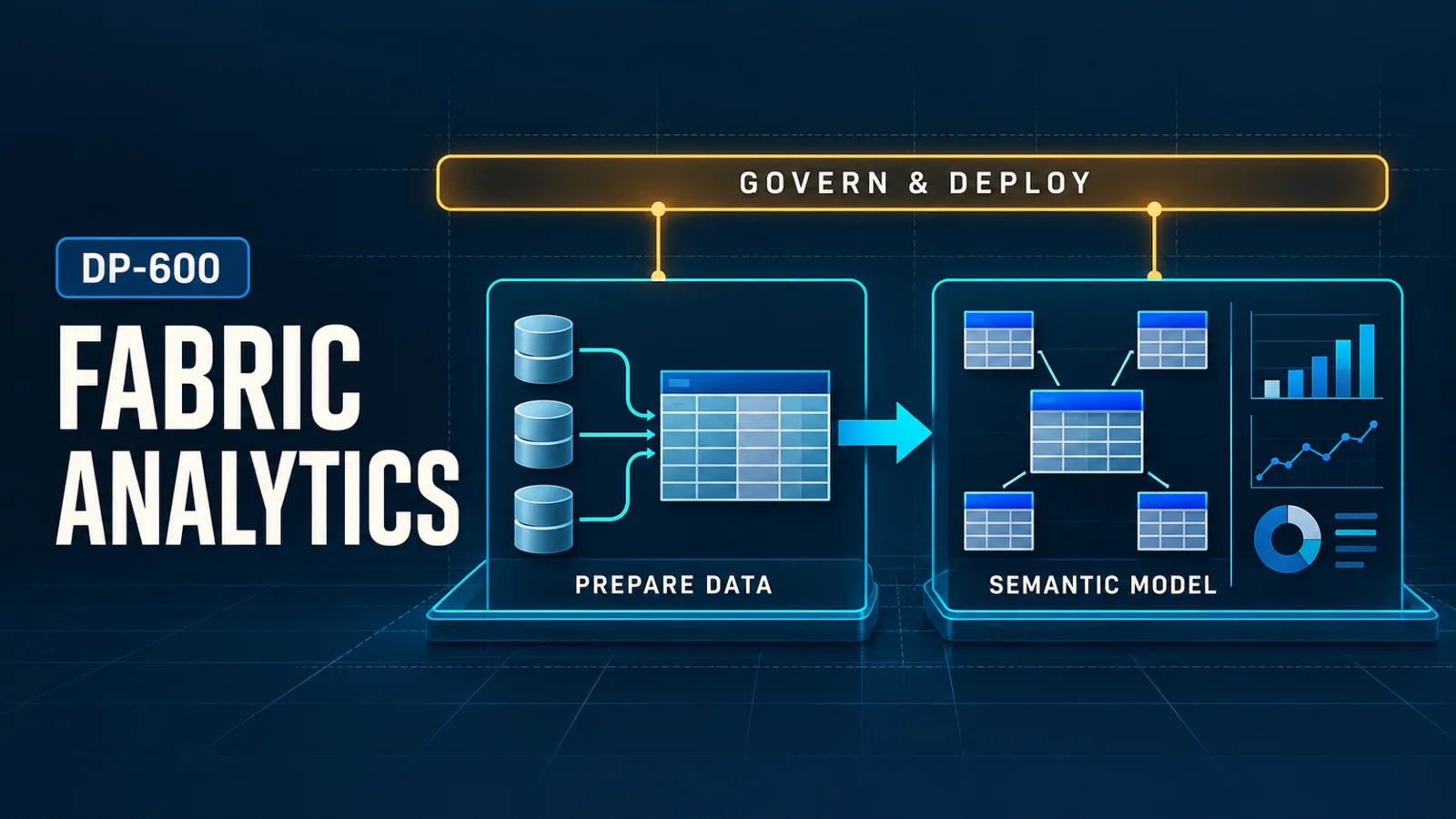
Exam DP-600 validates whether a candidate can implement and manage enterprise-scale analytics solutions with Microsoft Fabric and Power BI semantic models. It brings three connected responsibilities into one analytics engineering role: maintaining a governed solution, preparing analysis-ready data, and building semantic models that give reporting tools a reliable business layer. The credential associated with the exam is Microsoft Certified: Fabric Analytics Engineer Associate.
DP-600 is best suited to analytics engineers, data analysts, data engineers, and business intelligence developers who already understand data transformation, modeling, and analytical requirements. The three skill domains form a lifecycle rather than three isolated subjects: governance and deployment controls protect the environment, data preparation produces trusted analytical structures, and semantic-model design turns those structures into reusable measures and relationships for analysis.
Microsoft has announced that the English exam will update on October 19, 2026. Candidates testing through October 18 should use the July 21 skills baseline described here; candidates testing on or after October 19 should compare this learning path with the updated study-guide objectives before final review.
What the DP-600 Certification Validates
The current DP-600 study guide identifies the exam as Implementing Analytics Solutions Using Microsoft Fabric and organizes its scope into three weighted domains:
| Skill domain | Published weighting | Role outcome |
|---|---|---|
| Maintain a data analytics solution | 25–30% | Secure, govern, deploy, and manage analytical assets through their lifecycle |
| Prepare data | 45–50% | Connect to, ingest, transform, model, and query data for analytics |
| Implement and manage semantic models | 25–30% | Design, calculate, secure, refresh, and optimize the business-facing analytical layer |
The percentages describe the relative emphasis of the published skills measured as of July 21, 2026. They should guide learning priorities, but they do not guarantee the composition of an individual exam form.
DP-600 is not limited to report creation. Its scope covers decisions across data stores, transformation tools, query languages, security layers, lifecycle practices, and semantic-model behavior. Candidates need to understand how these parts work together and how a choice in one layer affects another.
Why the Scope Forms One Analytics Engineering Role
Microsoft Fabric is a software-as-a-service analytics platform that brings data integration, engineering, warehousing, real-time processing, business intelligence, and governance experiences together. OneLake provides the tenant-wide logical data lake beneath many Fabric workloads, while lakehouses, Warehouses, Eventhouses, and semantic models expose different analytical capabilities. The Microsoft Fabric overview explains this integrated platform model and its shared services.
An analytics engineer works across the boundaries between those capabilities. The role does not merely load data or define measures. It translates analytical requirements into governed assets that can move from source data to a dependable semantic layer.
Maintain a data analytics solution
Maintenance establishes the operating controls around analytics work. The DP-600 scope includes security at workspace, item, row, column, object, and file levels; sensitivity labels and endorsements; impact analysis; source control; and deployment methods.
These responsibilities make the solution manageable as teams and environments grow. A technically correct transformation is not enough if unauthorized users can reach its output, a deployment overwrites a valid version, or downstream dependencies are unknown. Maintenance therefore supplies the security and lifecycle foundation for the other two domains.
Prepare data
Data preparation has the largest published weighting because it spans the route from discovering a source to producing useful analytical structures. Candidates need to understand connections, ingestion and access patterns, transformation, cleansing, aggregation, data types, dimensionalization, and analysis with the appropriate Fabric experience.
The scope includes several ways to work with data rather than one universal tool. For example, Dataflow Gen2 offers Power Query-based low-code transformation, pipelines orchestrate activities, notebooks support code-driven engineering, and SQL, Kusto Query Language (KQL), and Data Analysis Expressions (DAX) serve different query contexts. Good judgment means selecting a method that matches the data, destination, workload, and operational requirements.
Implement and manage semantic models
A Power BI semantic model is the curated analytical layer that defines relationships, measures, hierarchies, and business metadata. This domain tests whether candidates can turn prepared data into a usable and efficient model rather than expose storage structures directly to report authors.
The scope includes star schemas, relationship design, bridge tables, many-to-many relationships, storage modes, composite models, DAX calculations, calculation groups, field parameters, refresh design, and performance optimization. These concerns depend on preparation choices: grain, data types, dimensions, and fact-table design all influence the model that sits above them.
Core Concepts to Understand Before Preparing
Candidates do not need identical backgrounds, but several concepts make the DP-600 scope easier to connect.
Analytical stores have different purposes
A lakehouse supports open data-lake storage with Spark and SQL analytical access. A Warehouse provides a relational analytics experience oriented toward SQL and dimensional workloads. An Eventhouse supports high-volume event data and KQL databases. A semantic model supplies a business-facing layer for measures, relationships, and reporting.
These are complementary items, not interchangeable labels. The right choice depends on data shape, latency, query patterns, transformation approach, and consumer needs. The deeper decision framework belongs in DP-600: Choosing Microsoft Fabric Analytics Stores: Lakehouse, Warehouse, Eventhouse, and Semantic Models.
Dimensional modeling connects storage to analysis
Fact tables record measurable events at a defined grain, while dimension tables supply descriptive context. Star-schema design reduces ambiguity for consumers and supports clearer relationships and measures in a semantic model. Candidates should be comfortable identifying grain, keys, dimensions, facts, and common relationship patterns before moving into advanced DAX or optimization.
Query languages operate at different layers
SQL is central to relational querying and transformation. KQL is used for event-oriented analytics in Real-Time Intelligence. DAX defines calculations and queries over semantic models. Python and Spark can support engineering and transformation in notebooks. DP-600 preparation should focus on why a language fits a layer and task, not on treating the languages as substitutes for one another.
Governance and lifecycle choices affect every layer
Permissions, source control, deployment pipelines, sensitivity labels, endorsements, and impact analysis are not administrative topics detached from modeling. They determine who can use an asset, how changes move between environments, and whether a team can trace the effect of those changes. Candidates should connect technical design with safe operation throughout the solution lifecycle.
Target Audience and Recommended Foundation
The official certification page describes the credential as intermediate and centers it on designing, creating, and deploying enterprise-scale data analytics solutions. A strong candidate profile combines analytical modeling skills with practical platform judgment.
Useful prior experience includes:
- Working with Microsoft Fabric workspaces and common analytical items.
- Designing dimensional models and reasoning about table grain and relationships.
- Writing SQL for data retrieval and transformation.
- Creating measures with DAX and understanding semantic-model fundamentals.
- Connecting to data sources and applying repeatable transformations.
- Applying basic security and software-development lifecycle practices.
Familiarity with KQL and Python is helpful because the exam scope spans real-time and code-driven analytical work, but those skills do not replace the need for SQL, DAX, and modeling fundamentals. Candidates coming primarily from Power BI may need more practice with data engineering and Fabric stores. Candidates coming from data engineering may need more depth in semantic modeling, DAX, and business-facing analytics.
Career and Technical Value
The certification can provide a structured way to demonstrate breadth across the Fabric analytics lifecycle. Its practical value is the connection among platform architecture, data preparation, governance, and semantic modeling—areas that are often divided among separate roles on larger teams.
For a data analyst or business intelligence developer, DP-600 expands the focus from reports and measures toward governed enterprise analytics assets. For a data engineer, it adds the consumer-facing modeling and Power BI perspective needed to deliver reusable analytical meaning. For an analytics engineer, it provides a role-aligned framework for making choices across both sides of that boundary.
The credential should be treated as evidence of a defined skill scope, not as a substitute for project experience. Hands-on work remains important because storage selection, transformation design, security, deployment, and performance tradeoffs become clearer when applied to realistic data and lifecycle constraints.
Common Learning Challenges
- Studying the domains in isolation. Security and deployment choices influence data preparation and semantic-model operation. Practice tracing an analytical asset from source to consumption.
- Treating every Fabric store as equivalent. Learn the workload and access patterns that distinguish a lakehouse, Warehouse, Eventhouse, and semantic model.
- Focusing on tools without design reasoning. Be able to explain why a transformation, query language, storage mode, or relationship pattern fits a requirement.
- Skipping dimensional-modeling fundamentals. Advanced calculations and optimization are difficult to reason about when grain, keys, and relationships are unclear.
- Assuming Power BI experience covers the whole scope. The exam also includes ingestion, OneLake, Fabric data stores, governance, and lifecycle management.
- Ignoring continuous service change. Microsoft Fabric and Power BI are cloud services that evolve. Use the current study guide to confirm exam scope and current product documentation to verify behavior.
Building a Coherent Learning Progression
A practical progression begins with the platform and its analytical stores, then follows data through access, transformation, dimensional design, querying, and semantic modeling. Security and lifecycle management should be applied throughout rather than postponed as final topics. Optimization and troubleshooting make more sense after the underlying architecture and model behavior are understood.
Use the official study guide as the scope checklist, but use product documentation and hands-on work to learn how the services behave. The DP-600: Study Plan and Hands-On Lab Roadmap turns that principle into a preparation sequence without relying on reconstructed exam questions.
Conclusion
DP-600 validates an analytics engineer's ability to maintain governed Fabric solutions, prepare trustworthy data, and implement effective Power BI semantic models. The domains fit together as an end-to-end delivery lifecycle: controls protect the work, preparation creates reliable analytical data, and semantic models translate that data into consistent business analysis.
Candidates are best prepared when they combine modeling fundamentals with hands-on experience across Fabric stores, transformation tools, query languages, security, and deployment. That connected understanding is more useful than memorizing isolated feature lists and better reflects the role described by the certification.
Authoritative Sources
- Microsoft Certified: Fabric Analytics Engineer Associate
- Study guide for Exam DP-600
- What is Microsoft Fabric?
- Data storage options in Microsoft Fabric
- OneLake overview
- Semantic models in Microsoft Fabric
- Power BI guidance documentation