
Introduction
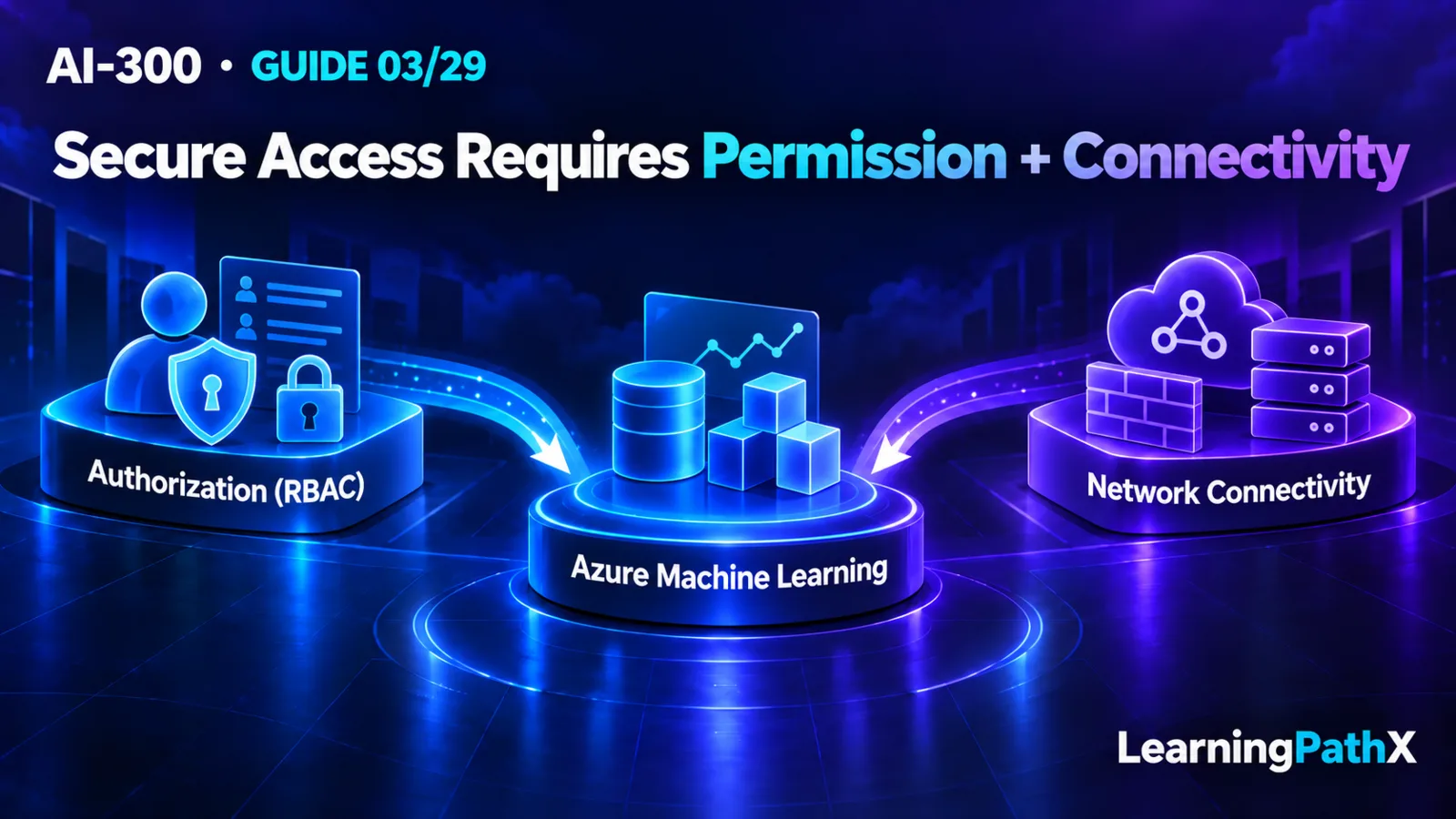
Secure Azure Machine Learning access by designing authorization and connectivity for each request separately. Microsoft Entra ID identifies the principal; Azure role-based access control (RBAC) governs allowed resource operations. A permitted operation also needs a usable network path. Granting a role does not create that path, and a private endpoint does not grant the caller permission to use the destination.
The architecture must distinguish the human submitting work, the effective identity used by the job, the workspace managed identity, and permissions on downstream resources. It must also distinguish private inbound access to the workspace from outbound access by managed compute. Record both the identity and the route for every dependency, then verify the combination from the actual client or runtime context rather than relying on an administrator's successful browser session.
Architecture Overview: Follow the Request
Use the workspace and asset relationships in AI-300: Designing Workspaces, Compute, Assets, and Registries as the foundation. Add a security record for each important interaction. The following is a recommended design-review format, not a platform configuration schema.
| Interaction | Authorization question | Connectivity question |
|---|---|---|
| Human or automation submits work | May this principal perform the required workspace operation at this scope? | Can this client reach the workspace through its intended access path? |
| Job reads input or writes output | Which identity or credential actually performs the data operation, and is it authorized there? | Can the runtime resolve and reach the particular data service? |
| Workspace establishes a managed private connection | Does the workspace identity have the required connection-approval permissions on the target? | Has the intended connection been provisioned and approved? |
| User works in studio | Are the required workspace and data operations authorized? | Can the browser reach both the workspace and any storage it accesses directly? |
This record prevents a misleading statement such as “the workspace has access.” Access belongs to a particular caller performing a particular action against a particular target through a particular route.
Core Components and Their Responsibilities
Human, Job, and Workspace Identities
The submitting principal might be a person or an automation service principal. Its workspace permissions govern management operations such as submitting jobs or managing compute. Azure RBAC assignments have scopes: being an Owner of one workspace does not make a person an Owner of its containing resource group.
Treat the runtime identity as a separate design entry even when a workload ultimately uses the same principal as the submitter. Check the selected job and data-access configuration before deciding which principal needs downstream access. A successful submission establishes that the submission was accepted; it does not establish that every later data request will be authorized.
The workspace managed identity supports service operations and has its own assignments. For managed-network private endpoint approval, Microsoft documents permissions for the workspace managed identity and the initiating user, and recommends the Azure AI Enterprise Network Connection Approver role for covered target types. That approval authority is distinct from permission to read the target's data. Do not assign it to a training identity merely because both are managed identities.
Workspace Permissions and Downstream Data Permissions
Assign permissions at the resource where the operation is evaluated. Workspace administration and storage data access are different authorization questions. In a design review, list the desired data operation explicitly: reading training input, writing results, or accessing a secret. Then verify the relevant service's permissions for the actual caller rather than assuming a broad workspace role solves all three.
Prefer a role that matches the task over escalating privileges during diagnosis. Review role capabilities carefully: the documented workspace Reader role can view datastore credentials. A read-oriented role name alone is insufficient evidence that the role is suitable for a sensitive environment.
Private Inbound Access and Managed Outbound Access
A workspace private endpoint provides an inbound private path for clients. The workspace managed virtual network governs outbound access from supported managed compute. These are separate paths with separate destinations and checks. Creating the managed network does not prove that an employee's laptop can reach a private workspace.
The current managed-network guidance recommends managedNetworkKind v1 and advises against preview managedNetworkKind v2. Its outbound choices include allowing internet outbound and allowing only approved outbound. Required default rules exist; additional dependencies must be considered explicitly. Supported outbound rule types depend on the selected isolation mode.
Use the approved-outbound design to review where data can leave the runtime, not as a substitute for destination authorization. For each added destination, record its purpose, owner, expected data, and removal condition. This is a recommended governance record, not a claim that the service creates such a record automatically.
How the Components Work Together
Consider an illustrative team that can open its workspace but cannot read training input from a private storage account. No commands or deployments were executed for this example.
First identify where the failure occurs. If a job fails after submission, investigate its runtime data request. If an integrated notebook operation in studio fails, investigate the browser's path as well. Microsoft documents that parts of studio run in the user's browser and communicate directly with default storage; workspace connectivity alone is therefore insufficient for those operations.
For the failing request, record the following evidence before changing configuration:
- The actual client or compute context, target resource, operation, and effective identity or credential.
- The applicable role or service permission at that target, including its assignment scope.
- The name being resolved and the resulting destination from that same context.
- The intended route, private connection status, and relevant firewall or outbound allowance.
- The observed failure stage and sanitized diagnostic information.
Domain Name System (DNS) checks belong before assuming that a private route is in use. As a recommended diagnostic test, compare the resolved destination with the intended private connection, then verify reachability from the caller's network. A name resolving successfully is not enough: it must resolve to the intended destination, and the caller must be able to reach it. Avoid changing permissions solely because a request timed out.
Conversely, a reachable service does not establish correct data permissions. Investigate an authorization failure using the principal and target operation rather than granting the human workspace Owner and retrying a job that uses another identity. Preserve sanitized evidence; do not paste credentials, access tokens, or secret contents into a troubleshooting record.
Design Considerations Before Restricting Access
Verify the Required Journeys
Before disabling public access or tightening outbound policy, use an authorized non-production environment and a documented recovery route. Inventory interactive clients, jobs, image and package dependencies, storage paths, and service-side operations. Test the operations that matter from each intended context. A successful resource creation is weaker evidence than a successful representative read or job operation.
Include negative checks in the acceptance plan. An authorized runtime should perform its intended operation, while an unrelated principal or destination should remain blocked. Define the expected observation for each test before running it; a green portal indicator alone does not establish this boundary. This article supplies the reasoning framework, not executed acceptance evidence or a complete infrastructure-as-code deployment.
Network restrictions can introduce costs and change constraints. Microsoft documents Azure Firewall charges for fully qualified domain name (FQDN) outbound rules. Review the selected mode's documented conversion restrictions and costs before adopting it; do not assume that every restrictive change has an immediate in-place reversal.
Check Model Monitoring Compatibility Early
As verified on October 15, 2026, Azure Machine Learning model monitoring does not support the AllowOnlyApprovedOutbound managed virtual network isolation setting. A design requiring both cannot be accepted as supported merely because training or inference works.
Record that incompatibility before committing to the architecture. Ask the security and operations owners to resolve the requirements and verify any alternative separately. Do not claim that adding an outbound rule removes the product limitation, weaken isolation as an incidental troubleshooting step, or promise monitoring coverage that the design cannot deliver. AI-300: Monitoring Drift, Actual Performance, and Retraining develops the monitoring outcome separately.
Common Mistakes
- Increasing workspace privileges when the failing request uses another identity or targets another service.
- Treating private endpoint approval as data-read authorization.
- Verifying DNS and connectivity from an administrator's machine while the job runs elsewhere.
- Testing workspace access while omitting the browser's direct storage dependency.
- Approving a restricted network without checking required outbound destinations and feature compatibility.
- Making a security change before defining acceptance evidence and a recovery path.
Each mistake removes context from an access decision. Restore the missing caller, operation, target, or route before choosing a fix.
Certification Relevance
For AI-300 preparation, explain the architecture in terms of independently verifiable responsibilities. Identify who submits work, who accesses data, which permissions belong to the workspace service, and where inbound and outbound controls apply. Then explain what evidence would distinguish a permission problem from a network problem. This develops security design and access diagnosis without relying on memorized error-to-role mappings.
Conclusion
Secure workspace access depends on a specific authorized operation and a usable, intended route. Keep human, runtime, and workspace identities explicit; verify downstream permissions independently; and test private inbound access separately from managed outbound controls. DNS, dependency access, cost, recovery, and current feature compatibility belong in the design decision before restrictions are applied.
Authoritative Sources
- Manage access to Azure Machine Learning workspaces
- Workspace managed virtual network isolation
- Azure Machine Learning model monitoring