
Introduction
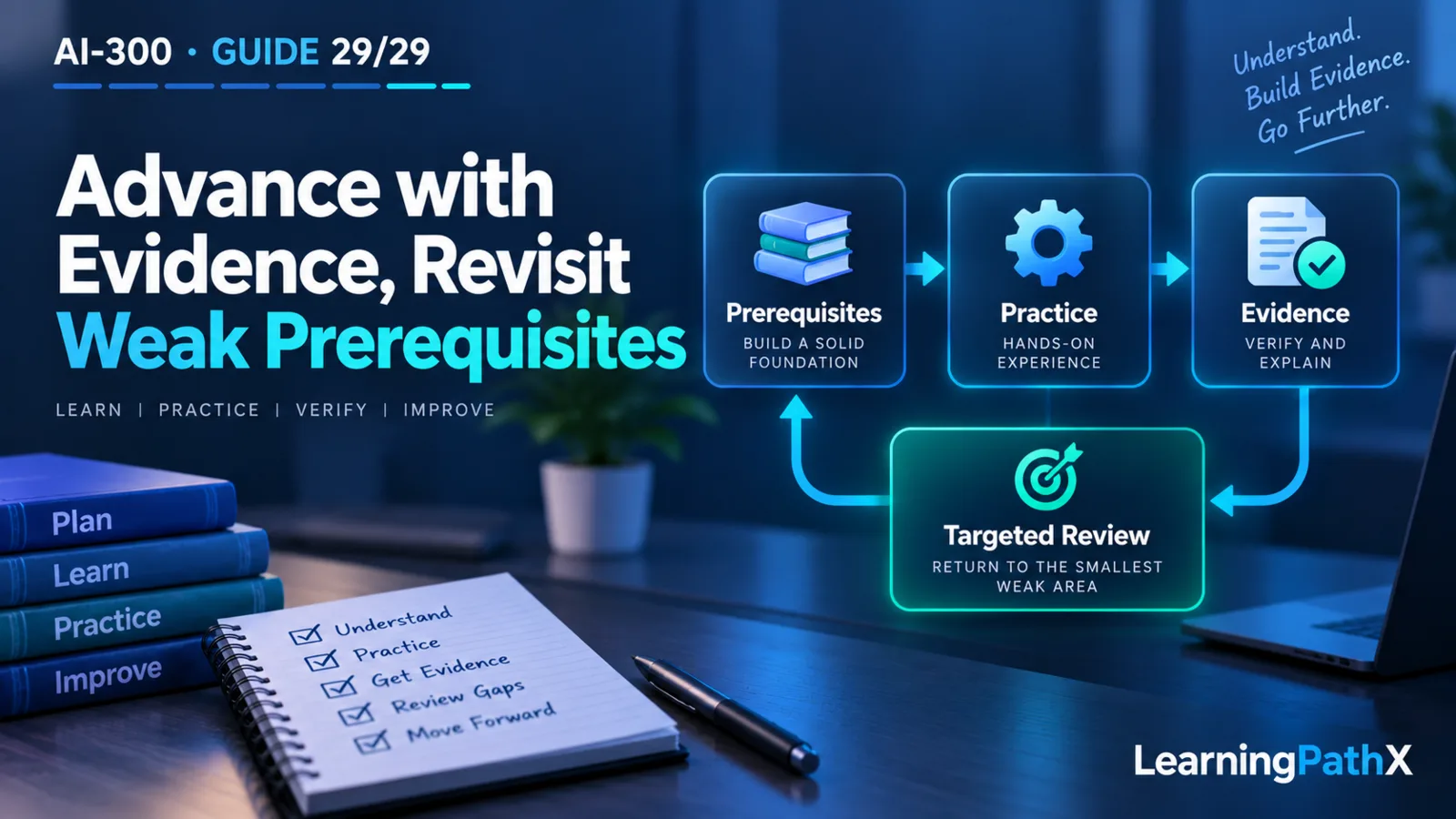
Build an evidence-based study sequence by mapping the current AI-300 skills to prerequisites, working from foundations toward operational decisions, and retaining an artifact for each outcome. Advance when you can explain and verify the outcome; when a weakness appears, return to the smallest missing prerequisite, practise a targeted task, and reassess it with a changed scenario.
The sequence below is a recommended learning method, not a personal timetable or an official completion schedule. It connects Azure Machine Learning and Microsoft Foundry work across the series, including release, monitoring and optimization. A source document read, a successful command and a justified operational decision are different kinds of evidence; record which one you actually have.
What Makes a Study Sequence Evidence-Based?
The current credential and study guide describe experience across traditional model operations and generative applications, supported by Python, command-line and DevOps skills. Use that scope to identify what you need to learn; use current product documentation to qualify implementation choices.
Start with AI-300: Certification Scope and the AI Operations Role. Create a simple learning record containing the skill, its prerequisites, the task you will attempt, the artifact you will retain, and the question that remains unresolved. These are recommended notes, not fields in an integrated learning platform.
For example, “read about deployment” is less informative than “can explain the selected serving mode, inspect its input/output contract, and identify what would verify runtime access.” Keep the artifact small enough to revisit: an annotated diagram, configuration revision, comparison table, sanitized run record or failure analysis can each serve a specific purpose.
Why Prerequisites Matter More Than Page Counts
Later tasks depend on earlier distinctions. A failed data read is difficult to diagnose if the learner cannot identify the caller. Model comparison is weak if its inputs and metrics are not comparable. A retrieval experiment is inconclusive if answer quality and search ranking are treated as one measurement.
Use the stages as one workable route through those dependencies. After orientation, the Azure Machine Learning and Foundry foundation tracks can be explored in either order; preserve the prerequisites within each track. Do not repeat completed foundations merely to follow a calendar, and do not skip them solely because the terminology sounds familiar.
Use AI-300: Choosing Official Documentation and Learning Resources whenever the missing step is source selection or version context. It supports every stage rather than functioning as a new technical prerequisite after all other learning.
Core Learning Sequence
1. Establish scope and an honest starting point
Read the current study guide and map each skill to an existing artifact or an unresolved learning task. Check the background needed for the next task: Python, model training/evaluation concepts, Git, command-line use and basic Azure resource/access concepts. Treat gaps as starting points for learning, not as invented credential eligibility rules.
Produce a scope map and a short prerequisite list. Move on when you can describe which work belongs to traditional model operations, which belongs to generative applications, and which evidence you still lack. This prevents confidence in one track from hiding unfamiliar work in the other.
2. Build the Azure Machine Learning foundation before automating it
Learn workspace, storage-reference, compute, asset and registry relationships first. Then distinguish human, job and resource identities, downstream data permissions, and inbound/outbound connectivity. Explain a proposed data path before trying to automate it.
Next use the constrained rehearsal in AI-300: Lab: Automating an ML Workspace with Federated CI. Microsoft's GitHub Actions guidance separates authentication, workflow configuration and verification of the Azure Machine Learning job. Use it to understand why a workflow status alone may not establish the intended application outcome.
Retain a resource/asset diagram, an identity-and-data-path record, and an annotated provisioning design with acceptance and cleanup criteria. If you perform an authorized sandbox run, add the actual revision and observed evidence; otherwise label it a design rehearsal. Advance when you can explain both how provisioning should work and which observation would reveal a permission or configuration failure.
3. Connect experiments, pipelines and qualified model artifacts
Compare training approaches using a stated objective, comparable inputs and a recorded budget. Progress from an experiment to versioned pipeline components, input/output contracts and reproducible environment/compute choices. Understand the distributed-code requirement before assuming a launch setting makes an ordinary script distributed.
Then study model packaging, registration, versioning, feature dependencies and qualification. Select responsible evaluation that actually applies to the chosen model and data, rather than treating every assessment interface as universal.
Produce a lineage record connecting data, code/configuration, experiment, pipeline outputs and the qualified model version. Include why a candidate was accepted or rejected. Advance when another reader can identify the artifact being considered for serving and the evidence supporting that choice. Registration alone is not the learning outcome.
4. Practise serving, recovery and the traditional-model operating loop
After model qualification, compare online and batch serving for a concrete request contract. Rehearse direct candidate tests, staged online release and reversal in the serving lab before moving to monitoring and retraining decisions.
Retain a serving decision, a release/rollback rehearsal and a monitoring action record. In that record, distinguish a changed input distribution from measured model-performance evidence, identify the missing information, and explain what would justify evaluating a retrained candidate. Do not replace investigation with “retrain whenever a signal changes.”
Advance when you can trace a failed request to a candidate component and explain how a viable accepted deployment would be restored. Keep simulated rollout decisions and actual executed changes clearly separated.
5. Establish Foundry environments and versioned application behavior
Learn Foundry resource/project/deployment boundaries, identity scopes and private connectivity before selecting a serving option. Compare model and deployment choices against current support, processing geography, quota and billing conditions. Preserve classic and preview qualifications when recording a choice.
Develop a real prompt baseline and a meaningful candidate variant. Microsoft's prompt-versioning module treats prompts as versioned assets with testing and promotion workflows. Use the series procedure to retain prompt/configuration revisions, a hypothesis, frozen comparison inputs and a compatible rollback reference; do not equate a repository commit with an automatic application update.
Produce an environment/deployment decision record and a prompt-change bundle. Draft the questions you will later need to answer about base-model migration and provisioned capacity, but hold those conclusions until the comparison and workload evidence exists. Advance when the application configuration is identifiable and the proposed change has a testable purpose.
6. Qualify generative releases, then learn to observe and diagnose them
Prepare evaluation inputs and mappings before choosing release gates. Distinguish stored-output evaluation from a target run, quality dimensions from risk, and judge disagreement from application failure. Define what blocks release, what requests revision and what leaves the decision unresolved.
Then connect quality, latency, errors, throughput and resource-use observations to an owner and investigation action. Follow a request through retrieval, model and tool stages to locate a failure. Retain a sanitized trace interpretation rather than only a screenshot of a dashboard.
Produce a comparison/gate record and a short incident analysis with a proposed fix and verification criterion. Return to base-model migration and throughput/capacity decisions with this evidence: compare versions against a fixed regression basis and distinguish workload estimates from verified availability and financial commitments. Advance when you can defend a release or hold decision and explain how operating evidence might cause it to be revisited.
7. Optimize only after a baseline can expose the failure
Study keyword, vector and hybrid retrieval, then embedding-model compatibility and conditional adaptation. Rehearse the controlled retrieval lab with frozen source/query evidence, isolated changes and separate retrieval and answer measures. An increased search score should not be accepted as proof of better answers.
Next compare fine-tuning methods against the available training signal and simpler alternatives. Learn to qualify synthetic data, preserve independent evaluation material and check the selected model/method/serving path. Understanding this decision does not require an unsupported customization endpoint or an expensive training run.
Produce an optimization comparison and a fine-tuned lifecycle design. The latter should connect base/data/method/model lineage, held-out acceptance, compatible serving, staged promotion and recovery. Close the loop: identify a post-release measurement, choose an adjustment or investigation, reevaluate the candidate, and record whether it should be accepted or held. This is a learning artifact until supported by actual execution evidence.
Advance when you can explain which layer the evidence implicates and why the chosen adjustment addresses it. “Use a larger model” or “fine-tune it” is insufficient without that connection.
Use a Weak-Area Review Loop
When a readiness check or exercise fails, record the observation before rereading an entire topic. Recommend the following loop:
- State the failure precisely: an incorrect distinction, an unexplained error, missing evidence or an unsupported decision.
- Identify the earliest prerequisite that would change the diagnosis.
- Read the narrow current source and attempt one relevant explanation or safe rehearsal.
- Reassess using a changed input or constraint, without copying the original answer.
- Update the artifact and retain the reason for the correction.
Use the failure to select the return point:
| Weakness observed | Targeted return | Useful reassessment |
|---|---|---|
| Can repeat a command but cannot identify its caller | Identity and resource foundation | Explain the same operation under a different principal |
| Can launch a job but cannot compare candidates fairly | Experiment/pipeline evidence | Identify which changed input makes a comparison invalid |
| Can create a deployment but cannot describe recovery | Serving and rollback rehearsal | State which accepted artifact and configuration would be restored |
| Can quote a quality score but cannot choose a release action | Evaluation contract and gates | Separate a judge error from a confirmed application failure |
| Can retrieve passages but cannot show answer benefit | Retrieval comparison | Trace required evidence into the actual generation context |
| Can propose retraining or tuning but cannot justify it | Monitoring and baseline analysis | Name the observation, adjustment and reevaluation needed |
These are learning actions, not exam questions or a diagnostic scoring instrument. If the blocker is unavailable quota, permissions or feature support, record that constraint separately from conceptual understanding. A design rehearsal may support reasoning, while hands-on verification remains incomplete.
Make Readiness Decisions from Artifacts
Use AI-300: Readiness Checklist for AI Operations Decisions after the relevant foundations. For each area, try explaining the artifact without the article open, defending the selected option against an alternative, interpreting a failure, and naming a verification or rollback condition.
Recommend three practical decisions: continue to the next dependent skill when evidence is explainable and current; revisit a named weakness when the reasoning fails; retain an explicit verification gap when access or support prevents execution. Do not replace those distinctions with a percentage of pages completed.
Review the full scope map again before concluding preparation. Confirm that familiar ML work has not displaced Foundry evaluation and optimization, or vice versa. A completed artifact collection is evidence of learning activity and judgment, not a predicted exam result or permission to deploy a production system.
Common Learning Challenges
- Collecting documentation without turning it into an observable task outcome.
- Treating a green workflow, registered model or fluent response as complete acceptance evidence.
- Copying current and classic procedures into one learning exercise without checking compatibility.
- Retuning against the same evaluation material until it appears successful.
- Recording a proposed or simulated operation as if it had run.
- Returning to an entire domain when one missing prerequisite explains the weakness.
- Allowing a fixed timetable to hide unresolved foundations or operational verification gaps.
Keep version-sensitive details attached to their current sources. Recheck applicability before exercising a capability, and use authorized sandbox boundaries and cleanup plans for resource-bearing tasks. The sequence organizes learning decisions; it creates no platform schedule or external study integration.
Conclusion
Progress from prerequisite understanding to inspectable operational evidence, then return to the smallest weak area when a decision cannot be justified. Preserve the connection between configuration, observations and corrective action across both ML and generative workflows. Readiness becomes a reasoned next-step decision rather than an invented deadline or pass prediction.
Authoritative Sources
- Microsoft Certified: Machine Learning Operations Engineer Associate
- AI-300 study guide
- Use GitHub Actions with Azure Machine Learning
- Manage prompts for agents in Microsoft Foundry with GitHub