
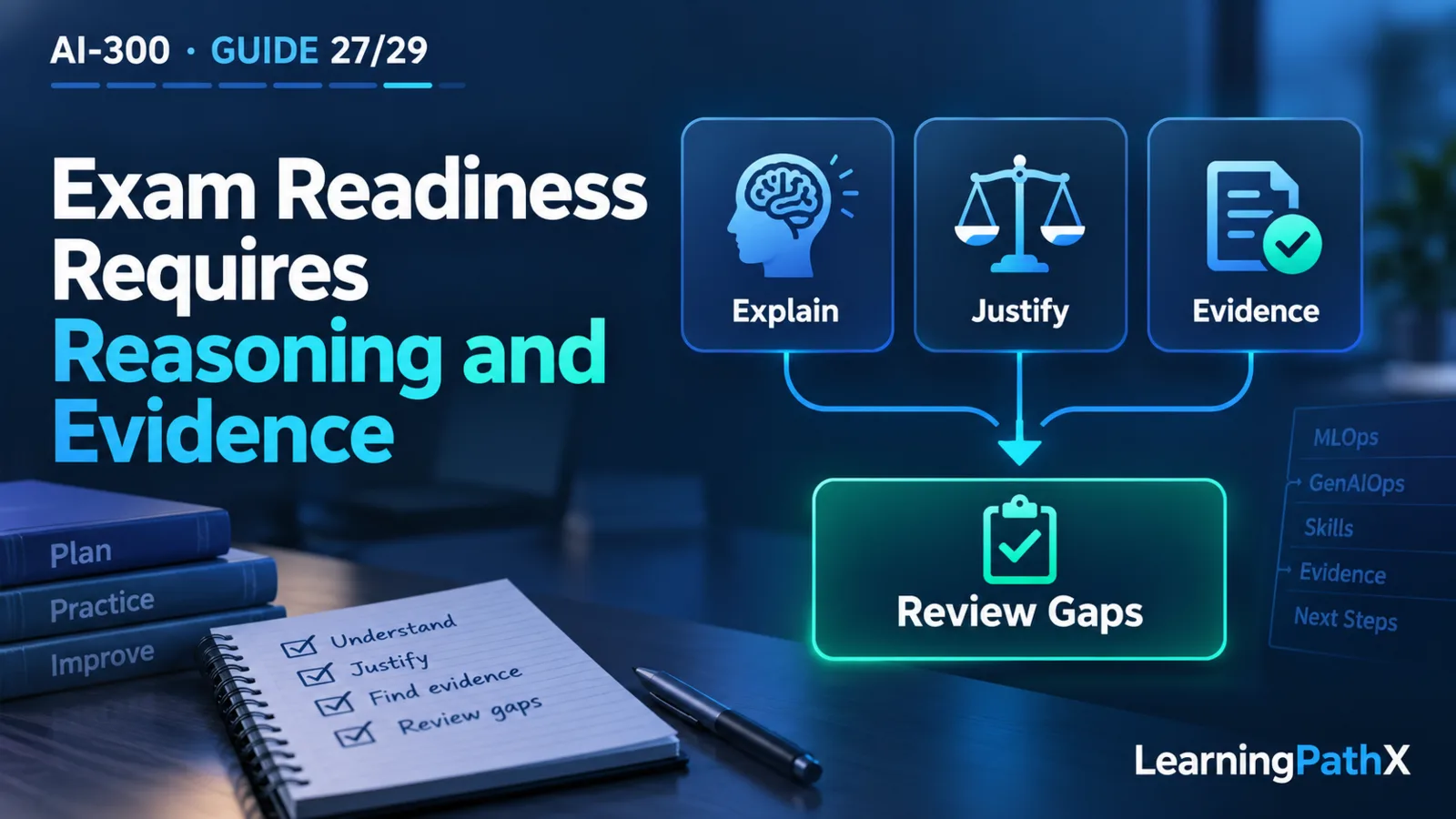
Use this readiness checklist after learning the foundations: mark an item when you can explain the distinction, justify a choice and identify supporting evidence from your own work or a clearly labeled design rehearsal. If you cannot do that, record the missing explanation or artifact and return to the focused lesson. The decision is what to revisit next; the number of checked boxes is not a diagnostic score or an exam-pass prediction.
The checklist follows the five official AI-300 domains for machine learning operations (MLOps) and generative AI operations (GenAIOps), using English scope and product documentation verified on October 15, 2026. It assumes familiarity with Azure Machine Learning resources, training and inference, Foundry configuration and evaluation. Complete AI-300: Choosing Quality, Safety, and Custom Evaluation Gates before using the release-evidence checks. This is recall and reasoning review, not a replacement for those lessons.
How to Use the Readiness Checklist
For each item, state a short explanation and name the evidence that would support it. An artifact might be a version record, access-path diagram, job comparison, evaluation result or rollback decision. Label a proposed artifact as proposed; do not describe an unexecuted rehearsal as a successful deployment.
Keep a brief note for each gap: the distinction that was unclear, the lesson to revisit and the observable explanation or evidence to produce afterward. Recheck that gap after review instead of repeatedly reading familiar material. The statements below are original learning checks, not reconstructed exam questions.
Design and implement an MLOps infrastructure
- Explain how a workspace, datastore and compute resource differ from versioned data, environment and component assets; identify what a registry shares across workspaces.
- Draw separate user, workload and storage-access paths; distinguish authorization from network reachability and name the identity used for each operation.
- Explain what a reviewed Bicep/command-line interface (CLI) definition and a GitHub Actions workflow contribute to repeatable provisioning; identify source revision, authentication and deployment evidence.
- Choose compute from workload and operational requirements, and identify which environment, data and configuration versions a repeated job needs.
Implement machine learning model lifecycle and operations
- Choose custom training, automated machine learning or a sweep from the uncertainty being tested; name comparable data, metrics and budget evidence.
- Trace a candidate from code/data through component inputs/outputs and training history; explain why distributed launch also needs distributed-aware code.
- Identify the model package's dependencies and evaluation evidence, including a feature retrieval specification where applicable and current Responsible AI dashboard eligibility checks.
- Distinguish synchronous online inference from asynchronous batch work; explain direct candidate testing, client traffic allocation, mirroring and a retained rollback deployment.
- Separate drift from measured performance; identify reference data, required ground truth and an investigation decision before retraining or promoting a new model.
Design and implement a GenAIOps infrastructure
- Distinguish a current Foundry resource/project from classic hub-based patterns, and identify the infrastructure definition and configuration evidence for the intended environment.
- Explain scoped role-based access control, managed identities, private connectivity and dependent-service reachability without treating them as interchangeable permissions.
- Choose a supported model/deployment path from application needs and processing-location constraints; check actual model, version, region and preview eligibility.
- Separate provisioned throughput unit (PTU) sizing, scoped quota, model-version capacity and reservation coverage; explain why deployed capacity and token consumption are different billing facts.
- Compare versioned prompt/configuration variants on fixed evidence, and explain how base-model retirement and deployment-specific upgrade behavior constrain rollback.
Justify sizing assumptions rather than quote a universal tokens-per-unit conversion.
Implement generative AI quality assurance and observability
- Identify whether a run scores stored output or invokes a target; trace the selected evaluators' required fields and the response actually being scored.
- Distinguish groundedness, relevance, coherence and fluency from risk/safety checks; explain why a favorable average cannot conceal a blocking failure.
- Identify evaluator errors, skipped results and judge disagreement separately from application quality; preserve rubric/version and preview qualifications.
- Connect sampled quality, error rates, latency distributions and successful throughput to an alert owner and investigation action; explain the limits of sample coverage.
- Use token/resource measurements to form a testable optimization hypothesis, distinguish estimates from billed cost, and identify the diagnostic context needed for investigation.
Optimize generative AI systems and model performance
- Separate retrieval evidence from generated-answer quality; justify a chunking, threshold or hybrid-retrieval change against a fixed comparison.
- Distinguish vector similarity from hybrid ranking scores; check current query syntax and preview status before reusing a threshold.
- Check embedding compatibility and any explicit adaptation support; identify the corpus/query consequences of changing the embedding model.
- Match demonstrations, preference pairs or grader feedback to a supported fine-tuning method; explain why training loss or reward alone cannot accept a candidate.
- Qualify synthetic sources and examples, keep related cases out of the independent holdout, and connect an adapted model's lineage to serving checks and monitored re-evaluation.
Route a Weak Area to the Right Lesson
Use the specific gap rather than the whole domain as the review target. These are navigation choices within the series, not an additional study schedule.
| Gap observed | Focused reading |
|---|---|
| Resource/asset or cross-workspace confusion | AI-300: Designing Workspaces, Compute, Assets, and Registries |
| Identity versus network diagnosis | AI-300: Securing Azure Machine Learning Access and Networks; AI-300: Securing Foundry Identities and Private Connectivity |
| Training comparison or distributed/pipeline evidence | AI-300: Choosing and Comparing Training Experiments; AI-300: Building Reproducible and Distributed Training Pipelines |
| Inference rollout or monitoring decisions | AI-300: Lab: Testing, Rolling Out, and Reverting an Online Model; AI-300: Monitoring Drift, Actual Performance, and Retraining |
| Foundry deployment, capacity or upgrade confusion | AI-300: Choosing Foundry Model Deployment Options; AI-300: Sizing Provisioned Throughput and Checking Capacity; AI-300: Migrating Production Base Models Safely |
| Evaluation inputs versus release judgment | AI-300: Preparing Evaluation Datasets and Field Mappings; AI-300: Choosing Quality, Safety, and Custom Evaluation Gates |
| Signals without actions or diagnostic context | AI-300: Monitoring Generative AI Quality, Latency, and Cost Drivers; AI-300: Tracing Slow or Incorrect Generative AI Responses |
| Retrieval/embedding comparison | AI-300: Designing Vector, Keyword, and Hybrid RAG Retrieval; AI-300: Selecting and Adapting Embedding Models |
| Synthetic leakage or adapted-model acceptance | AI-300: Qualifying Synthetic Fine-Tuning Data; AI-300: Promoting and Operating Fine-Tuned Models |
Keep Version-Sensitive Recall Current
- MLflow tracking remains relevant; Azure Machine Learning submission through MLproject files has a documented September 2026 retirement. Use the current CLI/software development kit (SDK) v2 job boundary.
- Foundry managed compute remains public preview, without a service-level agreement and not recommended for production in the verified deployment overview.
- Azure Machine Learning model-performance and feature-attribution monitoring are preview; current monitoring does not support AllowOnlyApprovedOutbound managed-network mode.
- Recheck evaluator and vector-query preview labels in the selected documentation. Do not turn a feature name remembered from an older workflow into a universal support claim.
These qualifications are operational distinctions to explain, not a list of facts that can establish exam readiness by themselves. Use the current official study guide to check scope and the relevant product documentation to verify behavior.
Conclusion
Retain the explanations and evidence behind each checked item, and turn unclear distinctions into focused review tasks. Use AI-300: Building an Evidence-Based Study Sequence when several gaps need ordering. The useful result is a concrete next learning action, with no inferred exam score or outcome.
Authoritative Sources
- Microsoft Certified: Machine Learning Operations Engineer Associate
- AI-300 study guide
- MLflow and Azure Machine Learning
- Safe rollout for online endpoints
- Azure Machine Learning model monitoring
- Role-based access control for Microsoft Foundry
- Deployment overview for Microsoft Foundry Models
- What is provisioned throughput for Foundry Models?
- Built-in evaluators reference
- Create a vector query in Azure AI Search