
Introduction
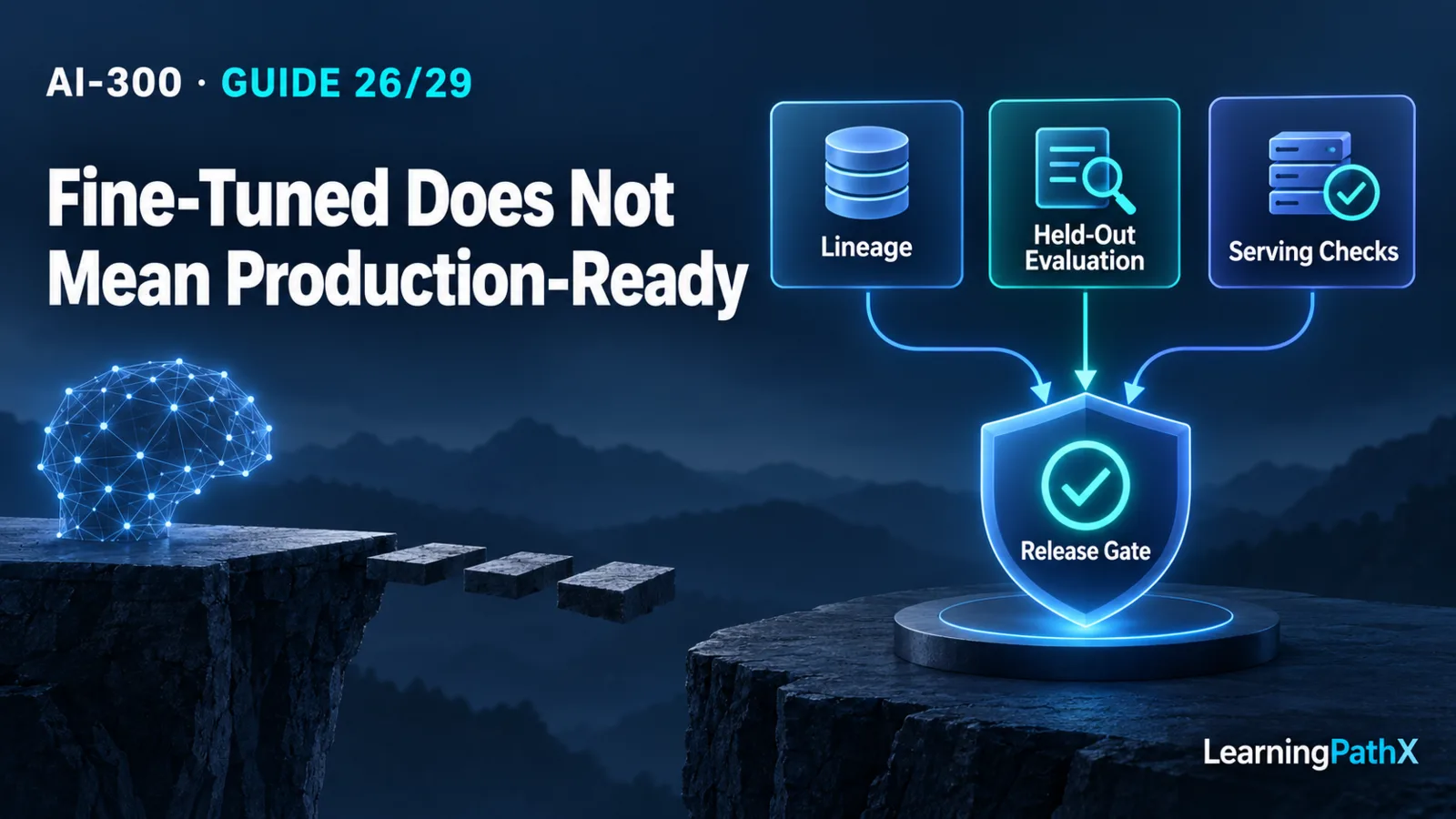
Promote a fine-tuned model only when its exact artifact is traceable to the base model, reviewed data, training method and run; independent held-out evaluation supports the intended use; and the target serving path supports that artifact with appropriate capacity and operational controls. Then verify the deployed fine-tuned model, expose it through controlled stages, retain a usable fallback, and monitor the outcome. A completed training job or a successful playground response is not production qualification.
The procedure continues after release: use monitored failures to identify a specific adjustment, version the changed artifact or application configuration, re-evaluate it against the accepted baseline, and release only if the combined evidence remains acceptable. This is a proposed engineering procedure, not a claim that training, deployment or monitoring was executed. It concerns fine-tuned artifacts and their serving lifecycle; training-data generation and base-model automatic-upgrade policies have separate scopes.
What Is Being Promoted
Distinguish the training output, the serving deployment and the application release. The output is the customized artifact or adapter. The deployment is the selected runtime/capacity arrangement that can serve it. The application release combines that deployment with prompts, retrieval, tools, safety controls and calling code. A qualification decision must identify all three.
Start with the accepted dataset and its documented limits from AI-300: Qualifying Synthetic Fine-Tuning Data. Its review establishes candidate supervision, not proof that a trained model improves task behavior. Keep the final assessment independent of the data-construction and training decisions.
Microsoft's fine-tuning guidance explicitly warns that benefits are not guaranteed. Training loss, validation results, preference rewards or grader scores can help select candidates, but they do not replace task-specific evaluation of the selected artifact and final serving configuration.
Why Lineage and Serving Qualification Must Agree
Consider an illustrative maintenance-summary assistant. A new fine-tuned candidate is intended to preserve warnings and mark unknown facts explicitly. A favorable evaluation is useful only if it concerns the same candidate that the application will invoke. Testing the base deployment by mistake, attaching an adapter to the wrong base version, or changing the surrounding prompt can invalidate the conclusion.
This example states a proposed goal, not an observed result. The release record should make it possible for another engineer to identify which artifact was evaluated, which runtime served it, and which application behavior was accepted.
Core Procedure for Promoting Fine-Tuned Models
1. Freeze the Candidate's Full Lineage
Create a controlled candidate record before approval. The following is recommended evidence, not a new Foundry metadata schema or a claim that every field is populated automatically.
| Evidence | What must be distinguishable |
|---|---|
| Base model | Exact identifier/version and relevant eligibility at training time. |
| Data | Accepted training and validation revisions, provenance/review references, and independent final-test identity. |
| Method and settings | Supervised, preference or reinforcement method; relevant settings; grader/reward configuration where used. |
| Training execution | Actual job/run reference, chosen checkpoint/output, completed state and any material interruptions or exclusions. |
| Resulting artifact | Fine-tuned identifier/version, artifact form and exact compatible base if it is an adapter. |
| Evaluation | Baselines, dataset, evaluator/rubric versions, application configuration, findings and decision. |
| Serving/release | Target project/resource, deployment option/type/region, deployment name, application revision and recovery target. |
If the method uses a grader, preserve its configuration and test evidence; a higher reward can reflect exploitation of the grading signal rather than better task performance. If several checkpoints are available, identify the one actually evaluated and selected. Do not substitute a later output merely because it belongs to the same training run.
Keep sensitive training data and evaluation examples under their access controls. The release record can reference protected artifacts without copying their contents into operational tickets or public configuration.
2. Verify Training Eligibility Separately from Serving Eligibility
Before relying on a candidate, check the current supported combination of model/version, training approach, method, training type and region. Then perform a separate check for deployment option, deployment type, artifact and serving region. The fine-tuning overview states that support for one approach or method does not establish support for another; a training recipe also does not establish service availability.
A model trained successfully in one region is not thereby eligible for every serving region or runtime. Confirm the exact combination rather than inferring support from a model family name. Record the current evidence and decision date because eligibility can change.
Training types and deployment types are different concepts. For example, Developer training uses idle capacity and can be preempted and resumed without latency, service-level agreement (SLA), or data-residency guarantees. That describes training behavior, not a production serving arrangement. Assess each side's requirements independently.
For low-rank adaptation (LoRA) artifacts, the deployment guide requires a matching base model and version and a base deployment using a LoRA-enabled template for Managed Compute. Similar naming is insufficient. Preserve the adapter/base association and verify the selected runtime rather than assuming an adapter is portable to a replacement base.
3. Qualify the Exact Candidate on Held-Out Tasks
Compare the selected candidate with the relevant base-model configuration and the current accepted application baseline. Use the same independent task set and compatible evaluation conditions. Keep generation parameters, prompt/tool contracts and retrieval context controlled so a model comparison is not silently an application rewrite.
Evaluate the intended improvement and plausible regressions. For the illustrative assistant, test whether warnings survive, unknown facts remain unknown, required output structure is retained and unrelated details are not invented. Include difficult and rare cases rather than relying on common easy examples. Preserve any authorized human review needed to interpret consequential or ambiguous behavior.
Check quality and safety alongside serving-relevant performance. A formatting improvement does not justify new sensitive-data disclosure, unsafe tool behavior or unacceptable response time. A lower training loss does not establish improvement on unseen work. Record subgroup/task coverage, missing evidence and uncertainty instead of hiding them in an average score.
Development validation and final holdout have different roles. If repeated candidate decisions use the same final-test cases to guide adjustments, reassess the independence claim and establish an appropriate fresh assessment. Preserve the reason for rejected candidates so the next iteration does not repeat an unsupported change.
4. Select a Supported, Appropriate Serving Path
The fine-tuned-model deployment guidance describes Serverless, Managed Compute and Fireworks on Foundry. Select from the options supported for the exact candidate; do not treat the broader catalog's deployment list as proof that a fine-tuned artifact supports every deployment type.
For a compatible Serverless candidate, the documented portal flow starts from its completed fine-tuning job, selects Deploy and Serverless, chooses an available deployment type, and configures capacity within available quota. The target project and resource must support that path and the operator must have the documented deployment permission. Confirm progress and the resulting deployment identity before testing.
Managed Compute and Fireworks on Foundry are preview serving paths as verified on October 15, 2026. The deployment guide states that marked previews have no SLA and are not recommended for production workloads. Do not present successful preview experimentation as a generally available production guarantee. Hold a production promotion when its support requirements remain unresolved.
For Managed Compute, check the matching adapter/base, LoRA-enabled base deployment, permissions and accelerator capacity. For Fireworks, check model registration, required provider enablement/setup, eligible deployment type, quota, supported region and provider terms. These are path-specific requirements, not interchangeable forms of one generic deployment action.
Developer serving, where supported, is explicitly for evaluation: it lasts 24 hours, has no availability SLA, and offers no data-residency guarantee. It cannot substantiate a durable production endpoint or fallback. Likewise, in-session sampling during training is not proof of final serving behavior.
Verify application-level safety on the chosen runtime. The general deployment comparison notes that content filtering is unavailable for Managed Compute in public preview; do not assume every path inherits the same filters. Keep the application's required safety controls and evaluate the final runtime rather than treating managed training or a deployment label as sufficient protection.
5. Verify Capacity, Identity and the Actual Deployed Artifact
Check target quota or accelerator availability, processing geography, identity/permissions, network dependencies and current pricing for the selected path. Reserve an operational plan for candidate and fallback capacity during comparison and release. Training capacity and existing virtual-machine quota are not evidence that the chosen serving arrangement can meet demand.
Use representative request shapes and concurrency to test latency, successful throughput, errors and repeated work. Record the measurement boundary and configuration. Include hosting, inference, evaluation and supporting-resource costs in the operational estimate; a smaller prompt or lower token count alone is not the total financial result.
In the Foundry playground, select the fine-tuned deployment that was created, not its base-model deployment. A representative response provides a smoke check. Follow it with repeatable evaluation against that deployment and a check of application-level calling configuration. Record the actual selected model/version and deployment so a familiar display name cannot conceal a different target.
If the candidate is only deployable through an unacceptable preview path, cannot meet capacity, or cannot satisfy the required data geography, stop the promotion. Do not quietly substitute another artifact or deployment option while carrying forward the earlier acceptance evidence.
6. Release in Stages with a Verified Recovery Target
Approve a bounded release plan with an owner, initial exposure, observation conditions, stop criteria and recovery action. Start with non-production application calls, then use an authorized limited exposure appropriate to the application and supported serving path. Expand only when the agreed quality, safety and operational evidence supports it.
If staged selection is implemented in an application or gateway, review and test that mechanism separately. Do not assume Azure Machine Learning managed-online traffic-split commands or mirroring behavior apply to a Foundry fine-tuned deployment. This article supplies no universal routing command or automatic release policy.
Retain the previously accepted deployment/configuration and sufficient usable capacity until the observation and recovery requirements are satisfied. Test that the application can select it and that its dependencies and response contract still work. Restoring a name in configuration is weaker evidence than observing restored user outcomes.
A rollback reselects an accepted serving/application combination; it does not undo side effects already produced by a tool or an incompatible shared-data change. Include those limits in the recovery plan. If safety or service criteria fail, stop expansion, apply the authorized recovery action, verify restoration, and preserve evidence for investigation.
Operating the Model: Monitor, Adjust, Re-evaluate
After release, attribute production observations to the fine-tuned artifact and surrounding application revision. Foundry observability distinguishes evaluation, monitoring and tracing; continuous evaluation samples production traffic rather than certifying every output. Keep sampling coverage, missing evaluation results, privacy and permitted trace access visible.
Monitor the behavior the fine-tuning was intended to improve as well as safety, errors, response-time distributions, token/call demand and relevant resource use. Define an owner and investigation action for each material deviation. The following is a recommended action map, not automatic remediation performed by Foundry.
| Observation | Targeted adjustment to investigate | Required re-evaluation |
|---|---|---|
| Intended task behavior degrades on a credible sample | Correct application configuration or propose revised training supervision, according to the diagnosed cause. | Original task tests, new reviewed failure cases, important cohorts and safety checks. |
| New unsupported or sensitive output appears | Contain exposure and inspect the responsible artifact, data and application controls. | The relevant safety failure plus broader quality/safety regressions before renewed release. |
| Latency/errors rise while task quality appears stable | Examine serving capacity, dependency path, call count and request/context shape. | Final-response correctness and quality together with comparable-load operational tests. |
| Task or source policy changes | Version the new requirements and determine whether prompt/retrieval adjustment or another training candidate is appropriate. | Independent cases covering old retained requirements and the approved new behavior. |
| Evaluation evidence disappears | Repair capture, mappings, execution or access before interpreting quality. | Successful measurement coverage, then the affected model/application checks. |
Close the loop explicitly:
- Preserve the observed failure and its permitted evidence, with artifact/application versions and affected task group.
- Diagnose whether the cause is training behavior, data, prompt/retrieval, tools, runtime or measurement. Do not retrain automatically for every alert.
- Make one justified adjustment and create a new identifiable candidate or application configuration. If retraining is needed, preserve the new data/method/run lineage.
- Re-evaluate against the accepted baseline on the independent holdout and reviewed regression cases, including quality, safety and operational impact.
- Accept, revise or reject the adjustment. A better isolated metric cannot override a failed required safety or task criterion.
- If approved, repeat serving compatibility/capacity checks affected by the change, release through controlled stages, and retain recovery capability.
- Monitor the changed version under comparable conditions to establish whether the adjustment helped. Record the actual result and any remaining uncertainty.
For the maintenance-summary example, missing warnings might justify reviewing supervision only after confirming that the application called the intended fine-tuned deployment with the approved prompt. A proposed data correction would create a new training candidate; it must still pass held-out warning-preservation, unknown-fact and safety tests. No improvement or completed run is asserted here.
Ownership, Maintenance and Retirement
Assign responsibilities for data/lineage, evaluation, serving operations and release decisions. Fine-tuned workloads have their own training and deployment retirement context. The model-migration source explicitly excludes fine-tuned workloads from its base-model process: plan re-tuning or distillation against a replacement base early, then qualify and deploy the resulting new artifact. Do not assume an existing customization transfers automatically.
Before retiring an old deployment, verify that no intended traffic, fallback or dependent workflow still uses it. Preserve required data permissions, lineage, evaluation and decision records according to retention policy. Remove only the serving resources that are no longer needed and verify completion; keeping a record of a deployment is not a substitute for keeping an operational fallback.
Do not let evaluation deployments, duplicate candidates or temporary capacity remain ownerless. Record retained resources and costs, and remove them when their accepted investigation/recovery role ends. Retirement changes the available recovery options, so update the operating record at the same time.
Common Learning and Operational Mistakes
- Treating successful training, lower loss or higher reward as release approval.
- Losing the exact base/data/method/checkpoint association before deployment.
- Testing the base deployment while believing the fine-tuned model was evaluated.
- Assuming training eligibility proves serving-region, artifact or deployment-type eligibility.
- Treating Developer evaluation service or a preview path as a production guarantee.
- Changing several application/model factors while reusing old acceptance evidence.
- Monitoring a regression without identifying an adjustment and re-evaluating its result.
- Retiring the old runtime before verifying recovery and maintenance requirements.
Use AI-300: Readiness Checklist for AI Operations Decisions to check these distinctions after completing the lifecycle procedure.
Conclusion
Promote the exact fine-tuned artifact through traceable lineage, independent evaluation, supported serving compatibility and measured operational acceptance. Keep staged release and recovery explicit. Production monitoring becomes useful when it leads to a justified adjustment, fresh evaluation and a verified post-release result; it does not automatically make the customized model better.
Authoritative Sources
- Deployment overview for Microsoft Foundry Models
- Model migration process
- Observability in generative AI
- Fine-tuning in Microsoft Foundry
- Deploy fine-tuned models in Microsoft Foundry