
Introduction
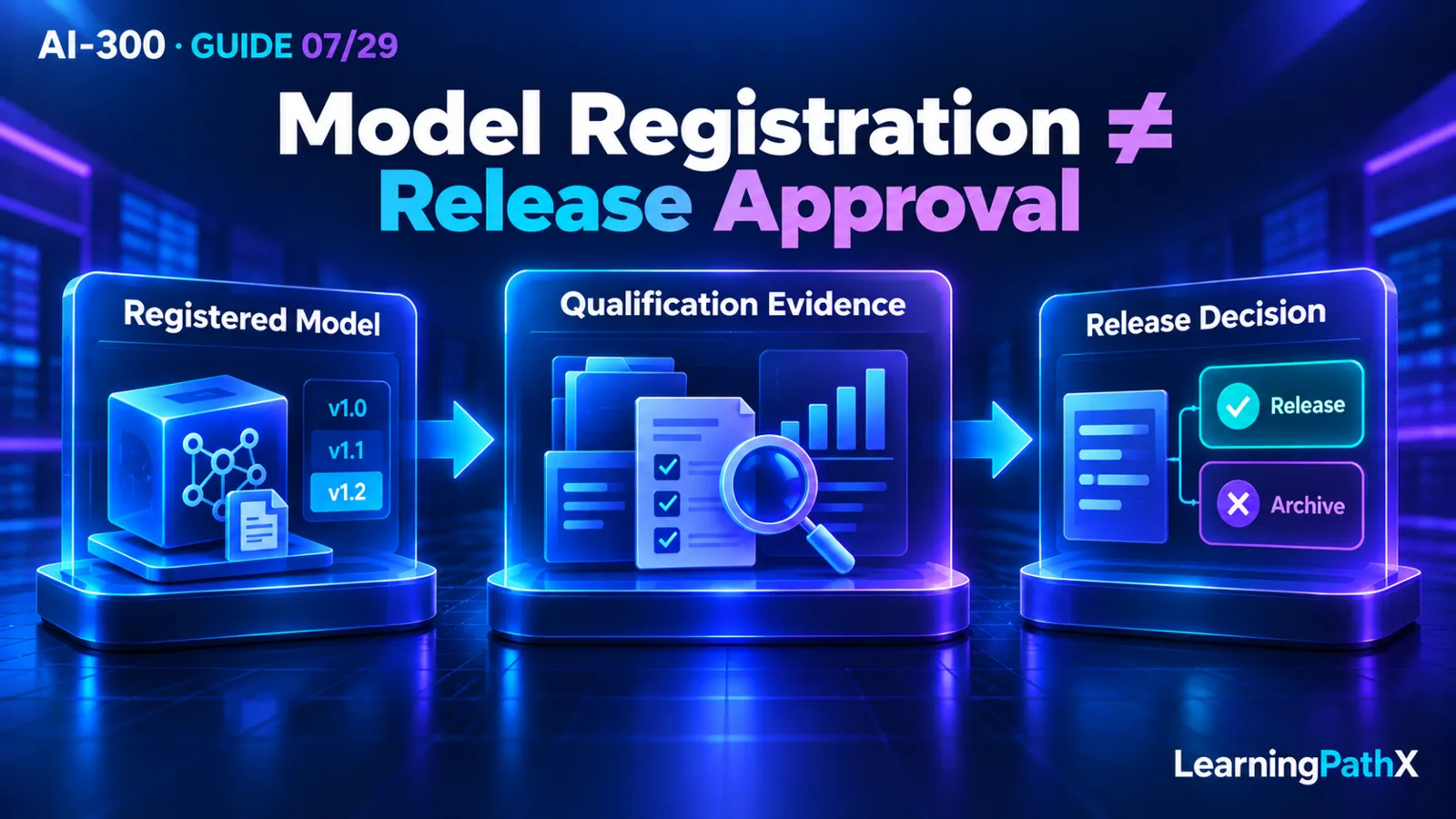
Before treating a registered machine learning (ML) model as a release candidate, package its required dependencies, identify the exact model version, and connect that version to training and evaluation evidence. When training uses managed feature-store features, include feature_retrieval_spec.yaml at the root of the model artifact. Then assess performance and relevant risks, record unresolved limitations, and make an explicit qualification decision. Registration supplies an addressable artifact; it does not establish fitness for use.
The procedure is to verify the training and feature contract, register the chosen MLflow artifact, inspect its lineage and reproducibility evidence, perform a supported responsible AI assessment, and record whether it remains a candidate or should leave active selection. Use a separate release record for the decision and its rationale. The suggested record is an editorial recommendation, not a built-in Azure approval workflow.
What a Qualified Registered Model Represents
Azure Machine Learning tracks models under a name and version. Its supported model asset formats include mlflow_model, and MLflow integration supports tracking and model management. A model version identifies the artifact being discussed; “newest,” “best,” and “approved” require additional evidence and an explicit decision.
Keep three things distinct. The packaged artifact is what a consumer loads. The lineage record identifies where it came from. The qualification record explains what was tested, what passed, and what remains uncertain for the intended use. Some evidence can be stored with model metadata or experiment artifacts; other evidence may live in an access-controlled engineering record. The requirement is that reviewers can resolve it unambiguously for the exact version.
Why Packaging and Qualification Belong Together
A strong evaluation result cannot rescue an incomplete package. A consumer may be unable to reproduce the result if the feature selection, input contract, or dependency environment differs. Conversely, a package that loads successfully can still perform poorly for an important subgroup.
Consider an illustrative transaction classifier. Its average score improves, but its training data accidentally includes feature values from after the prediction time. Another version has correct historical features yet performs poorly for a small, important transaction category. Both concerns belong in qualification: the first challenges the validity of the evidence, while the second challenges suitability for the intended population. Neither is resolved by assigning a higher model version.
Core Procedure for a Model Candidate
1. Establish the Artifact and Feature Contract
Start with a completed training outcome from AI-300: Building Reproducible and Distributed Training Pipelines. Identify the precise model output and its expected input columns, types, preprocessing, missing-value treatment, and output interpretation. Record the software and environment dependencies needed to load and evaluate it. These are recommended acceptance checks; do not infer that all of them are validated automatically during registration.
For a feature-store-based model, the feature retrieval specification identifies selected features from registered feature sets, potentially spanning more than one feature store. Generate it with the documented feature-store tooling and package it with the model during training. Its exact required name is feature_retrieval_spec.yaml, and it belongs directly in the model artifact's root folder. A copy buried in an unrelated nested directory or renamed for convenience does not satisfy that contract.
The documented workspace model-to-feature-set lineage depends on this specification being present in the model artifact. Its role is to identify the feature dependencies; it is not a copy of all feature values or proof that the consumer has access to the feature stores. Keep data permissions and availability on the handoff checklist.
2. Validate Point-in-Time Assumptions
Feature retrieval combines the selected features with observation data through a point-in-time join. Review the observation timestamp column, entity matching, selected feature-set versions, and the meaning of each timestamp before accepting the training data. These checks ensure that the intended historical question is being asked.
In the illustrative classifier, a prediction at 09:00 must not use a transaction aggregate that includes events at 10:00. As a recommended spot-check, choose a few observation rows and inspect which feature history should be eligible. Include a boundary case near the observation time and a row with missing history. Record the assumptions and expected behavior rather than judging the join only by whether a job completed.
Also document any source corrections, delayed arrivals, or backfills that could change the interpretation of historical information. Do not assume a point-in-time join proves that the underlying timestamps or source history are correct. The qualification record should explain how the team's data actually supports the historical availability assumption. If it cannot, hold the candidate and repair the data evidence before relying on its measured performance.
3. Register the Exact MLflow Artifact and Inspect Lineage
Register the selected artifact through the supported MLflow or Azure Machine Learning model-management workflow. Record the destination workspace or shared registry, model name, and resulting version, and verify that they resolve to the intended artifact. A similarly named model in another workspace is not an interchangeable reference.
Azure Machine Learning registries support sharing assets across workspaces. They can receive an existing workspace model or a model from a training-job output. Use that sharing boundary deliberately; do not confuse a shared registry with the runtime workspace in which the training or evaluation job ran.
Attach or reference the following evidence for the registered version. The table is a recommended release-record structure, not a prescribed metadata schema.
| Evidence | Qualification question |
|---|---|
| Training job/run and source revision | Can a reviewer identify the code and output that produced this artifact? |
| Data and feature references, observation-time assumptions | Can the reviewer establish what information the model learned from? |
| Environment and package dependencies | Can the selected package be loaded in the intended evaluation environment? |
| Input/output contract and representative cases | Is the model being evaluated with the contract its consumer will use? |
| Evaluation dataset, baseline, metric definitions, and results | Does the comparison concern this exact version under comparable conditions? |
| Intended use, owner, decision, and open limitations | Who is accountable for accepting the remaining risk? |
MLflow can track metrics, parameters, and artifacts, but model builders still need to configure the scenario-specific logging. Do not assume that creating a registered version fills every row of this table. Inspect the actual lineage and retrieve the referenced evidence. If evidence is missing or points to another candidate, keep the qualification decision pending.
As a recommended package test, load only the trusted candidate in an isolated evaluation environment and run representative inputs. Record failures as failures. Successful loading establishes package compatibility for that environment and test set; it is not yet a serving deployment or a production acceptance result.
4. Check Responsible AI Dashboard Eligibility First
The Responsible AI dashboard supports performance, fairness, data exploration, interpretability, and error analysis. Its current Azure Machine Learning support is constrained. As verified on October 15, 2026, check these conditions before selecting it for the qualification workflow:
- Tabular structured-data regression or binary/multiclass classification.
- A registered sklearn (scikit-learn) MLflow model with the required predict()/predict_proba() implementation or wrapper; it must be loadable in the component environment and pickleable.
- pandas DataFrames supplied in Parquet format; NumPy and SciPy sparse data are unsupported.
- Numeric or categorical features, with categorical feature names specified explicitly.
- No more than 5,000 points for the dashboard UI; downsample before passing data. Datasets above 10,000 columns are unsupported.
- The documented exclusions for AutoML MLflow models and registered AutoML models from the UI.
Being an MLflow model is therefore insufficient by itself. Do not infer that an AutoML-produced model becomes supported merely by registering it, renaming it, or changing a tag. If the candidate is outside the documented support boundary, record the tool limitation and choose an independently verified assessment approach. That limitation must not become a reason to skip risk evaluation.
5. Turn Evaluation Findings into a Decision
Choose the intended use, baseline, important error types, and acceptance criteria before inspecting candidate results. The following decision process is a recommendation rather than a universal Microsoft threshold.
Begin with the overall comparison, then inspect error concentration. Define a cohort as an explicit subset of evaluation data, such as a transaction category or a missing-history condition. Compare the candidate and baseline on the same cohort definition and dataset. Include cohort size and relevant error counts so a good-looking average cannot hide a weak or sparsely represented subgroup.
For the illustrative classifier, the team might consider missed high-risk transactions more harmful than unnecessary review referrals. That judgment should drive metric choice and follow-up investigation. It is a scenario assumption, not a prescription for all classifiers. A small cohort with few observed errors may still provide too little evidence for release; recommend gathering more representative data rather than declaring success from a noisy result.
Keep fairness and error analysis connected but distinct. An operational error cohort is not automatically a sensitive demographic group, and parity on one chosen metric does not establish that every affected group is treated acceptably. Select relevant group definitions through the use case and authorized governance process. Record which populations, harms, and intersections were evaluated and which could not be assessed.
Treat dashboard explanations as investigation evidence. Feature importance does not by itself establish causation, and a counterfactual prediction does not guarantee that a real-world intervention is possible or effective. A report or scorecard summarizes an assessment; it is not an automatic fairness certificate, legal approval, or release authorization.
If the assessment uses a downsampled dashboard dataset, preserve how it was selected and inspect whether important cohorts remain represented. Distinguish findings on that sample from results on the full held-out evaluation set. After changing features, training, or decision logic to address a finding, identify the changed artifact and repeat the affected evaluation rather than carrying forward the old approval.
Who Owns the Qualification Handoff
This workflow is useful to model builders, ML operations engineers, and reviewers who need an inspectable handoff. As a recommended responsibility split, the model builder supplies package and training evidence, the operations engineer checks resolvable dependencies and artifact identity, and the designated decision owner accepts or rejects the candidate for its stated use.
Keep raw evaluation data and sensitive cohort information under appropriate access controls. A consumer of the release record should receive enough evidence to understand the decision without receiving unnecessary personal or confidential data.
Record Release and Archive Decisions
Conclude with an explicit outcome: qualified for a stated use, held for specific evidence, or rejected/superseded. These are proposed release-record labels, not Azure model stages. Record the exact version, reason, evidence references, decision owner, and unresolved limitations. Registration can precede the final assessment; the registered artifact remains unqualified until the decision is supported.
When a version should leave active candidate selection, record an archive disposition in the team's lifecycle inventory. Preserve the artifact identity and the reason it was superseded or rejected. Before applying any platform archive or deletion operation, check current documented semantics, retention requirements, active consumers, investigation needs, and rollback dependencies. This guidance does not supply an unverified archive command or claim that an archive label stops deployed workloads.
Do not erase an unsuccessful candidate's evidence to simplify the history. A retained rejection reason can prevent repeating a failed experiment, and a retained prior version may be needed for recovery. Archive disposition, release approval, and deployment state must remain independently understandable. Continue to AI-300: Choosing Online and Batch Inference only when the handoff evidence supports the intended next step; serving setup is a separate outcome.
Common Learning Challenges
- Packaging the feature specification beside the training data but omitting it from the final model root.
- Trusting a point-in-time retrieval job without checking the observation-time assumptions.
- Evaluating one artifact while handing another registered version to the next team.
- Treating dashboard compatibility or an aggregate metric as evidence of fairness.
- Downsampling away an important error cohort without recording the limitation.
- Reusing an approval after changing the artifact or discarding a prior version before dependency checks.
For each issue, restore the missing evidence before advancing the candidate. A qualification record should make uncertainty visible rather than hiding it behind a version number.
Conclusion
A useful registered model handoff combines a resolvable version with feature dependencies, historical data assumptions, training lineage, a loadable package, and use-specific evaluation evidence. Responsible AI tooling adds insight within its documented support limits. Explicit qualification and archive decisions preserve what the evidence means, so the next team can assess the candidate without reconstructing its history.
Authoritative Sources
- How Azure Machine Learning works: resources and assets
- Machine learning registries for MLOps
- MLflow and Azure Machine Learning
- Feature retrieval specification and usage in training and inference
- Assess AI systems by using the Responsible AI dashboard