
Introduction
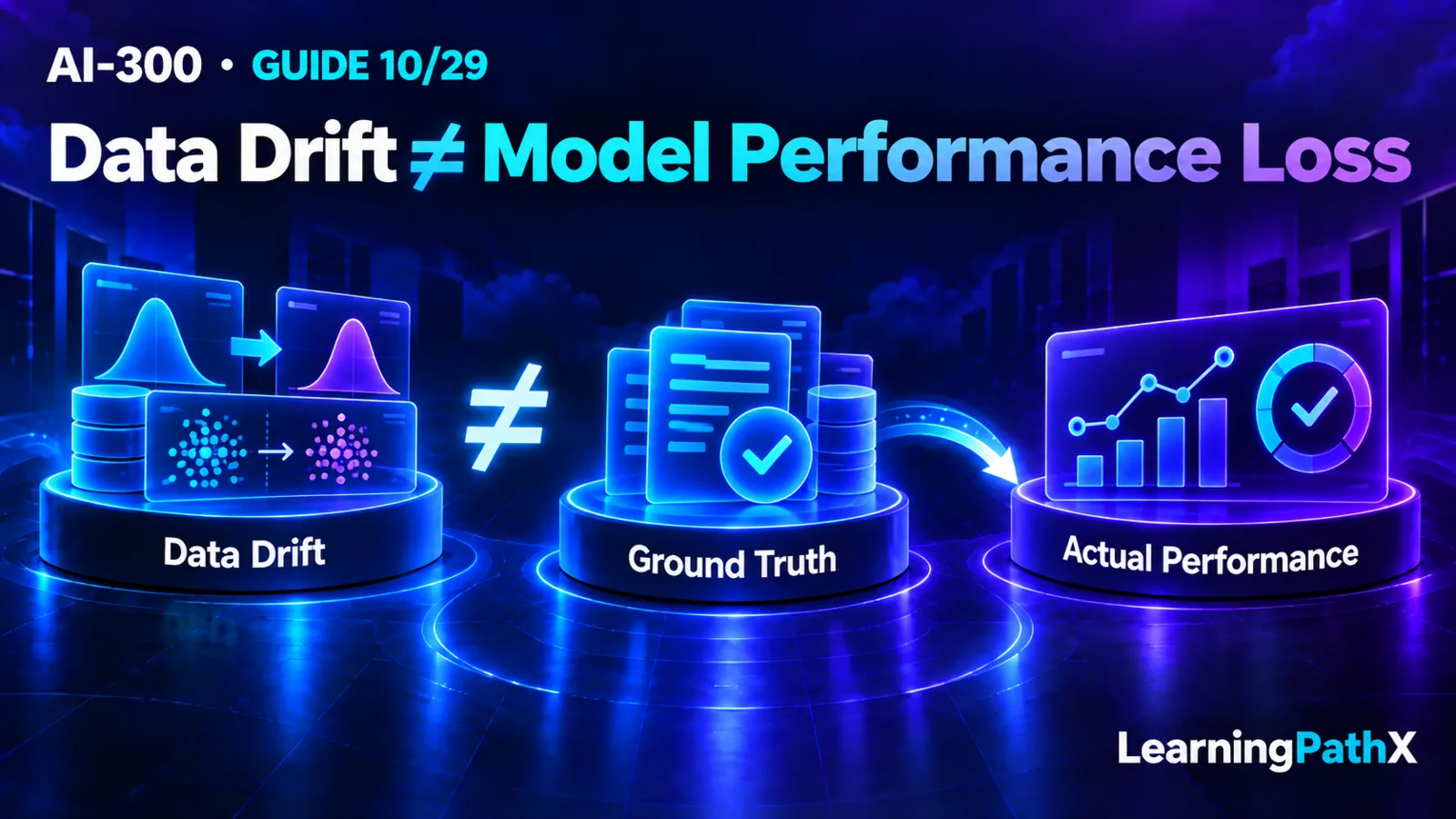
Investigate when production data quality, input or prediction distributions, or measured model performance depart from an agreed expectation. Consider a controlled retraining run only after establishing that the evidence is trustworthy and the likely cause is something new training could address. Drift shows that data or predictions changed; it does not by itself prove that predictions became less accurate. Actual performance measurement requires reliable ground truth, also called actuals, matched to the predictions being assessed.
The decision framework is to verify collection and comparison windows, identify the affected signal and population, distinguish data/service faults from model deterioration, and choose an owned response. An alert may justify investigation or launch a policy-approved training job, but the resulting model remains a candidate until it is independently evaluated and released through the team's controls. Monitoring does not guarantee that retraining improves quality.
What Azure Machine Learning Model Monitoring Measures
Azure Machine Learning model monitoring computes signals from production inference data and suitable reference data. Runs execute on a configured schedule, evaluate selected metrics and thresholds, and can generate alerts. Do not interpret this as a correctness judgment on every request at inference time.
Keep operational service health separate from model usefulness. A request can complete successfully while its prediction is poor; conversely, a data-access or runtime failure can prevent predictions even when the trained model remains suitable. Use the controlled release outcome from AI-300: Lab: Testing, Rolling Out, and Reverting an Online Model as a known starting point, then monitor what happens after that release.
The following signal distinctions determine which evidence to seek next:
| Signal | What changed or is measured | What it cannot establish alone |
|---|---|---|
| Data quality | Missing values, type mismatches, or out-of-bounds inputs. | Whether retraining is an appropriate remedy for a broken source feed. |
| Data drift | Production input distribution compared with a reference. | That a distribution change harmed prediction quality. |
| Prediction drift | Distribution of model outputs compared with a reference. | Whether changed predictions are correct. |
| Feature attribution drift, preview | Changes in feature contributions relative to training. | That a changed explanation establishes an observed prediction error. |
| Model performance, preview | Predictions compared with collected ground truth. | That the labels and their matching process are representative or error-free. |
Why a Monitoring Signal Needs Context
Consider an illustrative retail demand model. A promotion changes the mix of items being scored, creating a distribution shift. That shift might be expected. A separate feed starts supplying a quantity in different units; retraining on that corrupted input would not be a sound first response. Later, finalized sales outcomes may show that forecasts are consistently poor for a particular product group, providing a different reason to investigate model suitability.
These are reasoning examples, not measured production incidents. Their common lesson is that the same alert label can lead to different actions. The owner needs the model version, data window, affected population, source changes, and business context before choosing a remedy.
Core Decisions in the Monitoring Loop
Establish Collection Before Interpreting Silence
Enable and verify the intended production inference collection. For Azure Machine Learning online endpoints, the documented collection capability can supply production inputs and outputs. For batch endpoints or deployments outside Azure Machine Learning, the team is responsible for collecting the data used by model monitoring. Endpoint existence alone is not evidence that the required collection is complete.
As a recommended collection contract, retain a prediction identifier, model/deployment version, relevant event time, input/output references, and the information needed to associate later outcomes. Collect only the data needed for the approved purpose, with access and retention controls. This is a design recommendation, not a prescribed service event schema.
Verify that the monitor's identity or credential can read its data and that records arrive in the expected form. Inspect a sample and reconcile coverage against the workload. Separate collection gaps, monitoring-job failures, and genuinely quiet signals: an empty or failed run must not be reported as healthy model performance.
As verified on October 15, 2026, model monitoring does not support the AllowOnlyApprovedOutbound managed virtual network isolation setting. Resolve that compatibility requirement before promising monitoring coverage. Adding a destination rule is not documented as a workaround. Keep any alternative subject to its own security and support verification rather than relaxing the network requirement during diagnosis.
The current implementation also uses Spark for metric computation and guarantees only basic MLTable support. Do not assume complex/custom MLTable operations work unchanged in a monitoring job. Check the chosen data representation and a representative monitoring run before relying on the design.
Choose Reference and Production Windows Deliberately
A reference answers a particular comparison question. Training data can help reveal differences from the inputs used to develop the model; a recent production reference can help reveal change from an earlier operating period. Prediction drift needs an output reference appropriate to that signal. Ground-truth performance needs actual outcomes, not merely the training distribution.
Azure Machine Learning supports fixed and rolling data windows. Window size defines the duration included, while offset moves the window's end away from the run time. Keep the reference and production comparison periods nonoverlapping and record their actual boundaries. A scheduled run time alone is not enough to identify which observations were assessed.
For the retail example, choose a comparison period that makes the intended question explicit: ordinary weekdays against ordinary weekdays, or a promotion period against an approved comparable promotion baseline. These are recommended choices to validate, not service defaults. A mismatch in season, source pipeline, or product mix may explain a signal without establishing a model defect.
Do not move a reference forward just to remove an alert. Record why a new reference is valid and what earlier baseline it replaces. Likewise, a permanent training-data reference can become less useful after a legitimate operating change. Preserve enough history to explain how monitoring interpretation changed.
Treat Ground Truth as an Evidence Pipeline
Use performance metrics only when predictions can be matched to suitable actuals. For classification, the current preview signal includes accuracy, precision, and recall; for regression it includes error measures such as mean absolute error. Select metrics according to the task and the harm the team needs to detect, rather than assuming one metric captures every failure.
Delayed outcomes require a maturity rule. In the retail example, a forecast made today may be assessable only when the corresponding sales period is complete. As a recommended check, distinguish pending outcomes from missing, corrected, or duplicate outcomes, and document which population is eligible for assessment. Do not count an unavailable label as a correct prediction or silently exclude hard-to-observe cases.
Audit the prediction/outcome association on representative records and inspect coverage by relevant cohort. If outcomes arrive faster for some groups than others, the currently labeled subset can give a biased view of quality. Record that uncertainty and wait for adequate evidence or use a separately justified assessment; do not label drift metrics as “accuracy” while actuals are unavailable.
As of the verification date, model-performance and feature-attribution-drift signals are public previews. The official documentation states that preview features have no service-level agreement and are not recommended for production workloads. Establish acceptable support and operational arrangements before depending on them; the article does not present them as generally available production guarantees.
Connect Thresholds to Investigation and Action
Set a threshold for a defined metric, feature/population, and comparison window. Record its meaning and direction, the evidence volume expected, its owner, and the action after a breach. A threshold suitable for one distance metric or task is not a universal number for every signal.
The following is a recommended response policy, not a built-in rule engine:
| Evidence observed | First response | When a controlled training run is justified |
|---|---|---|
| Collection gap or failed monitoring job | Repair observability and establish which evidence is missing. | Not from that failure alone. |
| Abrupt null/type/range problem after a source change | Inspect and correct the data contract or pipeline. | Only after valid data and a separate model-related need are established. |
| Input/prediction drift with expected business change and no verified harm | Check affected cohorts, reference validity, and outcome evidence. | If investigation supports adaptation and suitable training/evaluation data exists. |
| Trustworthy ground-truth performance deteriorates | Examine label quality, serving changes, cohort mix, and model suitability. | If the cause is plausibly learnable and the candidate can be compared fairly with the current model. |
| Runtime/service fault | Restore the service or dependency using the incident process. | Not as the default fix for an unavailable runtime. |
Avoid alert fatigue by validating thresholds against realistic operating variation. Also avoid treating one non-breach as proof of safety. Low data volume, missing labels, or an unrepresented subgroup can make a quiet metric inconclusive. Record uncertainty in the investigation outcome.
Assign Owners and Bound Event-Driven Automation
This workflow needs cooperation between model builders, data owners, and operations engineers. As a recommended division, data owners validate source and outcome quality, model builders interpret performance and cohort evidence, and operations engineers maintain collection, monitor execution, notification, and response paths. Name a decision owner for unresolved tradeoffs.
Azure Machine Learning monitoring events can integrate with Azure Event Grid for event-driven processes, including starting a retraining job. That capability does not mean an event automatically provides a correct training dataset or deploys an approved replacement. Define the subscriber's permitted action explicitly.
For a proposed automated training trigger, recommend recording the triggering model/version, metric/window, evidence references, and policy decision; prevent repeated alerts from creating uncontrolled duplicate training work. Bound concurrency, spending, access, and retry behavior, and keep an auditable investigation path when the event lacks sufficient context. These are automation design controls, not a claim that the platform supplies this complete workflow by default.
Qualify the Retrained Candidate and Close the Loop
Freeze the training inputs and source revision for the new run. Preserve the currently deployed model as the comparison baseline, with suitable independently held-out evaluation data. Review relevant cohorts and task-specific failures as well as aggregate improvement. A candidate can improve one average metric while worsening an important operational outcome.
Record an explicit result: reject, request more evidence, or approve a controlled release. A completed training job and a lower drift score are insufficient approval criteria. Keep the existing model available according to the recovery policy, then verify the accepted candidate through the release controls before changing production.
After an approved change, check collection, model/version attribution, reference choices, and the monitoring response again. The loop is complete when the team can determine whether the intervention helped and can explain any revised thresholds or references. If retraining does not address the investigated cause, retain that result and choose a better-targeted intervention rather than repeating the same trigger indefinitely.
Common Learning Challenges
- Calling input drift “accuracy loss” without outcome evidence.
- Treating absent labels or a failed monitor as a healthy result.
- Comparing overlapping or poorly matched time windows without documenting their meaning.
- Updating the baseline to silence an alert rather than validating the change.
- Retraining on corrupted data or assuming Event Grid bypasses candidate review.
- Promising generally available performance monitoring or supported approved-only outbound networking despite the current qualifications.
For preparation, explain the evidence that would distinguish each of these conditions before choosing a response. AI-300: Readiness Checklist for AI Operations Decisions provides a later opportunity to check those distinctions after the foundations are understood.
Conclusion
Useful monitoring connects a trustworthy observation to an owned decision. Verify collection, windows, support constraints, and ground-truth quality; investigate drift before inferring harm; and retrain only when the evidence supports that response. The resulting model still needs qualification, controlled release, and renewed monitoring to establish whether the intervention improved the intended outcome.