
Introduction
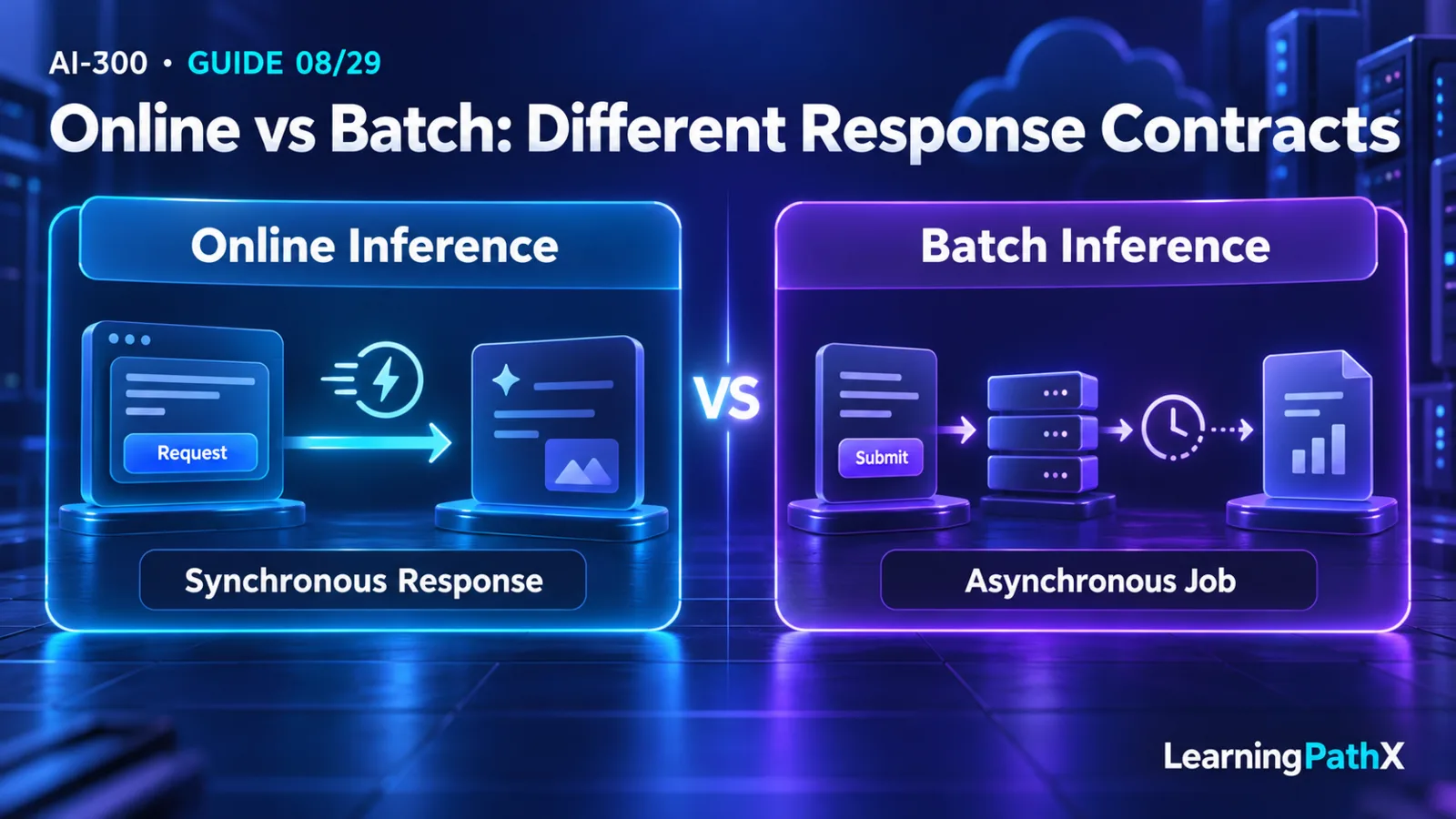
Choose managed online inference when a caller needs a prediction in the response to its request and the model can finish within that interaction's latency budget. Choose batch inference when the caller can submit work and obtain results later, particularly for long-running processing or many stored files. An online request returns inference results synchronously; invoking a batch endpoint creates an asynchronous job whose completion and outputs must be checked separately.
The decision therefore starts with the consumer's contract, then tests data access, identity, compute, failure handling, and cost against that contract. This comparison concerns custom trained models. Azure Machine Learning also supports standard deployments for supported foundation models; online and batch endpoints are not an exhaustive list of all current deployment options.
Architecture Overview: Endpoint and Deployment
An endpoint supplies a stable invocation address and access boundary. A deployment supplies the model or component and the resources used to perform inference. Online and batch endpoints can each contain multiple deployments. Keep the consumer-facing interface separate from the particular model version and runtime being evaluated.
Begin with the qualified artifact from AI-300: Packaging and Qualifying Registered ML Models. In the design record, identify its exact registered version, expected inputs, output meaning, and dependencies. A mode choice does not repair a missing model dependency or make an unqualified candidate suitable for production.
The following table translates the two invocation patterns into recommended design questions. It is a planning aid, not a list of service limits.
| Decision | Managed online inference | Batch inference |
|---|---|---|
| Consumer experience | Can the consumer wait for prediction during the request? | Can the consumer submit now and collect results later? |
| Input contract | Can the required input fit the request and be processed promptly? | Is the input already stored, or can it be prepared for a job? |
| Completion evidence | Is the returned response valid and timely? | Did the job finish, and are the expected outputs complete? |
| Failure recovery | How will the application handle timeout, rejection, or an uncertain result? | How will the operator identify incomplete work and avoid duplicating outputs on rerun? |
| Capacity planning | What concurrency and response latency must be sustained? | What workload must finish by the deadline, including startup and queueing? |
Core Components of the Serving Contract
Request Inputs, Stored Data, and Outputs
The official guidance positions online endpoints for low-latency requests whose inputs fit the request payload. Batch endpoints suit stored inputs, large collections of files, longer execution, and reusable pipelines. Select based on these workload characteristics rather than the model's name or training algorithm.
For online design, write down the required fields, types, permitted missing values, response schema, and response-time target. Include any preprocessing or downstream lookup in the latency investigation. Measure the whole interaction the application experiences, not just the model's prediction function.
For batch design, specify the input selection, output destination, expected record or file coverage, completion deadline, and reconciliation method. Define how a consumer learns that the output is usable. A job identifier is a tracking reference, not a prediction result. Do not design a downstream process that treats submission acceptance as data readiness.
Both sets of contract checks are recommendations. An endpoint's existence does not establish that the chosen schema, output interpretation, or business deadline has been validated.
Caller Identity and Runtime Data Access
Document who invokes the endpoint separately from who accesses data during inference. Verify the authentication mode supported by the selected endpoint and configuration, the caller's authorization, and the effective runtime identity or credential for each dependency. Do not assume that the person who created a deployment is the principal used by every subsequent operation.
For an online workload, identify what arrives in the request and what the runtime must retrieve elsewhere. For a batch workload, identify which context reads stored input and writes results. In both cases, record target permissions and network routes for those operations. A successful invocation cannot prove that a later storage request will succeed.
As a recommended acceptance check, use the intended application or automation principal for invocation and the actual runtime configuration for data-access tests. Also test an unauthorized context to confirm the expected denial. Protect credentials and sensitive input/output content in diagnostic records. These checks belong in the deployment plan even when an administrator can invoke the endpoint successfully.
Compute, Lifecycle, and Cost
The current endpoint comparison distinguishes online resources provisioned at deployment time from batch resources consumed when jobs run. Online capacity must support request demand; batch planning must account for job execution and queueing. The page also documents different scaling behavior, so do not apply one mode's scaling assumptions to the other.
Translate those facts into a workload estimate before selecting capacity. For online inference, measure representative request sizes, model loading and memory requirements, concurrent demand, and latency distribution. For batch inference, measure representative data volume, per-item work, parallel processing potential, startup, and time spent waiting for capacity.
Neither mode has a universal cost advantage. Recommend estimating the required online running capacity over the operating period and the batch compute needed for the expected job schedule, then adding relevant storage and supporting-service costs. Verify regional availability, quota, and current pricing for the chosen resources before committing. No fixed cost or latency figure is implied here.
How the Components Work Together: A Workload Decision
Consider an illustrative retailer with one trained demand model and two consumers. A planner requests a small prediction while adjusting an order. A nightly process scores a large collection of store-product records before the next planning cycle. These are design examples, not measured deployments.
Managed online inference is a plausible choice for the interactive planner if a representative request meets the application's agreed response-time target. The evidence should include realistic payloads, any required lookups, expected concurrency, and controlled failure behavior. A fast prediction on a developer's machine does not establish that end-to-end requirement.
Batch inference is a plausible choice for the nightly process if it can finish the actual volume before its deadline. The evidence should include input selection, queue/startup time, completed output coverage, and recovery from a deliberately incomplete run. Parallel processing may help only if the workload and implementation can use it effectively; do not assume that choosing batch makes every model scale linearly.
The same model can therefore lead to different serving choices for different consumers. If maintaining both contracts would add unacceptable complexity, investigate a simpler operating model explicitly rather than assuming the training artifact forces one answer.
Design Considerations and Deployment Acceptance
Test the Contract, Then the Operational Envelope
Create a non-production acceptance plan with a frozen candidate version and representative test inputs. The official comparison lists local testing for online deployments, but local tests do not replace testing the actual target runtime and its dependencies. Do not promise identical local tooling for batch deployments.
For online acceptance, retain the candidate identity, runtime/configuration, test payload definitions, output checks, observed latency under the chosen load, and failure observations. Include malformed inputs, missing dependencies, and a request that exceeds the application's tolerance. Define the application's response to each failure before claiming acceptance. There is no universal timeout or concurrency number in this guide.
For batch acceptance, retain the submitted job identity, resolved input selection, expected output coverage, final job state, and output reconciliation. Include an invalid input or inaccessible dependency in a controlled test. Decide whether partial output is acceptable and how reruns are identified so downstream consumers do not silently double-count results. These are application-level requirements to verify, not assumptions about automatic service recovery.
In both modes, separate infrastructure health from inference quality. A running deployment, a successful response code, or a completed job can coexist with incorrect predictions or an unexpected output schema. Reuse qualification evidence for the exact artifact and add serving-specific checks for preprocessing and input/output behavior.
Preserve a Clear Deployment Record
Record which model version, runtime, identity, compute configuration, and endpoint/deployment names were accepted. When any of these change, identify the affected checks and repeat them. Avoid validating one configuration and later describing another as tested because their display names look similar.
Online traffic routing and a batch endpoint's default-deployment selection are different mechanisms. A batch default change is not a percentage-based online traffic split. Define the intended target clearly during acceptance, and retain the version-to-deployment association in the release record.
Progressive rollout, direct candidate tests, and controlled reversion of a managed online deployment are developed in AI-300: Lab: Testing, Rolling Out, and Reverting an Online Model. This comparison stops at choosing the mode and defining evidence for deployment acceptance.
Common Mistakes
- Choosing online solely because it sounds faster, without measuring the consumer's full response path.
- Treating a batch submission response as proof that predictions are available.
- Testing invocation permissions while omitting runtime storage access.
- Comparing cost without including running time, queueing, or supporting resources.
- Accepting a healthy deployment without checking output schema and prediction behavior.
- Applying online traffic-split assumptions to batch default selection.
For each mistake, return to the specific consumer contract and identify the missing observation. The useful question is what evidence would establish a successful service outcome for that consumer.
Certification Relevance
For AI-300 preparation, explain a mode choice using the request/response contract, input location, completion evidence, and operational requirements. Then describe how you would verify the caller, runtime dependencies, capacity, and output correctness. This develops a defensible inference architecture without relying on a rule that every small model is online or every large model is batch.
Conclusion
Managed online inference supports a synchronous consumer contract; batch inference separates submission from execution and result collection. Choose between them using the workload's actual latency and completion requirements, then verify identity, data access, compute, cost, and outputs in the target configuration. Acceptance requires evidence from the complete serving path, not just a created endpoint or an accepted job.