
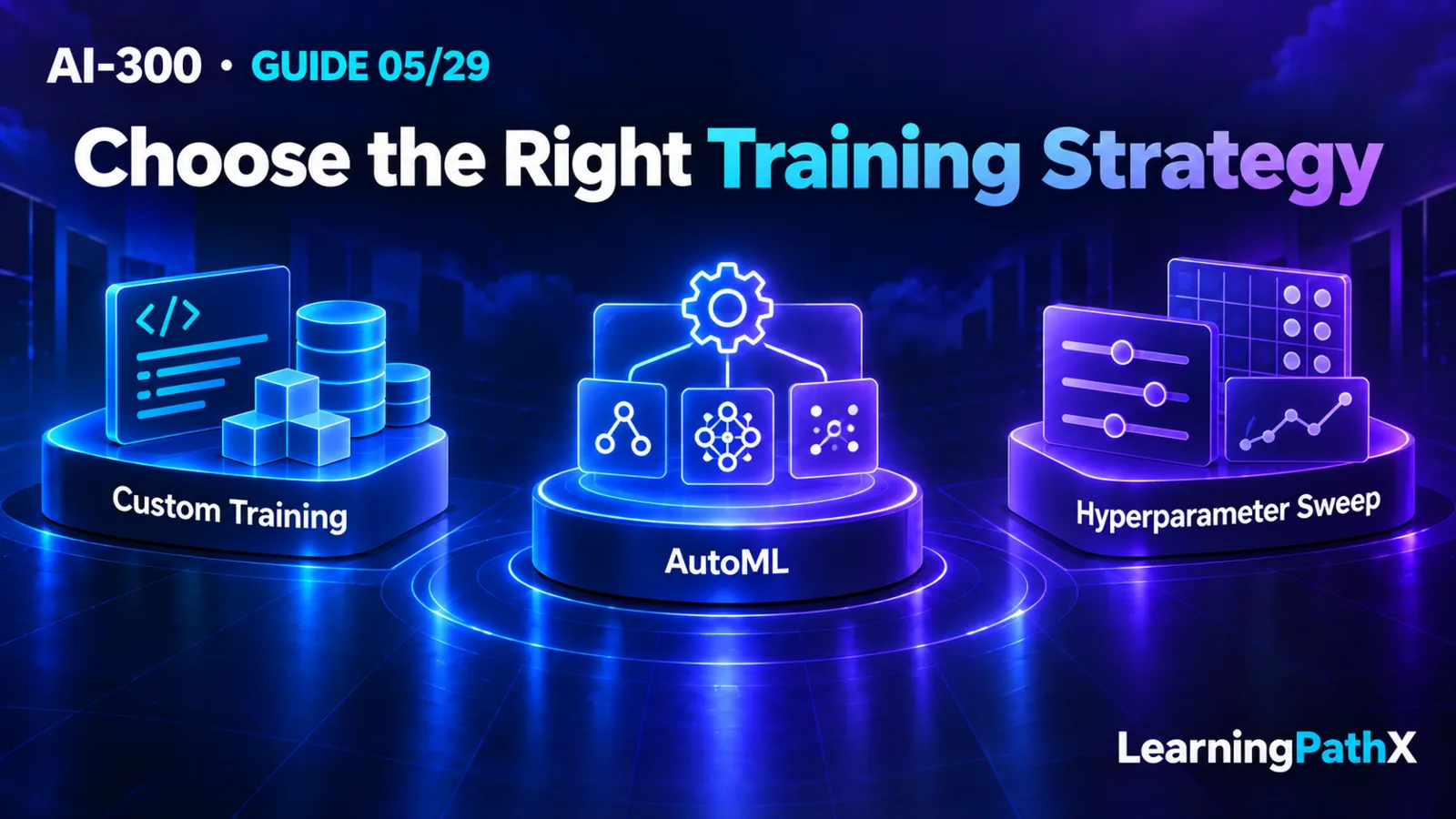
Use a custom Azure Machine Learning training job when you need direct control of the training logic, automated machine learning (AutoML) when a supported task fits an automated search across algorithms and configurations, and a sweep when you already have parameterized training code and want to search its hyperparameters. Choose the method from the uncertainty you need to resolve: implementation behavior, model-family choice or parameter values. MLflow tracking provides the evidence for comparing runs; it is useful with each method rather than a competing training strategy.
Compare candidates only after establishing compatible evaluation data, metric definitions and experimental conditions. A higher score is not persuasive if one candidate used an easier split or a different target definition. Keep the selected method, its resource budget and its evidence connected so another engineer can explain both how a candidate was produced and why it deserves further evaluation. This guide uses Azure Machine Learning command-line interface (CLI) and Python software development kit (SDK) v2 documentation checked on October 15, 2026.
What a Training Experiment Needs to Establish
A useful experiment answers a bounded question. “Does this preprocessing change improve validation error under the same split?” is actionable; “find the best model” leaves the search space, success criterion and stopping point unclear. Before choosing a service feature, write down the hypothesis, baseline, primary measure and limits on experimentation.
For operational work, the experiment should also leave enough evidence to investigate a surprising result. Azure Machine Learning captures job context such as code, environment and inputs/outputs; model builders still need to configure tracking of scenario-specific parameters, metrics and models. MLflow can record runs, metrics, parameters and artifacts in the workspace. A training job that completes without the intended objective measurement has not answered the experiment's question.
Recommended preparation is to identify the data snapshot, target column or outcome definition, validation split and expected outputs before adding search. Record the rationale for each selection. These are experiment-design practices, not claims that a platform can determine scientific validity automatically.
Choosing and Comparing Training Experiments
| Method | Choose it when | What the team must still decide |
|---|---|---|
| Custom training job | You need explicit control of preprocessing, algorithm implementation, loss or training behavior | The implementation, dependencies, parameters, evaluation and resource limits |
| AutoML | The problem matches a supported task and you want the service to explore algorithms and configurations | Task, target, usable input data, evaluation metric, validation strategy and exit criteria |
| Hyperparameter sweep | Working training code exposes meaningful tunable inputs | Search space, sampling method, objective, trial limits and suitable stopping behavior |
These methods can be successive stages of investigation. A custom baseline can establish whether the data and metric behave sensibly. AutoML can provide candidate approaches for a supported problem. A sweep can then explore an explicitly chosen implementation. This is a recommended progression, not a mandatory Azure workflow or a promise that one method will outperform another.
When direct control is the priority
Choose custom training when the computation itself is part of the experiment. Examples include investigating a specialized loss or applying preprocessing that must follow a particular domain rule. Begin with a small, inspectable baseline. If the result is poor, you need to distinguish a faulty data transformation from an unsuitable algorithm before multiplying trials.
A notebook is useful for exploring data and examining intermediate results. For a repeatable job, the recommended next step is to extract the relevant logic into a script with explicit arguments, dependency requirements, input paths and outputs. Restart the exploratory session and check that the intended sequence is clear; then assess the script independently of variables created interactively. This reduces hidden assumptions before a remote execution adds more moving parts.
Do not turn this transition into a change of experiment at the same time. Preserve the intended data split, parameters and metric calculation so a difference can be investigated. If the script produces a different result, resolve the reason before attributing the difference to a new training strategy.
When AutoML is a suitable search boundary
AutoML explores algorithms and parameters for supported tasks, including classification, regression and forecasting, with additional computer vision and natural language processing paths. Select the applicable task and inspect its current capabilities before adopting it. The service uses the specified metric and exit criteria; automation does not remove responsibility for the problem definition.
Use AutoML to ask whether a supported automated search produces useful candidates within the allowed budget. Avoid interpreting its leading score as a universal optimum. The candidate's data assumptions, preprocessing and evaluation conditions still need to suit the application.
Keep validation and final testing conceptually distinct. Microsoft's AutoML overview explains that repeated tuning against validation data can bias evaluation; its integrated final test-data evaluation is documented as preview. A recommended general practice is to reserve an independent held-out assessment under the team's evaluation process rather than repeatedly choosing candidates against the same final test results. Do not assume every AutoML task has identical controls or preview support.
Making a Sweep Answer the Intended Question
Start with a working trial and an exact objective
A sweep varies hyperparameters of a training job. Verify one representative trial before expanding the search: can it consume the intended inputs, use the proposed values and produce the objective measurement?
The sweep's primary_metric must exactly match the metric name logged by the script; goal selects maximize or minimize. For example, an illustrative regression experiment might log validation_rmse, meaning validation root mean squared error, and minimize that exact metric. Logging rmse instead is a different name. Optimizing training error while describing the decision as validation performance is a different measurement. Agreement on spelling cannot repair disagreement on meaning.
Recommended metric documentation includes the dataset partition, aggregation, units, direction and treatment of missing predictions. A numeric result alone does not explain these. Establish the convention before generating many trials so the comparison remains interpretable.
Choose a search space and sampling method deliberately
Azure Machine Learning supports random, grid and Bayesian sampling. Grid examines discrete choices; random sampling supports discrete and continuous parameters; Bayesian sampling uses earlier results to choose later samples and supports choice, uniform and quniform distributions.
For a small discrete space, enumerate the combinations and decide whether all are worth testing. For a broad continuous space, consider random sampling as an initial exploration, then reassess the useful region. For expensive trials, consider Bayesian sampling when learning from completed trials suits the experiment. High concurrency can reduce how much feedback is available before later choices are made, so throughput and search efficiency are different concerns.
As a design example, three candidate regularization strengths and two feature settings produce six combinations. That arithmetic describes the proposed space, not a platform quota. If the budget permits only a subset, record that the search is incomplete and avoid claiming an exhaustive comparison. Include only values the implementation can meaningfully accept; a broad distribution is not useful if much of it produces invalid training runs.
Bound trials, concurrency and time separately
Sweep controls include max_total_trials, max_concurrent_trials, whole-job timeout and per-trial trial_timeout. Concurrency also depends on available compute. A trial-count limit is therefore different from a duration limit or a cap on simultaneous resource use.
Set explicit limits before submission and use a small trial to inform the budget. Recommended planning should account for preparation overhead, failed trials and retained artifacts as well as training time. More parallel trials can shorten elapsed search time while consuming more resources simultaneously. Neither a timeout nor a trial limit is a fixed currency spending guarantee.
Azure Machine Learning offers Bandit, median stopping and truncation selection policies. Respectively, these compare performance with the best trial using slack, use running-average comparisons, or stop a low-performing fraction. No early-termination policy means there is no performance-based pruning; job limits remain relevant.
Policy evaluation is tied to logged primary-metric intervals, which need not be epochs. Choose reporting frequency and any evaluation delay deliberately. As a recommendation, inspect early learning behavior before using aggressive pruning: a slow-starting configuration may deserve more observations than a fast initial improver. Verify sampling/policy compatibility in the selected configuration and keep the policy settings in the experiment record. Early cancellation saves work only by accepting a decision with less evidence for that trial.
Compare Evidence Before Selecting a Candidate
Use a comparison record that joins measurement and provenance. The following is a recommended evidence structure, not an Azure output schema:
| Evidence | Why it affects the decision |
|---|---|
| Job/run identifier and experiment purpose | Locates the result and states what was tested |
| Code and environment versions | Helps explain implementation and dependency differences |
| Data snapshot, split and preprocessing | Establishes whether candidates faced comparable inputs |
| Parameters, search method and limits | Shows what was varied and how much exploration occurred |
| Metric definition and result | Connects the score to its meaning and optimization direction |
| Completion, cancellation and failure information | Separates finished evidence from incomplete or invalid trials |
| Model and diagnostic artifacts | Supports investigation beyond a single scalar score |
For illustration, suppose a custom baseline and an AutoML candidate are evaluated on different validation partitions. Even if both report an error metric with the same name, their scores should not be ranked as a controlled comparison. Reassess them under an appropriate common evaluation design. If a swept candidate improves the agreed measure only slightly while requiring materially greater resources, record that tradeoff instead of selecting solely by rank.
Inspect failed and terminated trials as well. A narrow set of successful configurations can hide an unsuitable search range; a canceled trial may simply lack enough evidence for the intended comparison. Retain the status alongside the score rather than treating missing measurements as poor model quality.
MLflow tracking remains supported and recommended for Azure Machine Learning workloads. Microsoft's documentation specifies September 2026 retirement for Azure Machine Learning submission through MLproject files and recommends moving to CLI/SDK v2 jobs. For this October 2026 scope, use the current job path for submission while retaining MLflow for tracking. Do not infer that the submission retirement removes experiment tracking.
Who Uses the Decision and What It Enables
Data scientists need to understand which hypothesis a candidate supports. Machine learning operations engineers need its execution context and retained artifacts. Reviewers need a comparison they can assess without reconstructing an interactive session. A useful handoff therefore names the selected candidate, its baseline, the evidence supporting the choice and remaining limitations.
For AI-300 preparation, practice selecting a method from a concrete uncertainty and explaining why the alternatives are less suited to that particular experiment. Then identify what evidence would change the decision. Building distributed execution and composing pipeline stages are covered in AI-300: Building Reproducible and Distributed Training Pipelines; they do not replace a sound experiment design.
Common Learning and Operational Mistakes
- Starting a large sweep before confirming a single trial logs the exact objective.
- Treating AutoML as a substitute for selecting the target, validation design or meaningful metric.
- Comparing runs whose data partitions or metric calculations differ without explaining the difference.
- Assuming every reporting interval represents an epoch.
- Selecting maximum concurrency without checking capacity or considering search feedback.
- Treating the best search result as automatic authorization for model registration or deployment.
- Copying an old MLproject submission example into a new v2 workflow because MLflow tracking still works.
Conclusion
Choose custom training for implementation control, AutoML for a supported automated model search and sweeps for parameter exploration around working code. Bound the work before running it and compare candidates through consistent measurement and traceable evidence. The outcome is an explainable candidate for further evaluation, with the assumptions and resource decisions visible alongside its score.
Authoritative Sources
- MLflow and Azure Machine Learning
- What is automated machine learning (AutoML)?
- Hyperparameter tuning a model (v2)