
Introduction
AI-300 assesses the infrastructure and operating practices needed to take traditional machine learning models and generative AI applications through production lifecycles on Azure. The exam, Operationalizing Machine Learning and Generative AI Solutions, is associated with Microsoft Certified: Machine Learning Operations Engineer Associate. Its principal platforms are Azure Machine Learning and Microsoft Foundry.
Candidates should bring a data science background, Python experience, familiarity with command-line interfaces (CLIs), and entry-level DevOps understanding, including GitHub Actions. Microsoft also describes experience operating both traditional models and generative applications and agents. Preparation therefore needs to connect model behavior with deployment, evaluation, monitoring, and controlled change; familiarity with only one side leaves a significant learning gap.
What AI Operations Means in This Certification
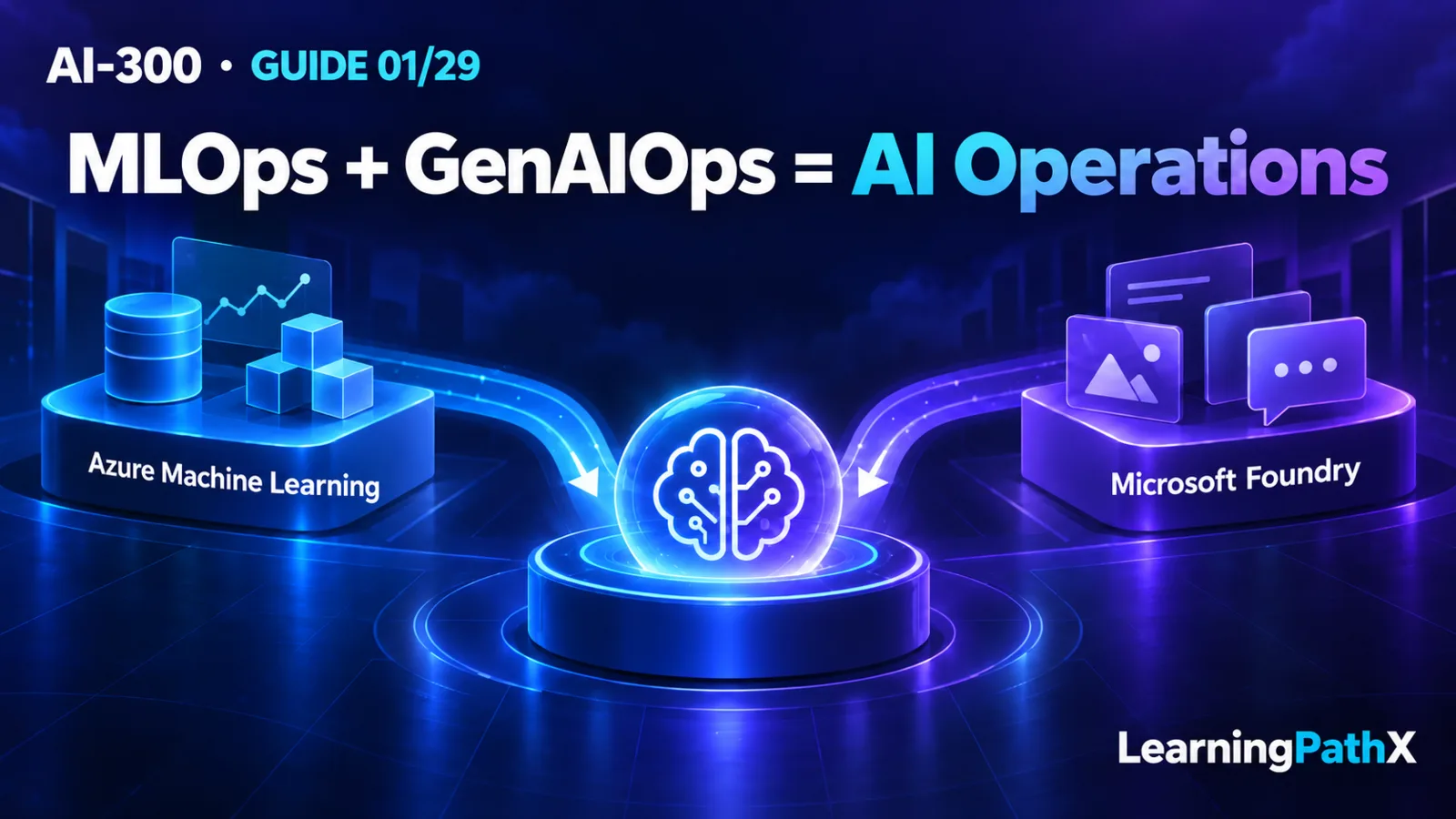
Microsoft uses AI operations (AIOps) here to bring together machine learning operations (MLOps) and generative AI operations (GenAIOps). Read the term in that certification context. It does not indicate a separate specialization in applying AI to general IT service operations.
The credential is positioned at the Associate level, with an Intermediate designation on the current certification page. The role works with data scientists, DevOps teams, and stakeholders. That makes the operational handoff a useful organizing idea: the person preparing a model or application must communicate what was changed, what evidence supports release, and how the team will respond when production behavior changes.
The following sections interpret that scope for learning. They do not prescribe an organization's job description or add formal entry requirements.
Why the AI Operations Role Matters
Consider this illustrative scenario. A support team has a prediction model that flags requests requiring specialist attention and a generative assistant that drafts responses from approved guidance. A demonstration shows that both can produce useful results. A release decision still needs evidence about repeatability, access, quality, and recovery.
For the prediction model, a recommended release record would explain which candidate was selected, what data and evaluation supported it, and when the team should reconsider that choice. For the assistant, the record would identify the prompt and model configuration, representative evaluation cases, and unacceptable response behaviors. Both records should give an operator enough context to investigate a regression without guessing what changed.
This is a design example, not a performed deployment or a claim that a platform automatically creates those records. Its purpose is to show why operational reasoning belongs alongside model development: a useful output is one piece of release evidence, while a maintainable service needs a way to explain and revisit decisions.
AI-300 Certification Scope Across Five Domains
The current English study guide lists the following domains in this order. The percentages are published weight ranges; they are not a readiness score or a guarantee about an individual assessment.
| Official domain | Published weight |
|---|---|
| Design and implement an MLOps infrastructure | 15–20% |
| Implement machine learning model lifecycle and operations | 25–30% |
| Design and implement a GenAIOps infrastructure | 20–25% |
| Implement generative AI quality assurance and observability | 10–15% |
| Optimize generative AI systems and model performance | 10–15% |
At a high level, the first two domains connect the environment for traditional models to their training, release, and ongoing operation. The remaining domains connect generative application foundations to quality evidence and improvement. Treat these as connected responsibilities rather than five isolated vocabularies.
For the illustrative support service, a useful learning exercise is to mark which decisions concern a shared environment, which concern a model candidate, which concern application behavior, and which concern a proposed improvement. Then describe the evidence that would let another team member accept or challenge each decision. This exercise is a recommended way to interpret the scope, not an official assessment task.
Experience a Candidate Should Bring
The audience profile is an experience expectation rather than a list of additional certifications that this guide requires. A practical self-assessment should distinguish unfamiliar foundations from unfamiliar Azure implementation details.
| Foundation | Recommended evidence from your own learning or work |
|---|---|
| Data science and Python | Explain how an evaluation result was obtained and identify the assumptions in the code that produced it. |
| Command-line work | Read a command's inputs, identify its intended resource scope, and interpret a failure before retrying. |
| DevOps and source control | Explain what changed between two versions and how a review would establish whether a release is justified. |
| Traditional model operations | Describe the evidence needed to move from an experiment to a maintained prediction service. |
| Generative application operations | Explain how you would test a behavior change and distinguish a quality concern from a service failure. |
These are suggested reflection criteria, not Microsoft scoring rules. A candidate who can train a model but cannot explain its release evidence should build that operational foundation. A candidate with deployment automation experience but little model evaluation experience should strengthen the evaluation foundation. Neither gap is resolved by memorizing service names.
Technical Value and Preparation Boundaries
A useful outcome of studying this scope is the ability to explain a change across team boundaries. For example, a data scientist may need an operator to understand why a new candidate is preferable; an operator may need a stakeholder to clarify which response failures are unacceptable. Recommended preparation artifacts include a short architecture explanation, an evaluation rationale, and a proposed recovery decision. Their value comes from making reasoning inspectable; possession of an artifact does not establish certification readiness by itself.
Keep three preparation activities distinct. Use the study guide to identify skills. Use current product documentation and controlled exercises to learn the corresponding behavior. Use the certification page and its official policy resources to check registration, delivery, and exam-experience details before booking. An exam-interface sandbox can familiarize a candidate with the interface; it cannot demonstrate production engineering competence.
This orientation reflects the English scope checked on October 15, 2026. It does not assign a numbered skills release. When following a product tutorial, check its version, project model, and preview qualifications before applying its instructions. A topic appearing in exam scope does not establish that every related capability is generally available or suitable for every production workload.
Common Learning Challenges
One common gap is treating a successful experiment or a plausible generated response as sufficient release evidence. In your learning notes, separate the observation from the decision: what did the test establish, what did it leave unknown, and what additional evidence would change your judgment?
Another is preparing only the technology already familiar from work. Use the five-domain inventory to expose missing foundations, while keeping detailed implementation learning in the relevant technical guides. The domain weights can help orient attention, but a smaller domain can still contain an essential prerequisite for a sound operational decision.
Finally, avoid equating familiarity with exam administration with mastery of the role. Prepare through official objectives, documentation, and original exercises. Reconstructed questions and answer memorization provide no dependable evidence that you can operate a system safely.
Conclusion
AI-300 brings traditional model operations and generative application operations into one Azure-focused certification scope. Start with the expected data science, Python, CLI, and DevOps foundations, then learn to connect infrastructure, release evidence, observation, and improvement. For a deeper explanation of the traditional model environment, continue with AI-300: Designing Workspaces, Compute, Assets, and Registries.