
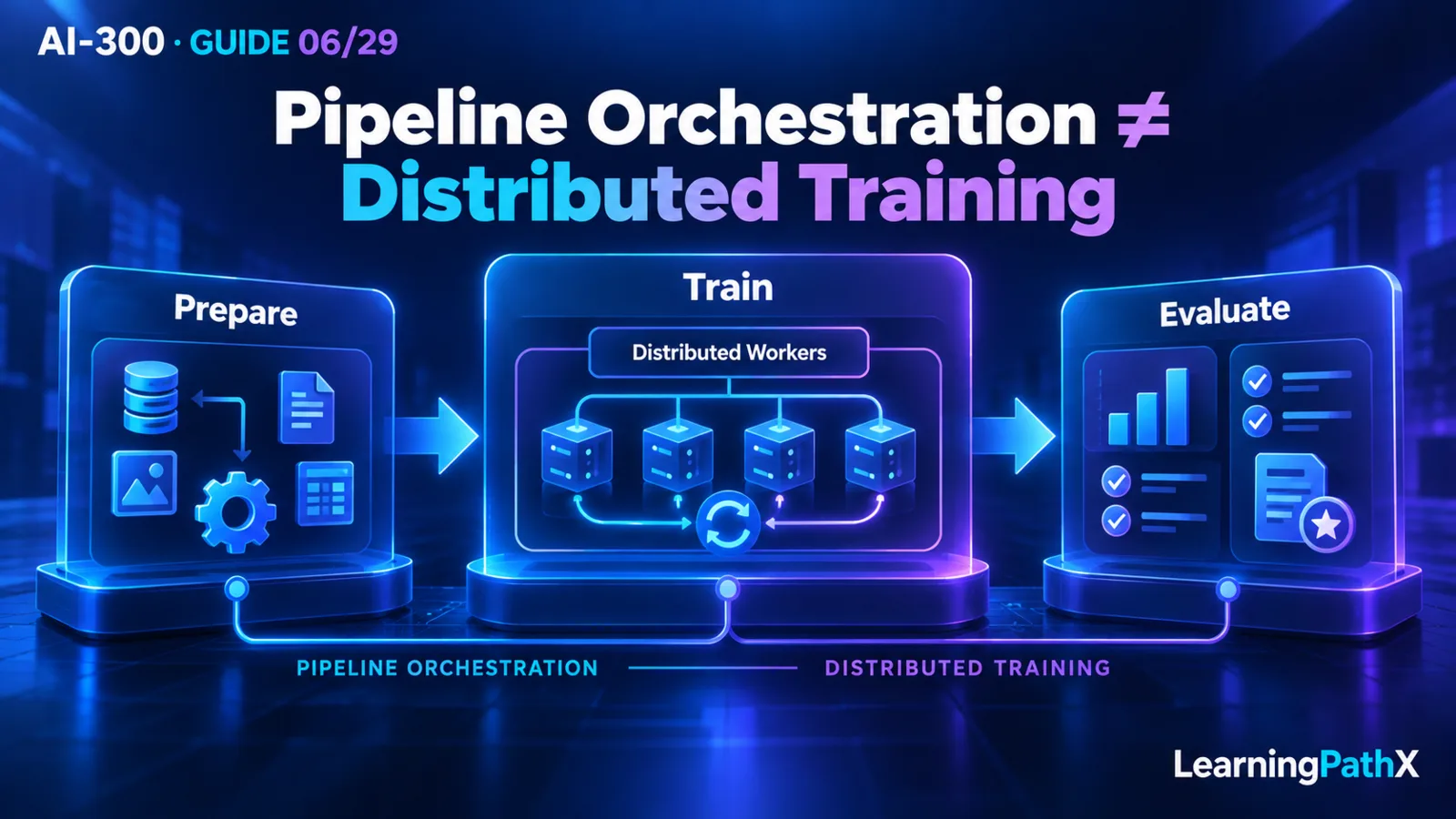
Build an Azure Machine Learning training pipeline from versioned components whose inputs, outputs, code and environments are explicit. Connect their outputs to downstream inputs, choose suitable compute for each stage and retain the execution evidence needed to explain the final candidate. For a distributed training stage, add a launch contract that agrees with the framework-aware training code: node count, processes per node, communication initialization and output ownership must form one coherent design.
Pipeline orchestration determines which stages run and how their data dependencies connect. Distributed training coordinates workers within a training stage. Azure Machine Learning manages the former and can launch the latter, but launch settings do not transform single-process training logic into coordinated distributed code. Reusing an earlier stage's output can improve execution efficiency; neither reuse nor a successfully completed job establishes that its model meets acceptance criteria. This guide follows Azure Machine Learning command-line interface (CLI) and Python software development kit (SDK) v2 documentation verified on October 15, 2026.
Architecture Overview: From Components to a Training Outcome
Azure Machine Learning pipelines break a machine learning task into independently manageable steps and manage dependencies between them. A component is a self-contained unit of code with inputs and outputs. Environments describe its software dependencies and settings; compute provides the execution resources. Their definitions should make sense together before they are assembled into a larger workflow.
A useful architecture separates data preparation, training and evaluation where those stages have clear responsibilities and handoffs. Do not split every function into a separate remote stage. Each extra boundary should justify its serialization, testing and operational cost. Conversely, a single opaque job makes it harder to isolate a preparation defect from a training or evaluation failure.
The intended outcome is an identifiable candidate accompanied by its provenance and evaluation artifacts. A diagram ending at “training completed” omits the evidence needed by the next decision maker. Keep candidate qualification distinct from orchestration even when both are represented in a broader automated process.
Core Components and Their Execution Contracts
Versioned definitions with explicit inputs and outputs
Treat a component interface as a contract between teams. A recommended interface record states the expected input type and meaning, required parameters, output structure and conditions that make an input invalid. A file or folder type alone does not specify column meanings, label interpretation, units or feature ordering.
For example, an image-preparation stage might emit a dataset folder and a manifest identifying each example and its split. The downstream training stage must know how those outputs are interpreted. If preparation changes label encoding, the interface or its version must make the change reviewable; successful file transfer is insufficient evidence of compatibility.
Version the definitions used for accepted runs and record the resolved component and environment versions. Recommended configuration should also identify the code revision, data snapshot, parameters and selected compute. This gives an investigator concrete references rather than relying on a notebook, mutable informal names or a recollection of what ran.
Separate software requirements from hardware selection
An environment supplies software dependencies; it is not a hardware reservation. Compute selection must separately satisfy the stage's memory, accelerator and execution requirements. Pin the intended environment version and verify that it is suitable for the selected compute and framework.
Azure Machine Learning supports assigning different compute resources to pipeline steps. As a design recommendation, keep inexpensive preparation on suitable CPU resources when it does not require an accelerator, and reserve graphics processing unit (GPU) resources for stages that benefit from them. Test representative inputs before choosing capacity. More nodes should follow a measured need rather than an assumption that every stage will accelerate proportionally.
Move the execution contract beyond notebook state
A notebook may reveal the right transformations and training behavior, but its interactive state should not become an unstated pipeline dependency. Extract the intended computation into scripts with declared arguments and outputs, and make the dependencies explicit. Keep notebooks for exploration and explanation where they help.
Before orchestration, run a small component-level check with known inputs. Recommended observations include whether required arguments are present, invalid inputs fail clearly and the expected outputs are complete. A training script that depends on an earlier notebook cell's in-memory object is not ready for a separate execution stage. These are development practices, not a claim that wrapping code in a component automatically verifies it.
Giving Distributed Training a Correct Launch Contract
Distinguish worker coordination from launching more copies
Microsoft's distributed GPU guide describes running existing distributed PyTorch, DeepSpeed and TensorFlow code. In its PyTorch path, the application initializes a process group through torch.distributed; Azure Machine Learning supplies launch environment variables such as MASTER_ADDR, MASTER_PORT, WORLD_SIZE, RANK and LOCAL_RANK. The job's distribution configuration includes its type and process_count_per_instance.
Those settings answer where and how many processes start. The training implementation must still coordinate them according to the chosen framework. As an engineering review, check how workers receive distinct data, synchronize training state, associate processes with devices and produce the final artifact. Starting several independent copies that each train on the entire dataset is not evidence of coordinated data-parallel training.
Use one framework's launch expectations consistently. The Microsoft guide describes TensorFlow's native distributed strategy and its TF_CONFIG configuration separately from PyTorch's process-group setup. Copying an environment variable from one framework into another is not a substitute for that framework's documented initialization contract.
Make topology understandable before scaling
For an illustrative PyTorch design with two nodes and two worker processes per node, the intended worker count is four. This is topology arithmetic, not a proposed resource quota or an executable Azure job definition. Check that the actual nodes, devices and training code agree with that intended layout before assuming it is viable.
The recommended review should resolve four questions:
- Which process owns each device, and can every worker identify its local and global role?
- How does the implementation divide the data and combine training updates?
- Which process writes the final model, and how are duplicate writes prevented?
- How are evaluation measurements combined so that a logged value describes the intended population rather than one worker's partial view?
For example, rank-specific diagnostics may be valuable while a model-level metric needs a deliberate aggregation and logging convention. Record which values are partial and which are global. A sensible recommendation is to avoid multiple workers overwriting one shared model path and to identify an explicit writer or framework-supported saving scheme. The exact implementation belongs in the chosen framework's design, not in a generic pipeline setting.
Begin with a small correctness run before using the intended larger topology. Examine worker initialization, data coverage and artifact integrity as well as elapsed time. Then assess whether the larger configuration improves the relevant throughput or capacity outcome. Communication and input preparation can become bottlenecks; neither a node-count change nor a specialized interconnect promises a particular speedup.
How the Stages Work Together: An Original Design Example
Consider a proposed visual-defect classifier for a manufacturing team. The following is an architecture example, not a report of live execution. Assume the team has approved data handling, a usable development workspace and suitable access to the selected storage and compute.
| Stage | Inputs | Intended outputs | Contract to inspect |
|---|---|---|---|
| Prepare | Identifiable image snapshot and reviewed split definition | Prepared examples, label mapping and manifest | Stable identifiers, permitted labels and no accidental split overlap |
| Train | Preparation outputs, versioned code/environment and training parameters | Candidate model and training diagnostics | Agreed distributed topology, input interpretation and output ownership |
| Evaluate | Candidate, label mapping and held-out evaluation inputs | Metrics and diagnostic report | Consistent preprocessing, metric definitions and evaluation population |
Wire preparation outputs to training inputs, then wire the trained candidate and appropriate evaluation inputs to evaluation. Keep the split definition explicit so the pipeline does not silently substitute a newly generated evaluation population between candidates. The orchestration describes dependencies; the component contracts explain what crossing each dependency means.
Within training, launch the distributed-aware implementation under its selected configuration. Record the topology alongside parameters and environment versions. MLflow tracking can retain metrics, parameters and artifacts in the workspace; choose a logging convention that makes those measurements attributable to the right stage and candidate. Do not assume the service infers application-specific quality measurements merely because it tracks job execution.
The resulting handoff should identify the candidate, the originating execution, the component/environment versions, data evidence and evaluation report. In this example, the team would check data-contract validity, distributed correctness and evaluation completeness before submitting the candidate for qualification. Detailed registration and evaluation restrictions belong in AI-300: Packaging and Qualifying Registered ML Models.
Design Considerations: Reuse, Automation and Failure Evidence
Understand what a reused result establishes
Azure Machine Learning pipelines can reuse outputs from unchanged steps. This is useful when expensive preparation does not need repeating, but reuse eligibility is an execution decision rather than a model-quality judgment. Do not infer from a reused output that data suitability, regulatory approval or a candidate's measured performance has been rechecked.
As a design practice, make meaningful dependencies visible. If a stage reads a mutable external source whose contents change behind the same reference, an unchanged definition alone is inadequate evidence that the intended input is unchanged. Use identifiable snapshots and deliberate parameters, and inspect the configured reuse behavior before relying on it. This guide does not assert an exhaustive cache-key algorithm or promise that a particular edit always causes rerunning.
For the defect-classifier example, changing only the training implementation might leave preparation eligible for reuse. The reviewer should still check which outputs were actually reused, which stages executed and what evidence they produced. A new acceptance decision should cite the relevant candidate and assessment, not the presence of green status indicators.
Keep code automation and model orchestration distinct
GitHub Actions can authenticate, prepare tooling and submit Azure Machine Learning work. The GitHub workflow and the machine learning pipeline have different responsibilities: the former coordinates repository automation, while the latter coordinates the machine learning stages. Preserve the submitted configuration and its code revision so a repository event can be traced to the resulting execution.
Do not equate submission success with completion of all training stages. Likewise, completion of every stage is different from accepting its output. Recommended automation should expose the relevant job identifier and failure evidence; a controlled model-qualification process consumes that evidence afterward. Authentication and full provisioning mechanics are separate topics.
Use current CLI/SDK v2 jobs for execution. Microsoft's MLflow documentation specifies retirement of Azure Machine Learning MLproject submission support in September 2026 while retaining MLflow tracking. For the October 2026 scope here, an old submission example is not the supported starting point for a new pipeline.
Diagnose at the layer that failed
| Observation | Recommended first investigation |
|---|---|
| Downstream stage cannot interpret a file | Producer/consumer contract, output completeness and matching definitions |
| Distributed workers do not initialize together | Launch topology, framework initialization and the actual worker logs |
| Each worker writes a different final file | Model-output ownership and save convention |
| Job finishes but the intended metric is absent | Application logging, worker aggregation and evaluation completeness |
| A stage reused an unexpected earlier output | Declared dependencies, actual input identity and configured reuse behavior |
Bound resource use for development rehearsals and retain only the artifacts required by the team's supported-model and investigation policy. Test smaller representative inputs before consuming a large distributed allocation. Avoid deleting the sole records that explain a candidate still under assessment.
Common Mistakes
- Treating input/output types as complete semantic validation.
- Pinning a component while leaving its important data or dependency assumptions implicit.
- Increasing worker count without distributed-aware training logic.
- Logging one worker's local metric as though it describes the entire evaluation population.
- Letting every worker write to the same final artifact without a coordinated convention.
- Assuming cached preparation proves the current dataset is acceptable.
- Treating successful repository automation or pipeline completion as model approval.
Certification Relevance
For AI-300, explain a pipeline through both its stage dependencies and its execution contracts. Be able to identify component inputs and outputs, versioned definitions, environment and compute choices, distributed launch requirements and the evidence retained for the candidate. The key operational skill is knowing which layer owns a failure or decision, including the boundary between efficient execution and qualified output.
Conclusion
Repeatable training starts with explicit stage contracts and traceable versions. Distributed training adds a coordinated worker contract inside a stage; it requires compatible code and launch configuration. Connect the stages, inspect actual execution and reuse, and retain the evidence that lets a separate qualification decision assess the resulting model.
Authoritative Sources
- How Azure Machine Learning works: resources and assets
- Use GitHub Actions with Azure Machine Learning
- MLflow and Azure Machine Learning
- Distributed GPU training guide (SDK v2)
- What are Azure Machine Learning pipelines?