
Study & Preparation
CCNA 200-301 Network Automation, SDN, REST APIs, and JSON
About this video
Network automation can improve consistency across hundreds of devices—but it can also distribute incorrect intent across an entire environment in seconds. In this video, we break down the network automation and programmability concepts covered in CCNA 200-301, including Software-Defined Networking, APIs, JSON, configuration management tools, and AI-assisted network operations. We begin by comparing traditional device-by-device management with controller-based networking. You’ll learn how SDN separates the control plane from the data plane, and how the underlay, overlay, and fabric work together to provide physical transport, logical connectivity, and centralized policy. We then examine how controllers communicate through APIs. Northbound APIs connect controllers to applications, scripts, and orchestration platforms, while southbound APIs communicate with the underlying routers and switches. We’ll also review the REST methods commonly associated with CRUD operations: • GET to read information • POST to create a resource • PUT to replace a resource • PATCH to make a partial update • DELETE to remove a resource The JSON section explains objects, arrays, name-value pairs, and common data types. More importantly, we separate JSON syntax validation from API schema validation. A payload can be correctly formatted and still fail because the requested VLAN, interface, address pool, or resource is unsupported. You’ll also learn the operational difference between Ansible and Terraform. Ansible uses agentless, task-based YAML playbooks, while Terraform uses a declarative model and state tracking to manage desired resources and configuration drift. Finally, we examine predictive AI and generative AI in network operations. AI can identify anomalies, summarize telemetry, and draft configuration changes, but generated output must never be treated as authoritative network state. The exam-thinking principle is simple: Automation amplifies intent. Before deploying a change, verify the target inventory, validate the syntax and schema, preview the result, test in a lab or canary group, and confirm the final operational state. Use this lesson to understand how modern network automation works—and how engineers scale change without losing control. #CCNA #Cisco #CCNA200301
Keep watching
 7:53
7:53Study & Preparation
CCNA 200-301 v1.1 Study Roadmap Before v2.0
 11:32
11:32Study & Preparation
CCNA 200-301 Network Devices and Topologies Explained
 11:32
11:32Study & Preparation
CCNA 200-301 Ethernet Switching, MAC Learning, and TCP vs UDP
 8:37
8:37Study & Preparation
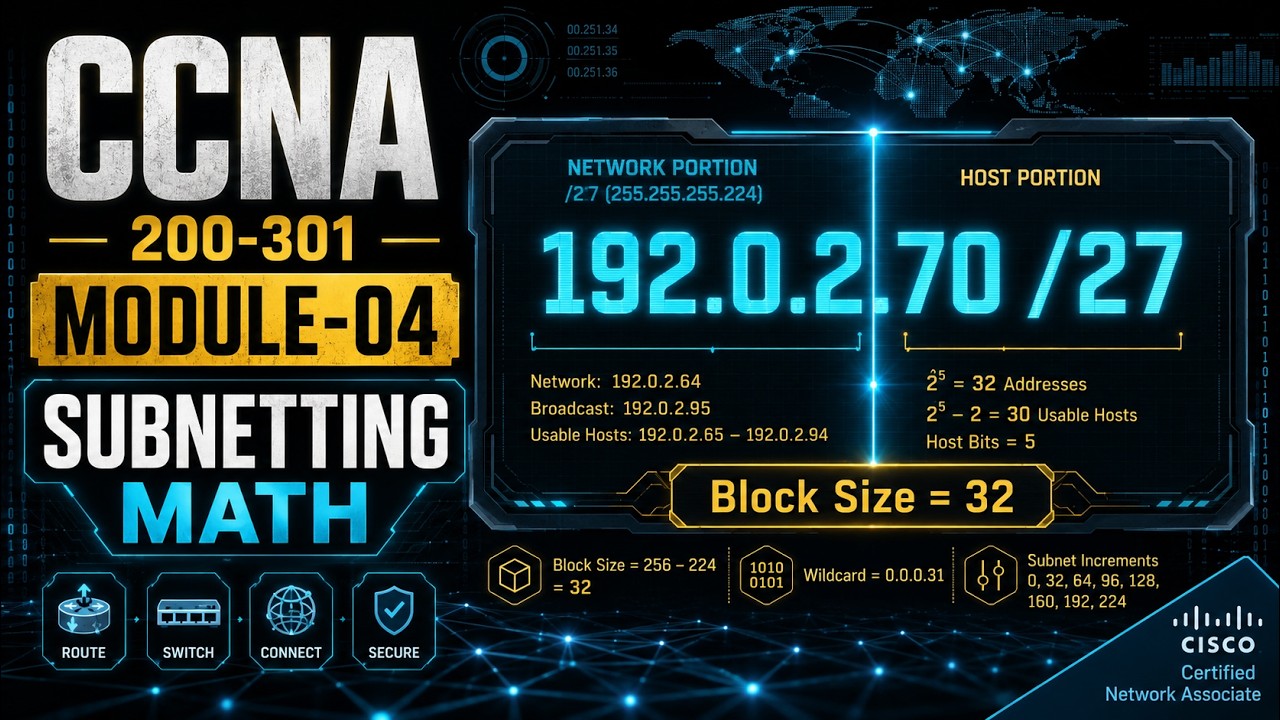
CCNA 200-301 IPv4 Addressing and Subnetting Explained
 8:12
8:12Study & Preparation
CCNA 200-301 IPv6 Addressing and Prefixes Explained
 10:07
10:07Study & Preparation