
Study & Preparation
CCNA 200-301 ACLs, Port Security, DHCP Snooping, and DAI
About this video
A security control can block an attacker—but the same control can also block legitimate users when its direction, dependencies, or trust boundary are misunderstood. In this video, we break down the network security controls covered in CCNA 200-301, including access control lists, Port Security, DHCP Snooping, Dynamic ARP Inspection, wireless security, and safe change verification. We begin with Access Control Lists, or ACLs. An ACL processes rules from the top down and stops at the first matching entry. Every ACL also ends with an invisible implicit deny, which means any packet that fails to match a configured permit statement is dropped. You’ll learn the difference between: • Standard IPv4 ACLs, which primarily match the source IP address • Extended IPv4 ACLs, which can match protocol, source address, destination address, and transport-layer port information We’ll also examine ACL direction. An inbound ACL filters traffic before the routing decision. An outbound ACL filters traffic after the routing decision. Before applying either one, you must map the intended traffic flow and account for management access, address assignment, routing traffic, and the return path required for legitimate communication. The lesson then moves to the Layer 2 access edge. Port Security limits which MAC addresses can transmit through a switchport. It can enforce maximum device counts and respond when an unauthorized address appears. However, Port Security is not user authentication. It restricts hardware addresses and device counts, but it does not prove the identity of the person using the endpoint. Next, we examine DHCP Snooping. DHCP Snooping separates switchports into trusted and untrusted roles. Ports facing legitimate DHCP infrastructure are trusted, while endpoint-facing ports remain untrusted. If a rogue DHCP server sends a DHCP Offer through an untrusted port, the switch blocks it. We then connect DHCP Snooping to Dynamic ARP Inspection, or DAI. DAI validates ARP information against the DHCP Snooping binding database. This creates an important operational dependency: if the binding database is missing, incorrect, or does not account for required static-IP devices, DAI may block legitimate communication. The wireless section examines how security boundaries continue beyond physical switchports. For smaller environments, a Pre-Shared Key model uses one shared credential. Enterprise environments can use 802.1X and centralized RADIUS services to provide individual authentication and accountability. When verifying a WLAN on a Wireless LAN Controller, check the complete configuration path: • Is the WLAN enabled? • Does the SSID match the intended network? • Is the correct security mode configured? • Are the key-management or authentication settings correct? • Is the WLAN mapped to the correct interface or VLAN? Seeing an SSID does not prove that the wireless network is secure or operational. The final section presents a structured workflow for making security changes safely: 1. Capture the current operational state. 2. Identify the enforcement direction and trust boundary. 3. Prepare a recovery path before making the change. 4. Apply the smallest possible modification. 5. Perform positive and negative testing. Positive testing proves that authorized traffic still works. Negative testing proves that unauthorized traffic is actually blocked. Useful verification commands covered in this lesson include: show access-lists show ip dhcp snooping binding show ip arp inspection ACL match counters, snooping bindings, inspection statistics, and wireless client states provide the operational evidence needed to determine whether a control is working as intended. Common CCNA security mistakes include: • Forgetting the implicit deny • Applying an ACL in the wrong direction • Trusting an endpoint-facing DHCP Snooping port • Enabling DAI without a valid binding database • Treating Port Security as user authentication • Confusing an SSID with a security method • Changing a wireless PSK without coordinating client devices The exam-thinking principle is simple: Map the traffic. Identify the trust boundary. Respect the dependencies. Prove both permitted and denied behavior. Use this lesson to understand how ACLs, access-layer protections, and wireless controls work together to defend different parts of an enterprise network. #CCNA #Cisco #CCNA200301
Keep watching
 7:53
7:53Study & Preparation
CCNA 200-301 v1.1 Study Roadmap Before v2.0
 11:32
11:32Study & Preparation
CCNA 200-301 Network Devices and Topologies Explained
 11:32
11:32Study & Preparation
CCNA 200-301 Ethernet Switching, MAC Learning, and TCP vs UDP
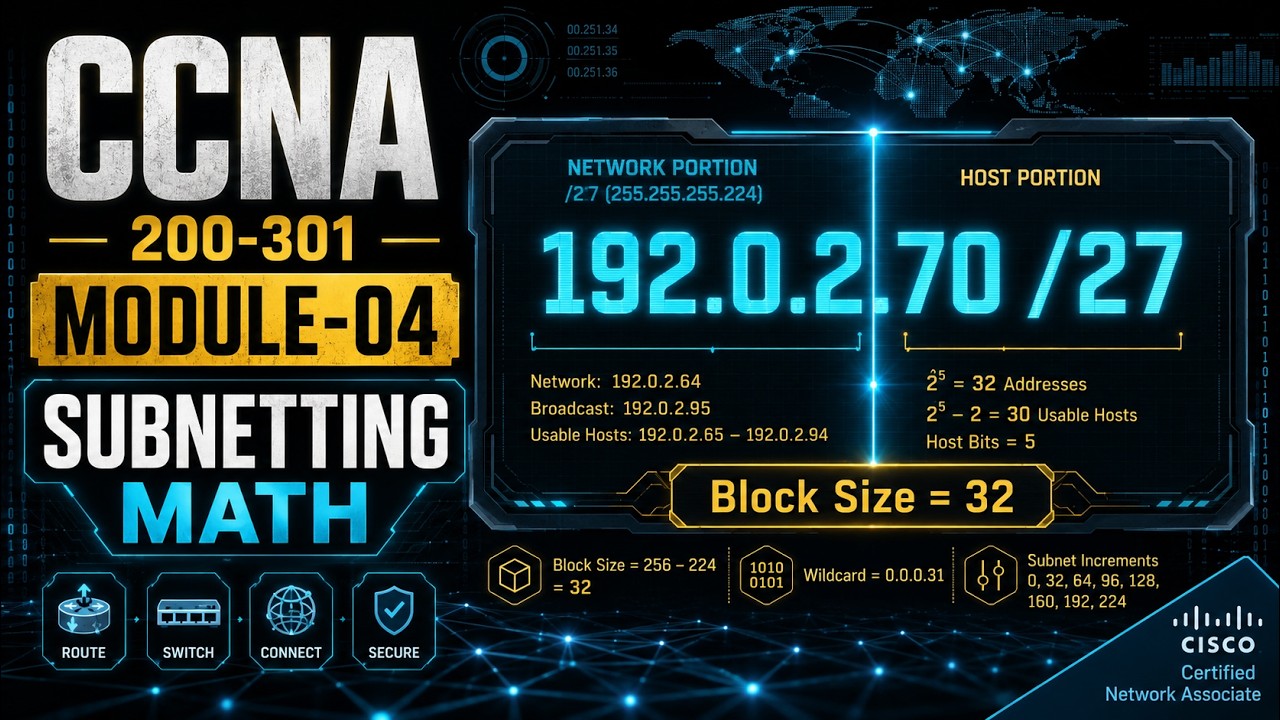 8:37
8:37Study & Preparation
CCNA 200-301 IPv4 Addressing and Subnetting Explained
 8:12
8:12Study & Preparation
CCNA 200-301 IPv6 Addressing and Prefixes Explained
 10:07
10:07Study & Preparation