
Study & Preparation
CCNA 200-301 Network Troubleshooting Workflow Explained
About this video
Good network troubleshooting is not random command execution. It is a sequence of falsifiable checks that compares the intended state with the observed state and identifies the first broken dependency. In this video, we build a structured troubleshooting workflow for CCNA 200-301 and enterprise network operations. We begin by defining the symptom precisely: source, destination, protocol, time, scope, and last known working state. Before changing any configuration, capture the current operational evidence, preserve the running configuration, prepare a rollback plan, and confirm that recovery access is available. The diagnostic process then moves through the network in dependency order. At the physical and access layers, verify administrative and operational interface states, speed and duplex, transceiver health, and error counters over time. For VLAN and trunk failures, confirm access VLAN assignment, VLAN existence, native VLAN agreement, allowed VLAN lists, Spanning Tree forwarding states, and EtherChannel consistency. A trunk can be operationally up while still dropping traffic for a required VLAN. At Layer 3, use the active routing table as the source of truth. Check the exact destination prefix, longest prefix match, next-hop reachability, ARP or IPv6 Neighbor Discovery, and the reverse route. For OSPF, verify interface participation, neighbor states, advertised prefixes, and final route installation. Once IP transport is proven, move to DHCP, DNS, NAT, ACLs, and application services. Test IP reachability before DNS resolution. Verify DHCP leases and relay configuration, inspect active NAT translations, confirm ACL direction and match counters, and remember that a reachable server can still reject the required TCP or UDP session. NTP also matters. Without synchronized clocks, Syslog messages and multi-device event timelines cannot be trusted. When the root cause is identified, change one controlling object at a time. Predict the expected operational evidence, apply the approved correction, retest the original symptom, and verify adjacent services for regressions. The exam-thinking principle is simple: Solve the lowest failed dependency first. Preserve evidence, test one hypothesis at a time, and let operational state—not assumptions—drive the diagnosis. #CCNA #Cisco #CCNA200301
Keep watching
 7:53
7:53Study & Preparation
CCNA 200-301 v1.1 Study Roadmap Before v2.0
 11:32
11:32Study & Preparation
CCNA 200-301 Network Devices and Topologies Explained
 11:32
11:32Study & Preparation
CCNA 200-301 Ethernet Switching, MAC Learning, and TCP vs UDP
 8:37
8:37Study & Preparation
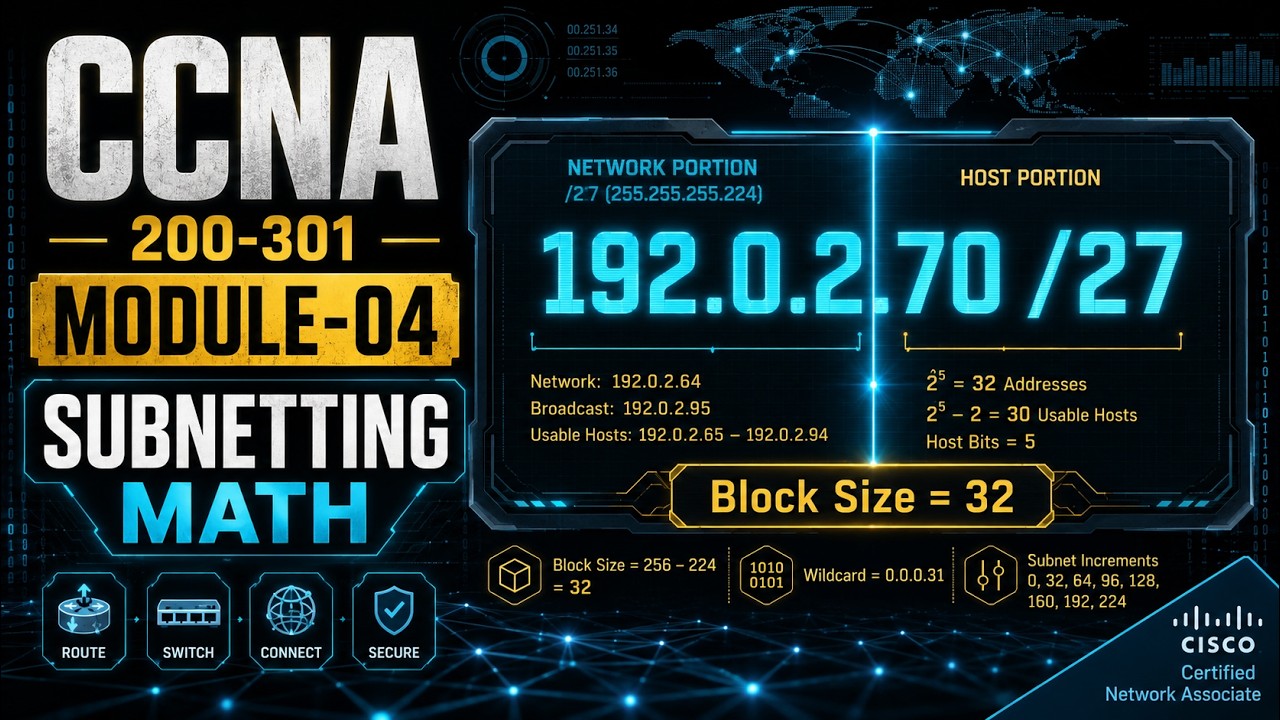
CCNA 200-301 IPv4 Addressing and Subnetting Explained
 8:12
8:12Study & Preparation
CCNA 200-301 IPv6 Addressing and Prefixes Explained
 10:07
10:07Study & Preparation